

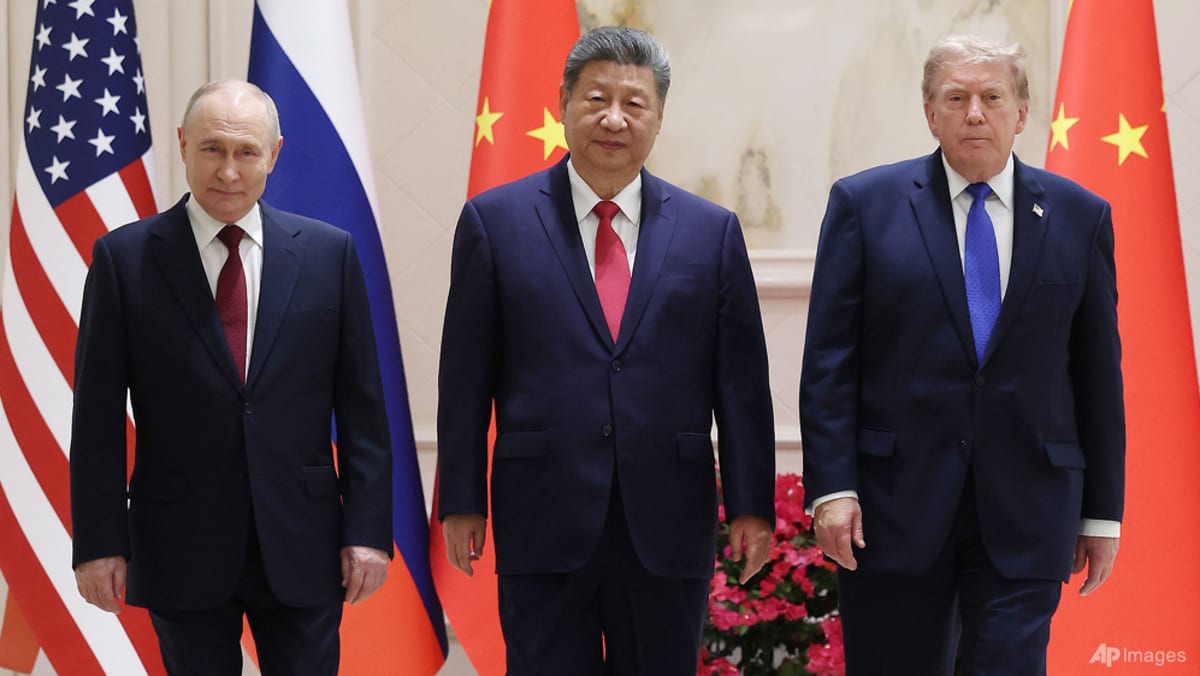
Trump referred to nuclear weapons at the start of the meeting, saying: “It’s not an easy thing to do – give them up.”
He told NBC afterwards that it “went great”.
“On a scale of zero to 10, I think it was a 12,” he said. “Fantastic relationships built.”
In a post on his Truth Social platform, Trump said he would hold a news conference in Washington at noon on Friday.
China’s Foreign Minister Wang Yi said the countries would maintain coordination at working level after the “peace summit”.
Analysts said Trump came to Shenzhen seeking to bolster his standing after his Republican Party lost control of Congress in midterm elections this month.
Trump told Reuters the Shenzhen summit was “bigger than Yalta”, referring to the 1945 conference between the US, Britain and the Soviet Union, which became shorthand for great-power deals.
He defended calling Putin a friend, saying that “it’s nice to have people that have 4,000 nuclear weapons as a friend as opposed to an enemy”.
He also called Xi a friend and “an amazing leader”, but acknowledged the difficulty of achieving nuclear-arms cuts, saying it was “psychologically very difficult” for leaders.
Charles Schumer, who leads Democrats in the US Senate, called the trilateral summit “a historic embarrassment that people will remember long into the future”.
“It’s a betrayal of the United States by a president who loves nothing more than to bow down to our adversaries for a photo op,” he said.
Daryl Kimball, executive director of the US-based Arms Control Association, called the reaffirmation that a nuclear war should not be fought “positive, but said, “We need much more than rhetoric. We need action on disarmament diplomacy”.
The reference to immunity of state officials came more than three years after the International Criminal Court issued arrest warrants for Putin and other Russian officials over alleged war crimes in Ukraine. Moscow rejects the allegations.
“The pushback against international norms and courts is the most interesting aspect,” said Jonathan Eyal, international director at the Royal United Services Institute think-tank in London. “The big powers dictate, the small powers suffer.”
Eyal said Putin had been a winner from the summit and “gained credibility and escape from pariah status”, while Trump “gained a photo opportunity he didn’t need”.

