



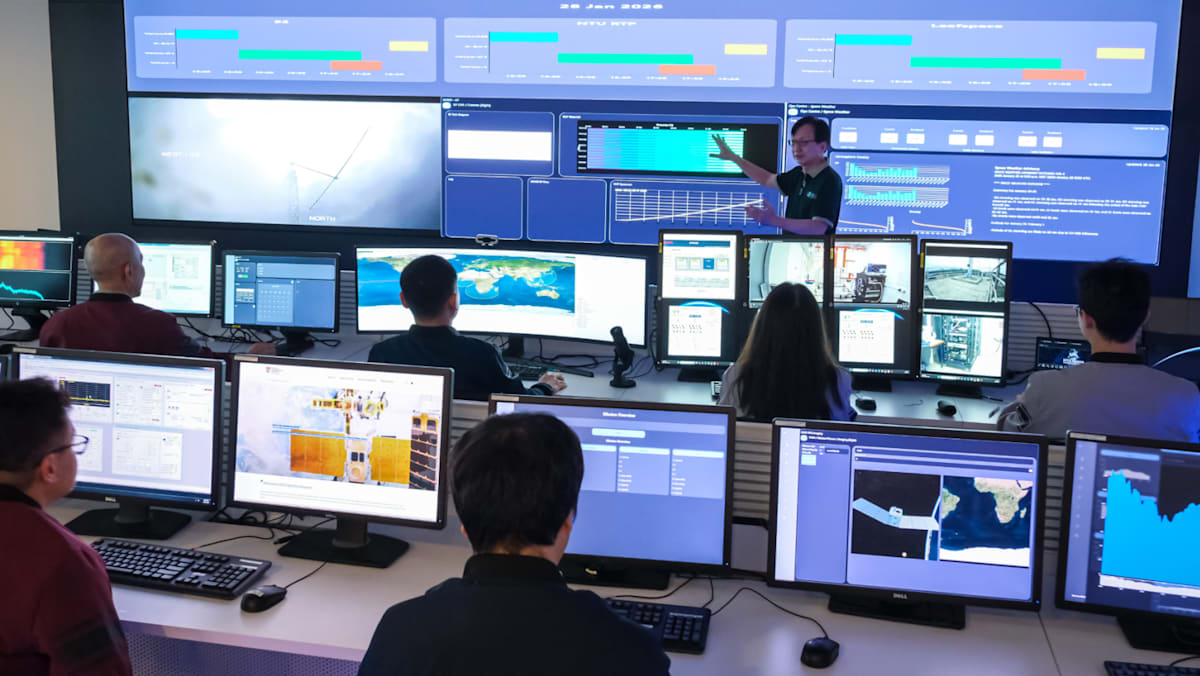
Another Memorandum of Understanding was signed between Nanyang Technological University and Fusic, a Japanese custom software development company.
They aim to explore how artificial intelligence can assist ground-control teams with routine satellite operations, mission scheduling, ground-station allocation and the early detection of technical problems.
“As satellite constellations grow, the space sector will need new ways to manage missions safely, efficiently and at scale,” said Professor Christian Wolfrum, deputy president and provost of NTU.
Singapore’s national space agency NSAS was set up in April to help the country seize opportunities in the expanding space economy.
“NSAS believes that strong international partnerships are essential to unlock opportunities for our growing space ecosystem,” said the agency’s chief executive Ngiam Le Na, noting that this marks NSAS’s first bilateral agreement.
“Together, we hope to deepen collaboration across our space ecosystems and create globally competitive opportunities for innovation and industry growth, while contributing to safe and sustainable uses of outer space.”
President of JAXA, Dr Hiroshi Yamakawa, said it comes as Japan and Singapore mark 60 years of diplomatic relations this year.
He noted previous areas of collaboration, such as the launch of Singapore’s satellites by Japan’s H-IIB rocket and from the ISS Kibo module.
“As we mark this new milestone, we look forward to further deepening our cooperation with Singapore – a key partner with whom we share common values, to contribute to addressing global challenges and advancing space science and technology,” he added.

