



Oil prices recovered from their session lows on Friday as traders weighed renewed security threats in the Strait of Hormuz against rising crude inventories and expectations of a global supply surplus.
January Brent futures were down 0.61% at $91.42 a barrel at 11:55 GMT, after briefly falling to $90.06 earlier in London trading. The contract settled at $91.98 on Thursday.
Actively traded January West Texas Intermediate futures slipped 0.25% to $82.23.
The partial recovery left Brent heading for a third consecutive weekly decline, highlighting the market’s increasingly muted response to geopolitical threats.
What happened to oil prices today?
Iran’s Revolutionary Guard navy claimed on Thursday that two supertankers carrying more than 4 million barrels of crude had struck mines and caught fire while navigating the Strait of Hormuz.
The vessels were not identified, and the alleged mine strikes remain independently unverified.
The Joint Maritime Information Center said in its latest advisory that no official or national authorities had confirmed Iran’s claims.
However, the organisation documented four separate attacks in the strait over the preceding four days.
Among them was Wednesday’s incident involving a tanker struck by an unidentified projectile near Khasab, Oman. The crew was reported safe.
Regional tensions intensified further on Friday when the Saudi-led coalition said it had intercepted five drones and a ballistic missile targeting the kingdom.
Despite those developments, Brent surrendered its initial gains, suggesting traders were reluctant to price in substantial additional supply losses without evidence of a sustained disruption.
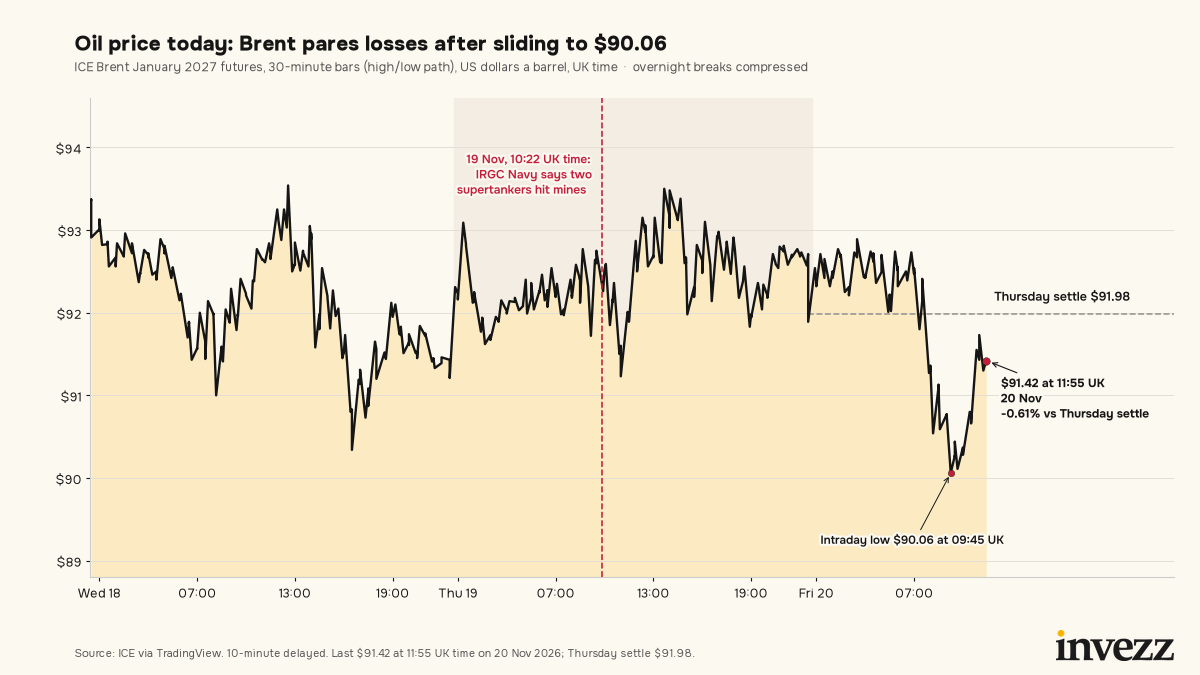
Why did oil prices fall, then recover?
Oil’s decline came alongside broader weakness in commodities.
The US dollar index traded around 103.89, close to its recent 19-month high, while gold and silver also recorded sharp losses.
Dollar strength makes crude more expensive for buyers using other currencies, potentially weakening demand.
Meanwhile, official US data showed commercial crude inventories increased by 3.4 million barrels to 417.8 million in the week ended 13 November.
Goldman Sachs oil researcher Daan Struyven has argued that exporters have become increasingly effective at managing the disruption through alternative pipelines, escorted shipping and ship-to-ship transfers.
Additional production outside the Persian Gulf and weaker Chinese demand have also helped soften the impact.
Goldman estimates the oil market moved into surplus in October and expects the excess to reach approximately 2 million barrels a day next year.
That supply outlook has made it harder for geopolitical developments alone to sustain a rally.
Can Brent hold above $90 before the OPEC+ meeting?
Goldman expects Brent to average $88 a barrel in 2027 before declining towards $78 late that year.
Its forecast assumes no major escalation causing lasting damage to Middle Eastern energy infrastructure.
The next important policy event comes on 29 November, when OPEC+ ministers meet to consider production arrangements for 2027.
Friday also marks the expiry of December WTI futures, making January the more actively traded contract.
Investors will additionally monitor the University of Michigan’s final November consumer sentiment survey for clues about US economic demand and inflation expectations.
For those comparing the best commodity trading platforms, Friday’s volatility illustrates why longer-term supply forecasts and immediate geopolitical risks need to be considered separately.
AI disclosure: AI tools assisted with research and drafting of this piece. An Invezz editor reviewed the facts, sources and wording before publication. Any opinions or analysis are Invezz’s, not those of an automated system.
The post Oil price today: Brent pares losses after sliding to $90.06 amid Hormuz tensions appeared first on Invezz

