

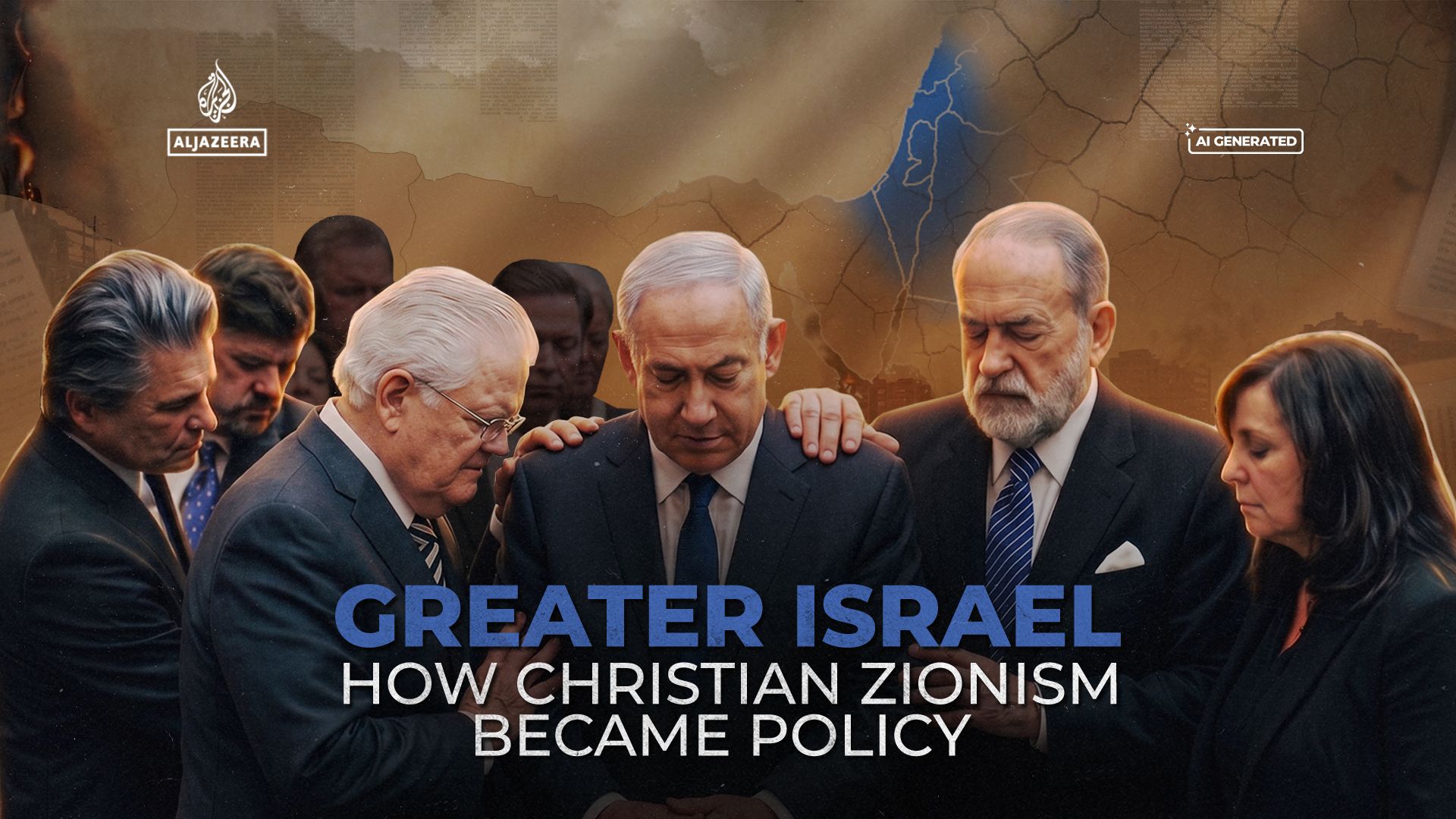
A sermon becomes a map. A map becomes policy. And policy becomes land taken, homes emptied and borders redrawn. ‘Greater Israel’: How Christian Zionism Became Policy – a 22-minute Al Jazeera Originals documentary directed by Awad Joumaa – traces how a centuries-old biblical idea travelled from English fringe pulpits to the heart of US politics, and from prophecy into the machinery of modern power. Blending archival footage and AI-assisted visuals, the film explores a question that no longer belongs only to theologians or historians: what happens when a religious vision of territory is backed by votes, money, military infrastructure and state policy?
A sermon, a map, a policy
In a megachurch in San Antonio, Texas, Pastor John Hagee reads the map aloud. God, he says, promised the Jewish people “one-half of modern-day Egypt, all of Israel, all of Lebanon, all of Syria, all of Jordan, all of Kuwait, and three-fourths of Saudi Arabia”.
This is not a negotiation, he tells his congregation.
“God’s not saying, ‘Let’s make a deal. He’s saying, this is the deal.’”
Hagee is not a fringe preacher. He is the founder of Christians United for Israel, or CUFI, which claims more than 10 million members and has become one of the most powerful pro-Israel organisations in the United States.
The film explores a world in which scripture is read as geography, geography becomes entitlement, and entitlement is carried to Washington, DC through lobbying, elections and policy.

The voting bloc behind the prophecy
Christian Zionism is often described as a belief system. In the United States, it is also a political force.
White evangelical Protestants account for roughly 13 percent of the US adult population, about 44 million people, and most identify as Republican. Their views on Israel are unusually firm. A 2018 LifeWay Research survey for Chosen People Ministries found that 80 percent of evangelicals believed the creation of Israel in 1948 was a fulfilment of biblical prophecy that would bring about Christ’s return. Roughly two-thirds said the modern state of Israel was an outgrowth of the biblical covenant.
That belief translates into votes. Pew Research Center’s analysis of the 2024 election found that 82 percent of white evangelical voters backed Donald Trump, the highest support of any religious group.
It also shapes attitudes towards war. The Chicago Council on Global Affairs found in 2024 that 64 percent of white evangelicals said Israel’s actions in Gaza were justified, roughly double the share of Americans overall, while 60 percent opposed cutting US military aid to Israel.
“The bedrock of support for the State of Israel is there because American evangelicals think it will bring Jesus back quicker,” former evangelical insider Frank Schaeffer says in Al Jazeera‘s 2024 documentary Praying for Armageddon. “And without the Republican bedrock evangelical voter, no Republican anywhere in America, for any office, gets elected. We don’t want peace, we being evangelicals. We want Armageddon.”

Following the money
The theology is preached from pulpits. The machinery runs through donations, lobbying and tax-exempt advocacy.
The International Fellowship of Christians and Jews says it has raised more than $3.6bn since 1983, with 92 percent of its donors identifying as Christian. Mother Jones, the US publication, has traced how Christian Zionist networks have channelled money into Israeli causes, including organisations linked to settlement expansion in the occupied West Bank.
CUFI’s political arm is smaller in dollar terms but influential in access. OpenSecrets records $679,410 in federal lobbying spending by CUFI Action Fund in 2025.
God’s not saying, let’s make a deal. He’s saying, this is the deal
The Congressional Research Service, in its 2024 overview of US aid to Israel, notes that both AIPAC and CUFI “express unequivocal support for US security assistance to Israel”.
Inside Washington, the influence is structural. Ralph Drollinger’s Capitol Ministries – which advocates a “Biblical case for defending Israel” – runs weekly Bible studies attended by members of Congress. During the first Trump administration, it convened a cabinet-level Bible study. The theology is not only in churches; it is in the room where power gathers.

From the Nile to the Euphrates
The Christian Zionist map of Israel itself comes from scripture. In Genesis 15, a part of the Torah and Old Testament, God promises Abraham’s descendants land “from the river of Egypt to the great river, the Euphrates”. For Christian Zionists and some Israeli ultranationalists, that passage is not a metaphor. It is a title deed.
In February 2026, the US ambassador to Israel, Mike Huckabee, sat with independent broadcaster Tucker Carlson as Carlson read out the biblical passage describing land “from the Euphrates to the Nile”. Asked whether Israel had a right to all of it, Huckabee replied: “It would be fine if they took it all.”
Such a vision is not new. As Professor John Mearsheimer of the University of Chicago notes in this film, Israel’s first prime minister, David Ben-Gurion, wrote in 1918 of a Greater Israel that would include all of historical Palestine, parts of southern Lebanon, southern Syria, the east bank of the Jordan and the Sinai Peninsula. It was not merely a fringe fantasy. It was part of the strategic imagination of early Zionism.
That imagination survives in the settler movement. Daniella Weiss, one of the most prominent leaders of the settlement enterprise, has insisted southern Lebanon is part of the vision of Greater Israel. In her words, “It is part of it. All of it, even parts of Syria, part of Iraq, part of Iran. It’s huge.”
Israel’s far-right finance minister, Bezalel Smotrich, has framed the claim in overtly religious language, praying publicly for “the expansion of the borders of the land of Israel for the complete redemption and for the building of the Temple”. In the Knesset, he has also declared that “there is no such thing as a Palestinian people.”
In 2017, Smotrich published what he called his “Decisive Plan”, arguing that the conflict should be resolved, not through Palestinian statehood, but through Israeli victory. Palestinians, he wrote, would face a choice: accept permanent Israeli sovereignty, emigrate, or resist and be defeated. The document gave ideological form to what is now visible on the ground: annexation without the word annexation.

Syria: the buffer zone becomes occupied ground
Syria shows the shows how Israel has used the language of “security” to move further east.
After the collapse of the Bashar al-Assad government, Israel moved beyond the occupied Golan Heights into the demilitarised buffer zone that had separated Israeli and Syrian forces since a 1974 disengagement agreement. Al Jazeera has reported that Israel captured about 400 square kilometres, or 155 square miles, of Syrian territory beyond the western Golan Heights it has occupied since 1967.
The move was presented by Israel as defensive and temporary. But the language of temporary security has a long history in the region. The occupied Golan Heights itself was seized in 1967 and later annexed by Israel in a move rejected internationally. Decades later, it remains under Israeli control.
Al Jazeera has also reported on Israeli Prime Minister Benjamin Netanyahu appearing with Israeli troops in occupied territory in southern Syria, a visit that angered Damascus and raised questions over whether any future deal was possible.
The Syrian case is crucial because it turns biblical geography into military geography. The Greater Israel idea speaks of borders stretching north and east. Israeli policy speaks of buffer zones, demilitarisation and strategic depth. For Syrians living under the shadow of Israeli military expansion, the distinction may matter less than the fact of land taken.
South Lebanon: occupation by another name
Israel’s invasion of southern Lebanon may well mark another move towards creating Greater Israel.
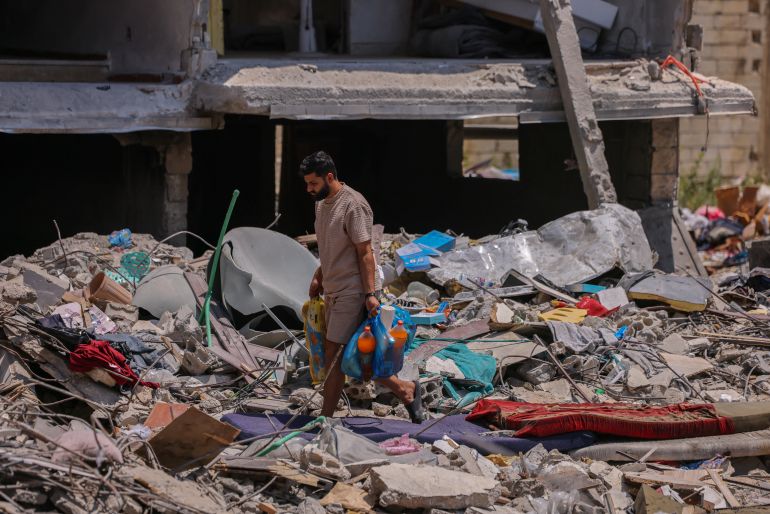
Israel occupied parts of southern Lebanon from 1982 until its withdrawal in 2000. But the border never became quiet, and after the latest war, Israel’s presence has again moved beyond episodic strikes. According to Al Jazeera reporting, Israeli forces have destroyed dozens of villages in southern Lebanon over the last 100 days, while attacks have continued despite ceasefire frameworks.
Al Jazeera has reported that Israel is currently occupying dozens of villages in southern Lebanon and preventing thousands of people from returning home. In one investigation, residents and officials described how Israeli attacks have damaged water infrastructure, deepening the conditions that make return impossible.
Another report showed more than 100 towns and villages across Lebanon were placed under forced displacement orders during the war, extending far beyond the immediate border area.
This is how a supposedly temporary security zone could become a political fact. A village is evacuated. A road is closed. Water networks are destroyed. The army remains. Residents cannot return. On paper, the border may still exist. On the ground, life is reorganised around Israeli military control, and eventually, geography is remade.

Gaza and the West Bank: the template
Borders are not redrawn only by tanks. They are also redrawn by permits, checkpoints, bypass roads, military zones and demolition orders.
In the occupied West Bank, more than 60 percent of the territory lies in Area C, under direct Israeli civil and military control. Palestinian construction is heavily restricted, while illegal Israeli outposts are often retroactively authorised. The separation wall, which the International Court of Justice ruled illegal in 2004, where it runs inside occupied territory, helped turn geography into policy.
The same logic appears across the occupied Palestinian territory: land is fragmented, movement is controlled, and Palestinian life is made administratively conditional. What looks on a map like one territory becomes, in practice, a system of islands.
UN Special Rapporteur Francesca Albanese has repeatedly warned that the destruction of Palestinian life in Gaza and the occupied territories is also a test of the international legal order. “What is lost in Palestine,” she told the UN Human Rights Council, “will be lost to us all.”
The pattern is visible beyond Palestine, too: enter on security grounds, build infrastructure, normalise the presence, and let the map change quietly.

Iraq: fragmentation, not annexation
Iraq sits awkwardly inside the Greater Israel imagination. The Euphrates, named in Genesis 15:18 as the eastern boundary of the promised land, runs through it. But the major strategists and ideologues driving the Greater Israel project did not usually speak of annexing Baghdad. Their stated aim was different: to break Iraq’s power.
In 1982, Oded Yinon, a former Israeli foreign ministry official, published “A Strategy for Israel in the 1980s” in Kivunim, a journal of the World Zionist Organisation. He described Iraq as Israel’s greatest strategic threat and argued that it should be dissolved into three entities: a Shia state in the south, a Sunni state in the centre and a Kurdish state in the north. The fragmentation of Iraq, he wrote, was “guaranteed” as a strategic goal.
Fourteen years later, “A Clean Break: A New Strategy for Securing the Realm”, a 1996 policy paper prepared for Netanyahu by a study group led by Richard Perle – a Reagan-era Pentagon official who would go on to chair George W Bush’s Defense Policy Board, Douglas Feith – later Undersecretary of Defense for Policy, 2001-2005, and David Wurmser – later Middle East adviser to Vice President Dick Cheney, named “removing Saddam Hussein from power in Iraq” as “an important Israeli strategic objective in its own right.” All three authors entered the George W Bush administration in senior national-security roles in the run-up to the 2003 invasion of Iraq.
There’s no evidence that the idea of a Greater Israel played any role in Bush administration’s motivation for the Iraq war. But Pastor Hagee from the San Antonio church was clear: He called the Iraq war “the beginning of the end” and “the gateway to the Apocalypse”.
So Iraq’s role in the Greater Israel worldview is not simply territorial. It is strategic. A unified, powerful Arab state east of the Jordan River is a threat; a fragmented Iraq is an opportunity.

A 400-year backstory
This messianic strand did not begin in Congress. It reaches back to 17th-century English Puritan preachers who believed the Jews had to return to the Holy Land before Christ could return. That belief was carried into Anglo-American Protestant culture long before the creation of Israel.
Long before the Balfour Declaration, American Christian Zionists were already lobbying presidents. In 1891, the Methodist lay preacher William Eugene Blackstone submitted a petition to President Benjamin Harrison calling for Palestine to be restored to the Jewish people. The “Blackstone Memorial” was signed by leading US politicians, businessmen and religious figures, making it one of the earliest organised Christian Zionist interventions in US politics.
The historian Regina Sharif identifies the hinge as Woodrow Wilson. After Wilson’s endorsement of Zionism, she argues, every American president who followed aligned, in one form or another, with the Zionist project.

The ground is shifting
Public opinion in the United States is moving in the opposite direction to policy. A Pew Research Center survey published in April 2026 found that 60 percent of Americans now hold an unfavourable view of Israel, with the share saying “very unfavourable” rising from 10 percent in 2022 to 28 percent in 2026. The sharpest shifts are among younger Americans, including young Republicans.
A December 2025 IMEU Policy Project poll, conducted by YouGov, found that 51 percent of Republicans under 45 would prefer a 2028 presidential candidate who reduces US weapons shipments to Israel, while only 27 percent wanted shipments maintained or increased.
This suggests the political coalition that made Christian Zionist influence so formidable may no longer be as stable as it once appeared. The policy machine is still moving. But the electorate beneath it is beginning to shift.

The human cost the map hides
Behind the slogans are villages with names.
In the South Hebron Hills, the herding community of Khirbet Zanuta, emptied under settler violence in late 2023, has watched repeated attempts to return blocked by demolitions and military closures, according to the Israeli rights group B’Tselem. In the same period, the UN Office for the Coordination of Humanitarian Affairs (OCHA) recorded the displacement of more than 2,400 Palestinians in the occupied West Bank by settler violence and demolitions in 2024 alone, the highest annual figure on record. In 2026 so far, nearl 2,150 people have been displaced, per OCHA.
In southern Lebanon, the same story is written through damaged villages, destroyed infrastructure and families unable to return. In Syria, it is written through new military positions beyond the occupied Golan. In Gaza, it is written through the destruction of homes, hospitals, universities and farmland.
The map is often discussed in abstractions: borders, prophecy, security, redemption. But every line moved on that map passes through homes, fields, schools, roads and cemeteries. Every grand theory is lived by ordinary people as expulsion, bombardment, closure or erasure.

Why it matters now
For all the talk of prophecy and God’s will, maps do not move by themselves. Settlements do not build themselves. Bombs do not fall from heaven on their own.
What this film shows is a project assembled out of policy, money and votes: a creed translated into lobbying, appropriations, military infrastructure and lines on a map.
This is not ancient theology. It is present-day policy. Israeli bulldozers are clearing Palestinian homes in Masafer Yatta. Israeli forces are holding ground in southern Lebanon. Israel has moved deeper into Syrian territory beyond the Golan. And in Washington, religious language continues to influence political permission.
The sermon, the speech and the bulldozer are no longer separate stories. They are the same story.
Watch ‘Greater Israel’: How Christian Zionism Became Policy here.

