

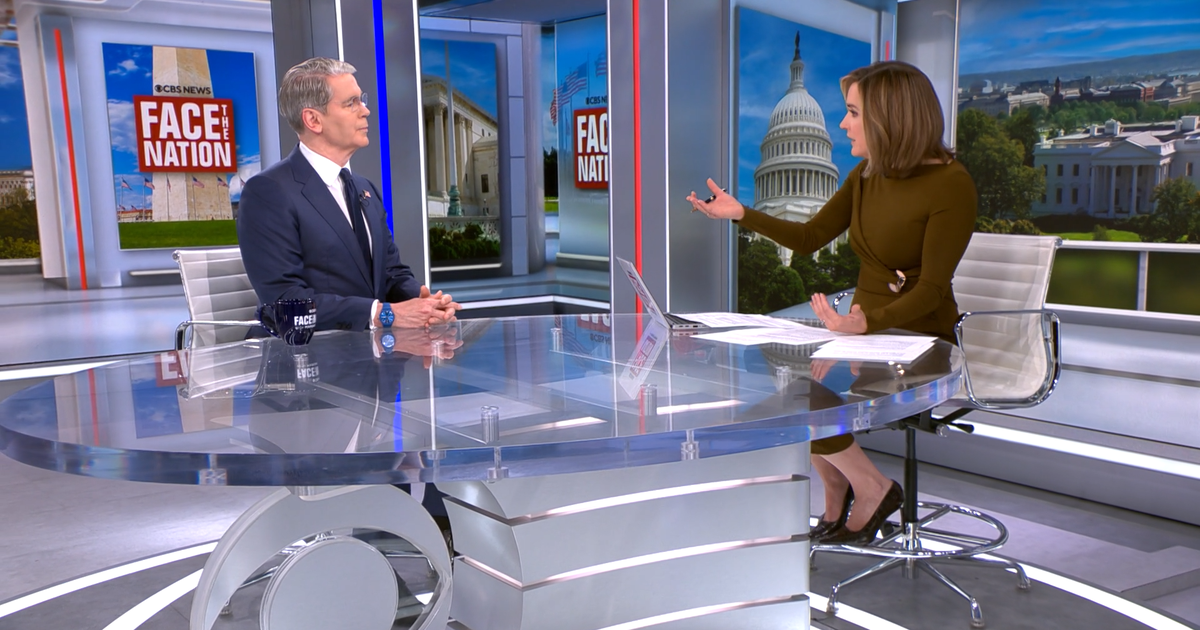
On this “Face the Nation with Margaret Brennan” broadcast, moderated by Margaret Brennan:
- Treasury Secretary Scott Bessent
- Brad Smith, Microsoft president and vice chair
- House Minority Leader Hakeem Jeffries, Democrat of New York
Click here to browse full transcripts from 2026 of “Face the Nation with Margaret Brennan.”
MARGARET BRENNAN: I’m Margaret Brennan in Washington.
And this week on Face the Nation: A surge of technology outages hit government agencies and major corporations.
Plus, what does the global AI arms race mean for the U.S. economy? Wall Street is bracing itself for Monday’s market opening after last week’s brutal sell-off, as concerns about artificial intelligence continue to rattle investors.
We will have an exclusive interview with Treasury Secretary Scott Bessent and the president of Microsoft, Brad Smith, whose company was at the center of one of those outages in recent weeks.
Our panel of experts, former CISA Director Chris Krebs, former Department of Homeland Security official Samantha Vinograd, and cybersecurity expert Dmitri Alperovitch, will break down the risks, the consequences, and what’s next.
Then: After a historic trilateral meeting with two of America’s biggest rivals, President Trump returns to questions about Iran, technology instability, and the looming Democratic takeover of Congress. Will he be open to working with the incoming speaker of the House?
(Begin VT)
DONALD TRUMP (President of the United States): He’s a smart guy. He’s a streetwise guy, and he’s smart. If they want to get things done, I want to get things done too.
(End VT)
MARGARET BRENNAN: We will ask Hakeem Jeffries what’s at the top of his agenda.
It’s all just ahead on Face the Nation.
Good morning, and welcome to Face the Nation.
We have a lot to get to today, and we begin with the secretary of the Treasury, Scott Bessent.
It’s good to have you here, and in person, sir.
SCOTT BESSENT (U.S. Treasury Secretary): Margaret, good to see you.
MARGARET BRENNAN: So, there were thousands of customers across America who, when they went to some of the biggest banks, had issues this past week with tech outages, and it caused a bit of a panic, with people pulling out cash.
In this age of AI, what should Americans be prepared for, and should they worry about their financial institutions?
SECRETARY SCOTT BESSENT: It’s a good, good question, Margaret.
And, no, they shouldn’t. The banks have been at the forefront of cybersecurity for decades. They experience attacks every day, every week, every month. And they are by far the most resilient companies in the U.S. economy.
What we are seeing, as they – because of the SI, as they go into patch their security systems, the patches may cause a glitch, which is what happened last week. J.P. Morgan went in. And I think the American people should think of it as a vaccine. Your arm may hurt, you may feel a little bad the next day, but it increases your long-term immunity and resiliency.
MARGARET BRENNAN: OK.
Well, there’s other concerns about AI, as you know. And we’ve seen in the stock market anxiety, a real sell-off over the past week. Nvidia is sometimes referred to as the central bank of AI, since it uses its cash to finance things like data centers and essentially boost demand for its own sales. We have a graphic there sort of showing the gist of that.
I mean, when you look at its size and how interwoven it is in the tech industry, do you worry that this kind of circular financing means that one company is becoming so hugely important that it could have ripple effects if something goes wrong?
SECRETARY SCOTT BESSENT: Well, look, Nvidia is one of our – our great companies.
With the management chains, the board has taken – has slowed things down. The CFO is now in charge. So, you know, I believe that she understands the financing quite well. And, no, it is – Nvidia continues to be fantastically profitable, and there is near unlimited demand for their chips worldwide.
MARGARET BRENNAN: Do you – how do you understand what happened in the markets this past week?
SECRETARY SCOTT BESSENT: Well, I think it’s a combination of things.
You know, we could see that the market sell-off actually began as the Democrats moved ahead in the polls and then accelerated after Election Day. The Democratic position on the SI build-out has spooked a lot of investors in terms of slowing it down.
We’ve also seen some very hawkish remarks from the Federal Reserve. Many people believe that they may be making a policy mistake if they overtighten. We’ve seen a substantial tightening in financial conditions over the past few months. So, you know, I think it was a combination of these things.
MARGARET BRENNAN: Well, President Trump gave that 90-minute or so press conference on Friday, and he did talk about things in AI. Among many things he said, take a listen to this.
(Begin VT)
DONALD TRUMP (President of the United States): We’re not allowing data centers to go into other countries, because China will take all of them, and we’re not allowing that to happen, and we’re going to put tremendous penalties on companies that try and do it.
(End VT)
MARGARET BRENNAN: How is that policy going to work, and won’t that also inhibit the sector?
SECRETARY SCOTT BESSENT: Well, I – I haven’t spoken to the president about that. I was sitting in that press conference, and I didn’t get a chance to speak to him after that.
But, look, I think the president’s very concerned that we don’t do a big technology transfer offshore. What we’ve seen, that the U.S. used to be the leader in the chip industry, and now we see that 97 percent of the high-end chips are made in Taiwan, which creates a strategic vulnerability.
This…
MARGARET BRENNAN: That’s been the case.
SECRETARY SCOTT BESSENT: Well, this administration is working to bring them back. There are large fabs being built by TSMC in Arizona. And we hope to have substantial onshoring of the chip business by the end of this administration.
So, I think he’s worried about the same thing happening with data centers.
MARGARET BRENNAN: With data centers.
So, one of the arguments against this – and the “Wall Street Journal” editorial board was pointing out a challenge here – is that if American companies can’t build data centers and their AI models close to the markets they’re trying to sell into, it will basically give their competitors, the Chinese, an edge.
SECRETARY SCOTT BESSENT: Well, look, I think that the A – the SI is very fungible, that companies access U.S. centers.
There are many centers in Southeast Asia. They get access from around the world. So I think the real thing here is going to be – and I have said it many times before the election. The industry has done a terrible job of explaining themselves to the American people.
MARGARET BRENNAN: Mm-hmm.
SECRETARY SCOTT BESSENT: And I think they need to have a conversation with the American people, with the communities where these centers are built, and rebuild public trust.
And I think, once we see that, then we could see a more substantial build out here in the U.S.
MARGARET BRENNAN: OK, so what the president announced was not reversing, for example, what the U.S. was encouraging in the United Arab Emirates with these data centers being built in some of our Gulf allies?
SECRETARY SCOTT BESSENT: No, he’s talking about American companies doing it.
MARGARET BRENNAN: Well, let me ask you about Nvidia in particular and what’s been happening in terms of the ongoing revelations.
Multiple congressional committees, federal prosecutors, and presumably regulators here in the United States are probing the role Nvidia played in sending advanced AI computer chips to China.
On FOX last Sunday, I watched your interview. It was pretty extraordinary. You did not parse words. You referred to a culture of noncompliance at Nvidia, the possibility that they were – quote – “pressing these seemingly illicit sales to goose their revenues and their earnings.”
You said you needed answers to what was going on within 10 days. That was seven days ago. Have you gotten the answers you need?
SECRETARY SCOTT BESSENT: We don’t, Margaret.
And I think the important word there is possibility. And we have seen – we’ve been in touch with the temporary management, with the lead directors, with their lawyers, and we do need answers.
And back to your question about the centrality of Nvidia to the SI system, it behooves Nvidia to move quickly on this, because we want to know what the culture was. Was there a promiscuous attitude toward this, and where – if it happened, where were the faults? And then they can move on.
MARGARET BRENNAN: So, when you say we, you mean to Treasury? You’re expecting those answers to go to Treasury, or they’re expecting to go to the White House?
SECRETARY SCOTT BESSENT: To the administration.
MARGARET BRENNAN: Because there was a lot of reporting that Nvidia’s business deals were often based on handshakes. That doesn’t leave a lot of a paper trail. How challenging is this for regulators to get to the bottom of what the CEO was doing?
I know you said the CFO is at the helm, but, last Sunday, you said basically they need to clean up shop and get someone from the outside to run the place.
SECRETARY SCOTT BESSENT: Well, what – what I said was, we – we do need to see who was in charge of compliance there.
Normally, it’s the legal department, the general counsel’s office. So we’ll see what they have to say. And – but, you know, in terms of handshake deals, for deals that size, there’s no such thing as an untraceable handshake deal. There are bills of lading movement. There are money movements.
So, you know, they may not be the 100-page documents, but there – it will be possible to understand what has gone on here.
MARGARET BRENNAN: I mean, that’s an extraordinary charge, though, a culture of noncompliance.
SECRETARY SCOTT BESSENT: Well…
MARGARET BRENNAN: That’s not just the foibles of one man.
SECRETARY SCOTT BESSENT: Well, again, we will – I said the possibility.
MARGARET BRENNAN: Yes.
SECRETARY SCOTT BESSENT: So, we will see. And that’s why I think the board is moving very quickly to establish whether this did or did not exist.
MARGARET BRENNAN: The president of the United States said Jensen Huang get his job back. You said the board of directors needs to go to the outside.
Does the president understand the national security risk and the regulatory risk that you’re pinpointing here?
SECRETARY SCOTT BESSENT: Well, Jensen is on the outside now, so, you know…
MARGARET BRENNAN: I know. The president said he should come back.
SECRETARY SCOTT BESSENT: I – well, I – I said they should go to the outside, but he’s on the outside now.
But I think what we need to see, because the other thing I said was, we will see which level of the business knew about this. Was it at the lower levels? Was it the middle levels? Did it go all the way to the top? And I have confidence that the Nvidia committees are moving very quickly on this and will come up with some very fulsome and robust answers.
MARGARET BRENNAN: I understand Mr. Huang is no longer at the helm, but are you saying that you would be – you think it would be a good idea for him to go back and run the company?
SECRETARY SCOTT BESSENT: I think we have to see the – where – where the buck stops. You know, what – were these malicious actors down at the bottom of the company who were responsible for the noncompliance?
MARGARET BRENNAN: OK.So you see that as almost separate and apart from the relationship with Alice Huang, who is – Alice Huang, who’s reportedly linked to Chinese security?
SECRETARY SCOTT BESSENT: Yes, I – I think – look, I think that is kind of a canard, that the – you know, was there a culture of compliance versus the one person’s foibles?
MARGARET BRENNAN: With a Chinese spy, allegedly.
SECRETARY SCOTT BESSENT: Well, as – I assume he didn’t know that she was an alleged spy.
MARGARET BRENNAN: Senator Tom Cotton, the Republican chair of the Intelligence Committee, told “The Journal” about his frustrations with Commerce Secretary Lutnick, ignoring what he said were repeated letters and information from him about Megaspeed, the company that Alice Huang was running, which is at the heart of this.
Cotton said he’s glad that the Trump administration is finally coming around, but we need to catalog the damage. What damage has been done? Do you know?
SECRETARY SCOTT BESSENT: Well, again, we – we will see if Megaspeed was indeed a pass-through company, a front company based in Singapore, to get the high-end chips to Chinese entities.
MARGARET BRENNAN: So, should it be blacklisted while that’s under consideration?
SECRETARY SCOTT BESSENT: Well, Nvidia actually took them off their vendor list or sales list in August of ’25, so they wouldn’t have gotten any chips since then.
MARGARET BRENNAN: Should it be blacklisted in the meantime?
SECRETARY SCOTT BESSENT: The – we at Treasury and several other departments have pushed for it.
MARGARET BRENNAN: Right.
SECRETARY SCOTT BESSENT: I think the important thing was, last week, we did something called the connected – or the remote access rule, which prevents certain countries, certain entities from accessing chips via lease capacity, which I actually think may be more important.
MARGARET BRENNAN: Mm-hmm.
Right. That’s Singapore, Malaysia, Thailand, Indonesia, Brazil. You’re trying to tighten the licensing there.
SECRETARY SCOTT BESSENT: Yes.
MARGARET BRENNAN: But, in the meantime, it was pretty extraordinary to have the Republican chair of the House Foreign Affairs Committee release publicly documents showing that the Commerce Department had approved the sale of more than 800,000 Nvidia and AMD AI chips to China.
The approvals included two companies highlighted here as known to be linked to the Chinese military. I know there’s a threshold set on the type of chips, but is any sale to the Chinese military really advisable?
SECRETARY SCOTT BESSENT: The president’s been very clear that the H – and drawn a very hard line at the…
MARGARET BRENNAN: Yes, the H200s.
SECRETARY SCOTT BESSENT: … H200s.
So I think – and, you know, these are companies – I think one of them is Alibaba, which is, in general, a social media and online platform. So I think, once you draw the threshold, then I don’t know if you have to differentiate.
MARGARET BRENNAN: So, some sales to the Chinese military are OK?
SECRETARY SCOTT BESSENT: Well, again, this isn’t Chinese military. These are companies that do business with the Chinese military.
MARGARET BRENNAN: Understood. And there’s a very, very thin line there.
But, Secretary Bessent, I appreciate your time today.
Face the Nation will be back in a minute. Stay with us.
(ANNOUNCEMENTS)
MARGARET BRENNAN: We turn now to the incoming speaker of the House, Democratic Congressman Hakeem Jeffries, who joins us from New York.
Good morning, Mr. Speaker-Designate.
REPRESENTATIVE HAKEEM JEFFRIES (D-New York): Good morning. Great to be with you.
MARGARET BRENNAN: Well, you have really a huge role to take over in January.
And I want to lay out for you what we saw in our exit polls as the message sent by voters; 89 percent said cost of living was crucial or a major factor in their vote; 90 percent said the same about corruption.
Given those dual messages, what is the first bill you try to pass, and will it be bipartisan?
REPRESENTATIVE HAKEEM JEFFRIES: We’re going to work incredibly hard to deliver on our promises to the American people around affordability and accountability.
We have to drive down the high cost of living. Life is way too expensive. There are far too many people who are working hard, they’re playing by the rules, they can’t thrive, and they can barely survive.
There are several things that we plan to do very early on in the new Congress. We need to end this reckless and costly war of choice in Iran that has skyrocketed gas prices, food prices, and diesel prices. We need to reverse the Medicaid cuts. We need to restore SNAP benefits.
MARGARET BRENNAN: Mm-hmm.
REPRESENTATIVE HAKEEM JEFFRIES: We need to deal with the Trump tariffs, which have also increased costs on everyday Americans by thousands of dollars per year.
MARGARET BRENNAN: Yes.
REPRESENTATIVE HAKEEM JEFFRIES: And, of, course we need to extend the Affordable Care Act tax credits.
MARGARET BRENNAN: Well, when I asked about whether or not it would be bipartisan, some of the things you just laid out, it really doesn’t seem likely that the president, a Republican president, would sign off on.
Some of the things you listed There were part of his signature tax-and- spending bill that Republicans passed. Are you going to send these as messaging vehicles?
REPRESENTATIVE HAKEEM JEFFRIES: No, we’re committed to delivering the type of bold, dramatic, and meaningful change that the American people are demanding.
When we moved earlier this year to extend the Affordable Care Act tax credits, that was bipartisan in the House of Representatives, because the reality is, tens of millions of people in this country, hardworking, working-class, middle-class folks, those who aspire to be part of the middle class, have experienced dramatically increased health insurance premiums, in some cases, more than $1,000 per month.
That’s unacceptable. Reversing the Medicaid cuts will help out people all across this country…
MARGARET BRENNAN: You don’t think Trump will veto that?
REPRESENTATIVE HAKEEM JEFFRIES: … in rural America, urban America, small-town America, the heartland of America, and black and brown communities all throughout America.
Listen, that remains to be seen. We have three areas that we need to work on. We need to drive down the high cost of living and deal with the affordability crisis. We have a broken health care system. We need to fix it, and then make sure that we actually don’t simply return to the status quo, but we do much better than what currently exists.
And we need to fix our broken immigration system as well. And those are three possible areas to explore whether we can work together with the president and our colleagues on the other side of the aisle.
MARGARET BRENNAN: There are a lot of different ways to define accountability.
Rahm Emanuel, the former congressman, mayor, and ambassador – I know you know him well – told my CBS colleague that Democrats seeking accountability should move on ethics reform. He suggested a ban on stock trading in prediction markets, mandatory blind trust for everyone with over $1 million in wealth, and no foreign money when you’re in government or two years afterwards.
Do you have an appetite for that kind of proposal?
REPRESENTATIVE HAKEEM JEFFRIES: Yes, we have promised the American people that, in addition to our affordability agenda, we know, in the face of the unprecedented corruption that has been unleashed on the American people and the country over the last two years, that we need to deal with accountability.
And we’ve made that clear. And no one is going to get a pass…
MARGARET BRENNAN: But how do you define that?
REPRESENTATIVE HAKEEM JEFFRIES: … because there’s a cost to corruption that adversely impacts everyday Americans.
So – well, listen, we’ve got to clean up the mess in Washington. That means the Congress, that means the Supreme Court, and that also means with respect to the administration. And we should begin by dealing with our own house, which is why, very early on in the new Congress, House Democrats are going to move to ban members of Congress from trading stock.
MARGARET BRENNAN: Well, we will see if that gets the bipartisan support needed.
I want to ask you as well about what President Trump said he thinks he can work with you on. He said: “We can get a lot of great things done.”
Take a listen.
(Begin VT)
DONALD TRUMP (President of the United States): I’m open to great health care. Now, can it be what they want? No, but it can be a combination of what we all want, and we could end up with great health care in our country. We could end up better than dealing with the Republicans.
(End VT)
MARGARET BRENNAN: So, what would working with him on health care do, apart from, like you said, repealing the things that have already been passed?
REPRESENTATIVE HAKEEM JEFFRIES: In addition to what I have talked about in terms of fixing our broken health care system, of course, we can’t simply return to the status quo.
In my view, we should lower the age of Medicare eligibility. We should expand coverage to include vision, hearing, and dental, and we should make sure that we cover the kids, so that every single child and young American in this country can afford to go see a doctor when they need one.
That’s a place where we can explore coming together. I know it has strong support amongst Democrats in the House and the Senate. And let’s see what’s possible in terms of what the president has said with respect to health care.
Can you imagine how angry the American people will be with Washington if, over the next two years, we fail to do anything…
MARGARET BRENNAN: Yes.
REPRESENTATIVE HAKEEM JEFFRIES: … about affordability, fail to do anything about health care, and fail to do anything about immigration?
We’re committed to bringing about the type of dramatic change the American people are demanding.
MARGARET BRENNAN: But you also have constraints on you, given the already over $40 trillion in debt America is carrying. You have constraints with the rising cost of Social Security and Medicaid. How do you pay for expanding this?
REPRESENTATIVE HAKEEM JEFFRIES: Well, those are conversations that we look forward to having as members of Congress, both sides of the aisle, and certainly with the administration.
But we have to do better. The economy is broken. Life is not working for far too many Americans. And it’s clear we can’t simply return to the status quo. This is a great country. When you work hard and play by the rules, you should be able to live an affordable life and a comfortable life and a good life.
And that’s what we’re committed to bringing about for every single American in this great country of ours.
MARGARET BRENNAN: So, when you were elected as speaker-designate, there were seven of the 11 lawmakers who voted against you who released a statement.
Some of them are Democratic socialists, and they said that they had secured commitments from you already. It was in a positive direction, still wasn’t enough to win their vote. But can you tell us what commitments you have made to the left of your party?
REPRESENTATIVE HAKEEM JEFFRIES: The only commitments that I have made is to continue to deliver upon the aggressive agenda that we’ve talked about with respect to making life more affordable for the American people, and that’s in every area.
We believe we have to drive down the high cost of health care, and housing, and gas, and groceries, and goods, and utilities, and caregiving.
MARGARET BRENNAN: Mm-hmm.
REPRESENTATIVE HAKEEM JEFFRIES: And we have plans to make sure that we aggressively engage in every single one of those areas.
With respect to the House Democratic Caucus, I’m going to continue to have an open-door policy and talk to everyone. But what I believe unites us is our shared commitment to the affordability agenda and our shared commitment to making sure that, if you have folks out there who’ve been stealing from the American people, screwing over the American people, or shortchanging the American people, we will also hold the crooks accountable.
MARGARET BRENNAN: But that doesn’t mean impeachments come January? It’s not an immediate plan?
REPRESENTATIVE HAKEEM JEFFRIES: We haven’t ruled anything in, and we haven’t ruled anything out. We’re focused on actually delivering and keeping our commitment.
And it’s my expectation that, with respect to the accountability agenda, that everyone involved and whatever investigations are unveiled, they’re going to follow the facts, they’re going to apply the law, they’re going to be guided by the Constitution, and they’re going to let the chips fall where they may, so we can deliver a government of the people, by the people, and for the people that’s focused on actually making life better for everyday Americans.
MARGARET BRENNAN: Speaker-Designate, we will watch your work. More questions for you, but we have to leave it there for today.
We’ll be right back with a lot more Face the Nation. Stay with us.
(ANNOUNCEMENTS)
MARGARET BRENNAN: We will be right back with the president of Microsoft, Brad Smith, and our panel of experts to break down the recent tech outages and cybersecurity threats, plus more fallout from the pace of the development of artificial intelligence.
Stay with us.
(ANNOUNCEMENTS)
MARGARET BRENNAN: Welcome back to “FACE THE NATION.”
We turn now to the president and vice chairman of Microsoft, Brad Smith, who joins us from Seattle.
Very early morning. Thank you for joining us.
BRAD SMITH (President and Vice Chairman, Microsoft): My pleasure. Thank you.
MARGARET BRENNAN: So, we’ve been talking about these outages at companies. Microsoft had a global outage for 24 hours, hobbled corporations. It was tough for us here in the news business not to have our email working on November 12th or so. Microsoft said it was linked to a technical issue, not a cyber hack. What is the company doing to make sure this doesn’t happen again, and did A.I. play a role here?
BRAD SMITH: Well, the first thing we always need to do when this happens is apologize. And we have, and I want to do so again.
And you’re right, it was not linked to A.I. It wasn’t a cyberattack. It was basically a perfect storm of software that was updated four months earlier, and then it interacted with a new update and a shift in network traffic.
You know, we have taken steps, we’ve published two reports in the last ten days, we’ve worked to be transparent, showing minute by minute to the public what happened. We’ve taken nine steps already as we laid out in our report. There’s 13 more steps we’re going to take. We’ve learned a lot. It was painful, especially for everybody who relies on us. We get it. And I think this combination is going to make us stronger going forward. It’s just constantly what we have to do in an age of such complex technology.
MARGARET BRENNAN: Well, as you know, there was a series of events. It wasn’t just Microsoft. But we saw tech outages and all sorts of complications. It’s raised questions about what A.I.’s role is generally. I heard you say it wasn’t a factor for Microsoft. But when you look across the country right now, I mean, do you think that we are applying A.I. tools to look for vulnerabilities and then doing these automated updates in such a way that, frankly, like our old infrastructure just isn’t prepared for?
BRAD SMITH: I think that is part of the really important question. And you can think about what’s happening with all of these outages, at least in substantial part, as sort of A.I. ripple effects. What A.I. did earlier this year was basically make it much easier for people to find vulnerabilities in code, and then you can either use that knowledge to patch the code, or if you’re a bad actor, you can use that knowledge to try to hack into systems.
So, what happened is we’ve set off in effect a race around the world. People who have technology are using these systems to identify the vulnerabilities and patch at a pace we have never seen before to beat the bad actors so they can’t use them to hack in. But especially when you have older infrastructure, especially when you’re trying to patch at such a pace, especially when you have to go so fast that you can’t take as much time to test what you’re changing in the code, you do increase the risk of something going wrong.
And that’s what we’ve seen over the last week. I think we have to be prepared, frankly, for the coming months because this isn’t the type of thing that just gets done in a couple of weeks. The whole information infrastructure of the world is in effect being upgraded right now.
MARGARET BRENNAN: That makes it sounds like there are some pretty big risks that we may not yet be anticipating. Like, what are Americans supposed to do?
BRAD SMITH: Well, what I would say for all of us is three things. First, if you get an update on your phone or your laptop with a patch, apply it, because I think that’s going to keep your technology far safer. Second, for all the organizations in the world, people are having to update their patching practices, they’re having to change the way their I.T. teams work together, they’re having to upgrade their legacy infrastructure. And I think there’s a huge opportunity for the government and the tech sector who work more closely together. Jay Clayton is really, I think, focused on advancing this in the administration. I think that’s critical and we’re going to need better sharing of threat intelligence, better concerted action.
MARGARET BRENNAN: I want to ask you about something I asked the Treasury secretary about just a few moments ago. On the Microsoft website it says your company has more than 600 data centers in 34 countries. The president said that he wants to put a tremendous tax on companies that build data centers abroad and he’d like to stop them from building abroad.
I know Bessent said he didn’t have the details, but when you hear that from the president of the United States as a new policy, what impact does that have on your business?
BRAD SMITH: Well, my sense is that the president is making an important point, but there’s some critical nuance we need to think about as well. The point is sort of analogous to the chip industry. I think the administration might want to see the most advanced frontier models trained in the United States. And there’s room to have that kind of conversation. The nuance is that there’s lots of different kinds of data centers. Most data centers actually don’t have A.I. They’re cloud services to stream a video, play a video game, run your business. And those have to be located close to customers. They often now have A.I. because the business applications, even your video games, have an A.I. element.
MARGARET BRENNAN: Yes.
BRAD SMITH: And you – the president talked about, say, data centers in Finland. You can’t support Helsinki from New Jersey any more than you can keep the lights on in Helsinki from an electricity power plant in New Jersey. Those have to be located locally.
MARGARET BRENNAN: Yes. He might have been referring to a Chinese project there. It wasn’t clear. I heard that line, too.
TikTok owner Bytedance is reportedly spending significantly on Microsoft’s A.I. and cloud services. And that has gotten the attention of the Republican chair of the committee in the Communist Party. He said that given Microsoft’s crucial Pentagon contracts, it’s unacceptable for your company to sell A.I. tools to arm Bytedance, which works for the Chinese Communist Party. That’s his opinion. But why do you think it’s a good idea?
BRAD SMITH: Well, take TikTok, it’s a social media service. It’s a social media service today that uses A.I. to make it easier for TikTok users to find what they’re looking for. And as Secretary Bessent said –
MARGARET BRENNAN: It’s social media in a surveillance state, right?
BRAD SMITH: Well, there’s TikTok services around the world.
MARGARET BRENNAN: Yes.
BRAD SMITH: You know, in the United States it’s now a separate company. So, I think the question is always, what technology is being provided, how is the technology being used. We always go up to Capitol Hill to provide information when these kinds of news stories arise. I’m sure we’ll be going up to Capitol Hill to answer the questions of that committee.
MARGARET BRENNAN: OK. We’ll watch for that.
And before I let you go, we had Speaker-designate Jeffries on the program. He was talking about this idea of accountability. There’s been a lot of focus, as you know, on the president’s projects, including this ballroom. Microsoft donated $10 million to it according to “The Journal” and “The Post.” So, that makes your company one of the top donors to the ballroom. I know that was a decision that you must have weighed in on. Why did you come to that conclusion, and are you worried now about risk from a Democratic- controlled Congress looking to focus in on companies like yours?
BRAD SMITH: We always have the same philosophy for every administration regardless of which political party it comes from. We partner where we can. We stand apart when we should. We looked at the ballroom. We didn’t know, obviously, that it was going to involve any demolition of the East Wing. That was – we put in the first category. And we’ve disagreed where we thought that was important, including suing this administration, as we have previous administrations, to stand up for the free press, to make sure that the privacy of journalists are protected. We always have to make judgment calls. We never expect to get everything perfect. But I think that is the right philosophy for us.
MARGARET BRENNAN: Brad Smith, thank you for your time today.
We will be right back.
(ANNOUNCEMENT)
MARGARET BRENNAN: To help us understand these recent technology outages, we are joined now by Sam Vinograd, a former counterterrorism official at the Department of Homeland Security, now a CBS contributor, Chris Krebs, also CBS contributor, is the former director of the Cybersecurity and Infrastructure Security Agency, or CISA, and Dimitri Alperovitch is here as well, he runs a geopolitical think tank and co-founded cybersecurity firm Crowdstrike.
It’s good to have you all here.
Sam, before I get to the tech, I want to ask you about this homeland security concern. DHS and TSA issued a memo entitled, “Al Qaeda Praises Attempted Hijacking and Encourages Copycat Aviation Attacks.” It referenced the FlyDubai incident. Americans are about to travel, what do they need to know?
SAMANTHA VINOGRAD: Well, this memo is just good counterterrorism hygiene. Certainly information sharing with private sector partners is a key part of how officials keep this country safe. It is unsurprising that after a high- profile attack we have terrorist groups like al Qaeda trying to inspire copycat attacks.
And for that reason, Americans should rest assured that the federal government is sharing information with their partners and that particularly, not just in the post 9/11 era, but in the post FlyDubai era, security officials are reexamining any vulnerability in security architecture and trying to stay informed and vigilant.
MARGARET BRENNAN: Well, there’s other concerns about airlines, Chris, including – I mean it was just a week ago we had this ground stop. The FAA administrator said that “it is completely unfounded to say A.I. is a cause of what happened last Friday.” Does that statement still hold? Is it accurate?
CHRIS KREBS: Well, that’s my understanding of what happened last Friday. And there is information, I think, yet to come on the investigation that the FAA, the FBI and others have been looking into. But I would put this at a system upgrade, whether it’s installing new equipment that, just like Brad said with what happened at Microsoft on Thursday, there was a bit of a perfect storm in a remote facility in Arkansas and in Texas last Friday. They got things back up and running. Ultimately, it was a safety decision. And, you know, here we are, we’re flying again. Except for – earlier this week we had United with a temporary issue and then even this morning Delta, out of Atlanta, had an issue as well. So, these outages are in some part due to these hardware upgrades and in others there may be some A.I. element. But nonetheless, we are racing, just as Brad said, to patch these systems.
MARGARET BRENNAN: Yes, I thought that was an interesting almost forewarning of prepare yourselves and think about this.
Dmitri, one of the other things we saw was in government systems some impact. The National Security Agency’s classified network, which CBS reported, was hit but it was linked to an urgent patching of vulnerabilities, not a hacking. The president said this about all of the incidents. Take a listen.
(BEGIN VC)
DONALD TRUMP, PRESIDENT OF THE UNITED STATES: They’re all separated. They’re not like, oh, gee, Chase went down and this one went down. They’re all separate events. They’re all separate events. You know, we have thousands of companies that are upgrading right now. And when they upgrade, bad things happen.
(END VC)
MARGARET BRENNAN: You know, people look at this and say there’s no such thing as a coincidence. Is the president right to say they’re not connected?
DMITRI ALPEROVITCH (Chairman, Silverado Policy Accelerator): Well, these individual events are not connected, but there is a thread that connects them all in a sense that because, as Brad and Chris have said, we have this perfect storm, we have a vuln-apocalypse happening right now where these vulnerabilities are being discovered by A.I. More vulnerabilities have been discovered this year in software than in the last 30 years combined. This is a huge number of vulnerabilities that companies are starting to patch. And as a result you have I.T. teams, network teams are overwhelmed. They’re working 24/7. They’re making mistakes. Some of these patches are causing problems. And you are having these outages. And I think you’re going to see more of these outages going forward.
MARGARET BRENNAN: How do people prepare for that?
DMITRI ALPEROVITCH: Well, we have to prepare for it like we prepare for weather events, for hurricanes. Stock up on water. Make sure you have enough cash if the ATM is down for a little bit.
MARGARET BRENNAN: Is this what you are doing?
DMITRI ALPEROVITCH: I am doing that.
MARGARET BRENNAN: Are you really?
DMITRI ALPEROVITCH: I think – I think it’s good to prepare because this is not a catastrophic event. You know, your money, your bank account is safe. But maybe you won’t be able to get money at the right moment when you need it, so have some preparedness, stock up on key groceries, dry foods, et cetera.
MARGARET BRENNAN: Is that what you’re doing, Sam?
SAMANTHA VINOGRAD: If I could just – if I could just level sound the threat environment for a moment because there’s a lot going on. We have electricity outages all the time. Our cars break down and we all keep going, right?
MARGARET BRENNAN: Right.
SAMANTHA VINOGRAD: Like, if we just take a step back and look at the threat environment. More Americans rely on digital infrastructure today than at any point in history. So, when antiquated systems that are prone to malfunction, malfunction, it’s more costly and more disruptive.
At the same time, the A.I.-enabled threat environment is different. Cyberspace is more crowded and it’s moving faster. At the same time, cyber defenders have better tools to find threats, to triage threats and more. So, yes, it seems really noisy right now, really bumpy. That could continue for some time, but we do have certain things that can make it a little easier. Good information that’s timely and credible and resilience. And to Dmitri’s point, resilience is built on redundancy. Having a plan b. I am not stocking up on supplies. I’m not canceling my travel plans. That’s everyone’s individual decision, of course. But the government tries to find fallbacks if a system goes down. We all should be thinking of that, too, so that there’s no single point of failure.
MARGARET BRENNAN: It just seems it’s a sudden problem and that can be overwhelming to people. Like, this is going to be a topic at Thanksgiving dinner for families across this country.
CHRIS KREBS: Not just this Thanksgiving, but next Thanksgiving as well.
MARGARET BRENNAN: Right.
CHRIS KREBS: This is going to take some time to work through. But just as Brad said, it is directly related to the advancements of A.I. this year. So, April of 2026, Anthropic releases Methos preview. Methos is particularly good at finding vulnerabilities in systems. It is the equivalent of every hacker ever – that ever existed, all in one model, that never sleeps, never takes a smoke break, it is constantly looking for vulnerabilities.
So, as everyone said, there are two things happening at the same time, defender a using A.I. to find bugs and patch them. On the other side, we have bad guys that are using not as capable bugs. Just as the secretary said, we are the best in the world at A.I. That edge remains and it likely will remain if we make good decisions at the government and the policy level.
But there’s a connection because when these patches are released to defenders, almost instantaneously the bad guys are able to reverse that patch and figure out how to exploit it.
MARGARET BRENNAN: Yes.
CHRIS KREBS: Fortunately, only about two percent of bugs are able to be exploited, or are exploited. But nonetheless, when you’re stacking things up, and you’re patching systems and introducing instabilities, as Sam pointed out, you’re going to have a rough go. And again, patience is key. Preparation is key. But everybody needs to buckle up. This is going to be a couple years to burn down all the bugs that are across the software on the internet.
MARGARET BRENNAN: Wow. I mean, speaking of the bad guys, Dmitri, you made a business of finding vulnerabilities and the bad guys in the systems. The president of the United States said this week that he fired America’s national cyber director, Sean Cairncross, because, quote, he “didn’t think he was good enough,” and he replaced him with Kirsten Davies. Is this solved with personnel changes?
DMITRI ALPEROVITCH: Well, we have to appreciate that the government is actually not in charge of over 90 percent of the critical infrastructure in this country and certainly private sector networks. And as Chris said, you have these vulnerabilities, they’re being discovered, and these outages are not cyberattacks, it’s important to point that out.
But there is a huge amount of cyberattacks that are taking place right now. The FBI, the criminal database was just hacked a couple days ago.
MARGARET BRENNAN: Yes.
DMITRI ALPEROVITCH: This was – this is happening across the industry. We literally just had the biggest heist in the history of the planet taking place with Bytedance (ph) a few weeks ago where almost $3 billion were taken out. We’ve never seen that in cyber in the physical world almost instantaneously. This is happening because of A.I. systems that the criminals are using and nation states to break in autonomously in these systems and to do it at scale.
MARGARET BRENNAN: And that’s where the Treasury secretary was trying to reassure people about their access to their money, saying that, you know, financial firms have been all over this for quite a long time. Do you – do you agree?
SAMANTHA VINOGRAD: Well, I think there’s an important point that we need to acknowledge, which is whatever the facts are, if the public doesn’t digest those facts, there’s panic. And so, you know, having worked in financial services, having worked in government, working in tech, like, I know that these systems have redundancies, have resiliencies, and sometimes these disruptions that look so major publicly are actually being managed by experts.
However, last week, I don’t know about all of you, but the conspiracy theories filling the social media feeds were overwhelming.
MARGARET BRENNAN: Yes.
SAMANTHA VINOGRAD: Whatever the facts are, if this was a cyberattack, a software upgrade, it is a fact that our adversaries and our competitors don’t just enjoy these moments, they’re probably amplifying them. The information vacuum that is created by a lack of credible facts –
MARGARET BRENNAN: Yes.
SAMANTHA VINOGRAD: Lends itself to manipulation by foreign adversaries that want to see more panic in the homeland, want to see more confusion, and really want to undermine U.S. leadership. So, despite government personnel working overtime to try to get the FAA systems back up, certainly I don’t think anyone in Beijing or Moscow was crying that we had, you know, the secretary of transportation saying that we had aging infrastructure in this country and that people were uncertain when they could get home to their loved ones.
So, what that means is, we really need to find those leaders that can deliver credible facts and really think before we tweet, think before we spread that information, because it doesn’t help us, it hurts us.
MARGARET BRENNAN: Now, I want to ask you as well about the chip war with China. Chris, I asked Secretary Bessent about the disclosure that the U.S. has been approving the sale of some computer chips to entities linked to the Chinese military. He kind of played that down. He’s been very vocal in the past, though, that there are big loopholes in this system that needs to be fixed. Should we be concerned that even these lesser-quality chips are being sold to our adversary?
CHRIS KREBS: So, my view is that, yes, we should be concerned. There is a school of thought that we need to keep the Chinese addicted to U.S. chips. I certainly don’t believe that and I know that Dmitri does not believe that.
MARGARET BRENNAN: But the Commerce secretary, the president has echoed that. David Sacks an adviser to the president had echoed that.
CHRIS KREBS: There’s a tension here –
MARGARET BRENNAN: Yes.
CHRIS KREBS: Between that A.I. edge that we are maintaining, we have to maintain, as well as propping up an A.I.-driven, A.I.-fueled economy.
MARGARET BRENNAN: Yes.
CHRIS KREBS: The stock market. We’ve seen this week the market take a pretty big hit. My view, like it started last administration, is that we have to limit the ability of the Chinese to get their – get U.S. cutting- edge chips. We need to own that market. And that will, I think, down the road, lead us to ultimately American dominance in the A.I. game.
MARGARET BRENNAN: On another network, the director of national intelligence, Jay Clayton, talked about a case that he had previously been part of prosecuting and said some of our high-end chips are making it to China, despite, you know, the sanctions regime and the black list out there. Is this just whack-a-mole and the Chinese are going to get there anyway?
DMITRI ALPEROVITCH: No, because we are, right now, enabling this. First of all, we are selling these somewhat lower end clips to China, but they’re very powerful, including to, as you said, to – connected – to companies connected to the Chinese military. But also, we know that there’s billions of dollars, potentially tens of billions of dollars, that have gone through the smuggling network that Alice Huang and Mr. Jensen Huang was running with Megaspeed and many other companies, by the way, in Singapore –
MARGARET BRENNAN: Allegedly.
DMITRI ALPEROVITCH: That provided the cutting-edge chips, the best of the best chips to China. Which, by the way, hurts us in two ways. One, it helps China and the Chinese ad companies. It also hurts American companies because they all are saying, we can’t get enough chips. So, all these chips are being funneled through China to help their military, to help their A.I. labs that, by the way, are building tools that are now being used to attack us in cyber as well.
MARGARET BRENNAN: So, you would like to see Megaspeed put on a black list?
DMITRI ALPEROVITCH: Well, I think not just Megaspeed. We need to crack down on all of the smuggling that is taking place. By the way, there is no addiction to chips. This is not cocaine, right? You have American A.I. companies that are moving off Nvidia chips, moving to Google and others.
And, by the way, selling chips to China to win the A.I. race is like selling rockets to the Soviet Union to win the moon race. It is – it makes zero sense.
MARGARET BRENNAN: Well, we’ll see if the policy changes.
Dmitri, Sam, Chris, good to have you all here.
We’ll be back in a moment.
(ANNOUNCEMENTS)
MARGARET BRENNAN: That’s it for us today. Thank you for watching. Until next week. For “FACE THE NATION,” I’m Margaret Brennan.
(ANNOUNCEMENTS)

