

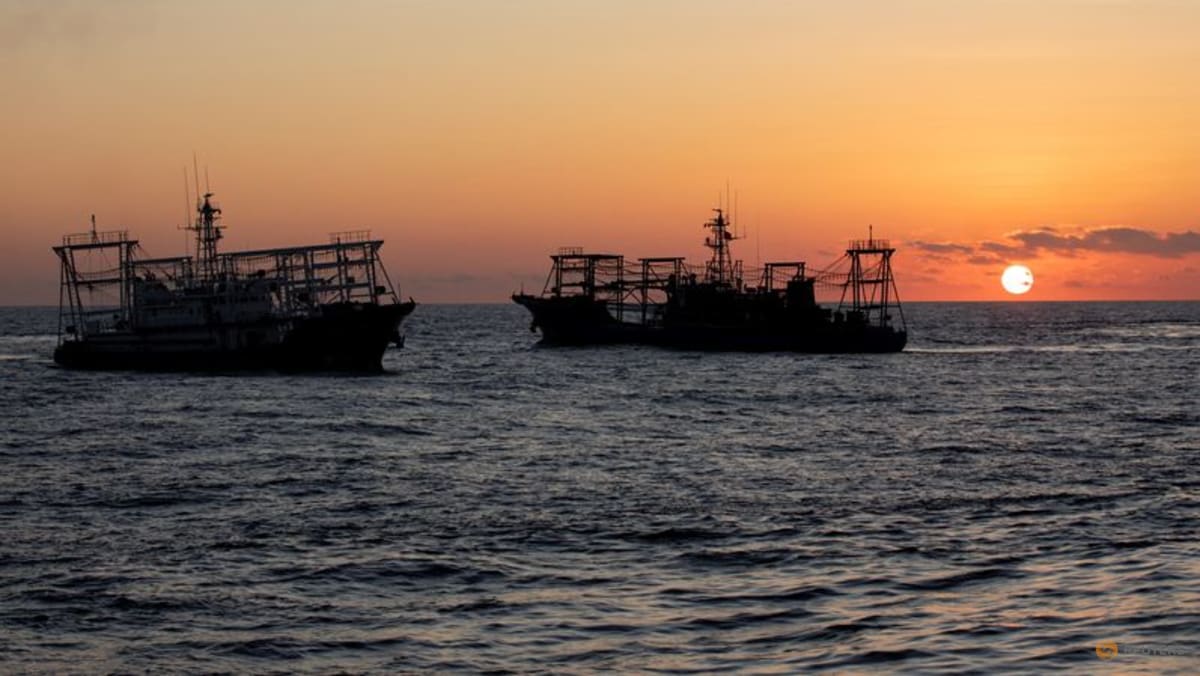
More than two decades later, confrontations continue in the South China Sea.
The Philippines and China have repeatedly clashed in the waterway. Manila has accused Beijing of repeated aggressive actions inside its exclusive economic zone, including dangerous manoeuvres, the use of water cannons and disrupting resupply missions. Meanwhile, China has accused the Philippines of intruding into what it claims as its territory.
Other ASEAN countries, namely Malaysia, Vietnam and Brunei, also have overlapping claims with China. While Indonesia is not a claimant state, its North Natuna waters, which lie on the edge of the South China Sea, have also seen clashes between the Indonesian coast guard and Chinese fishing boats.
WHY HAVE NEGOTIATIONS TAKEN SO LONG?
Lazaro said several key questions remained unresolved, including whether the code would be legally binding.
“The ASEAN countries plus China have also different views on how things are,” she told reporters at the ASEAN Summit on Sunday.
Experts told CNA that another fundamental obstacle is the code’s geographical scope: The parties have yet to agree on precisely where its rules would apply.
“The issue here has always been that even if you agree on a certain geographical scope, then as one of the parties, do you therefore essentially give de facto recognition to the other parties’ claims?” said Dr Collin Koh from Nanyang Technological University’s S Rajaratnam School of International Studies (RSIS).
For example, China does not want the Paracel islands to be included in the code’s geographical scope, while Vietnam does. Also known as Hoang Sa in Vietnamese, the Paracel islands are controlled by Beijing but have been claimed by Vietnam.
Beijing’s expansive claim in the South China Sea creates further complications because it overlaps with the exclusive economic zones of several Southeast Asian states.
Koh said ASEAN countries would have to consider whether accepting a geographical scope based on China’s claimed boundary could be interpreted as implicitly recognising Beijing’s claim.
“If China wants the geographical scope to cover well within the so-called 10-dash line, and if from the ASEAN perspective, you accept that, then does it mean that you essentially recognise that China does have a legitimate 10-dash line claim to it,” he said.
Poling added that China would want to include areas within its claim, including waters off Malaysia and farther south that overlap with Indonesia’s waters.
“So there’s the whole bucket of, ‘How do we have a code if we can’t even agree on where we’re talking about?’” he said. “You can’t manage disputes if we can’t decide on where they are.”

