



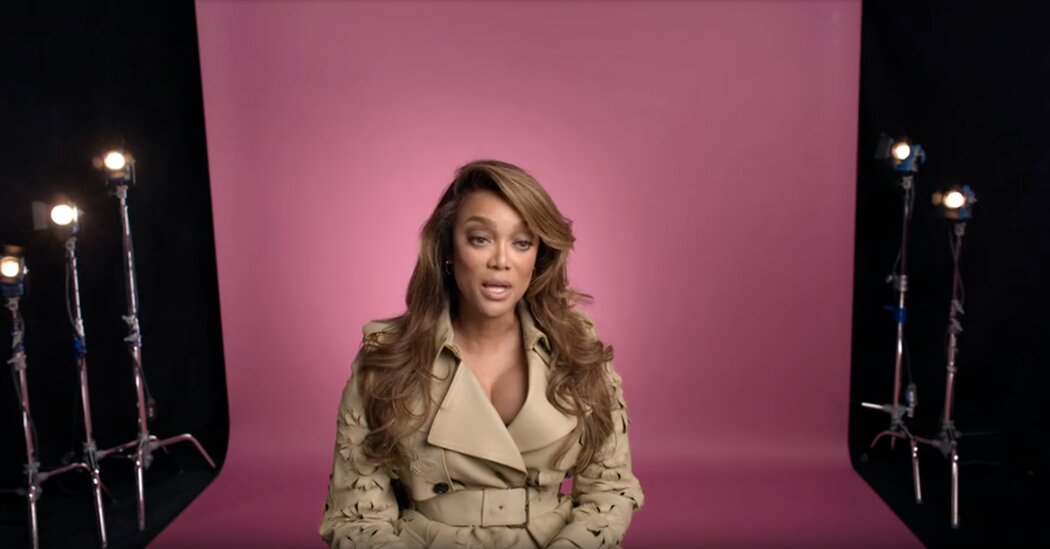
Tyra Banks filed a defamation lawsuit against Netflix and the directors of its “America’s Next Top Model” docuseries, claiming they manipulated hours of interview footage to support a false narrative about her role on the show.
The lawsuit, filed on Saturday in the U.S. District Court for the Central District of California, says that the three-part docuseries, “Reality Check: Inside America’s Next Top Model,” which premiered on Netflix in February, defamed Ms. Banks by implication and portrayed her in a false light.
The lawsuit also claims breach of contract and false endorsement. The production company EverWonder Studio is also named as a defendant.
Representatives for Netflix, as well as for the show’s directors, Mor Loushy and Daniel Sivan, and EverWonder Studio did not respond to requests for comment on Sunday. A representative for Ms. Banks declined to comment.
“Reality Check,” which explored the legacy of triumphs and controversies of “America’s Next Top Model,” drew a variety of responses. Some questioned why it had taken so long to scrutinize the show, which ran in the United States for 24 seasons (or “cycles,” in the show’s parlance) between 2003 and 2018. Others wanted to hold Ms. Banks, who created, hosted and executive produced “America’s Next Top Model,” accountable for the show’s missteps, which included asking models to pose as people who were homeless, bulimic, drug-addicted or victims of violent crime, and requesting them to adopt different races or ethnicities.
Ms. Banks says in her lawsuit that the producers did not share enough of her responses from the three-and-a-half-hour interview she had given to them, in which she answered questions about the show’s history, including criticism of decisions that she says she would approach differently today.
“Of the hours of answers Ms. Banks provided, the producers used only about 16 minutes,” the lawsuit says. “The producers used what could be stripped of context and reassembled to support a false and defamatory narrative unrelated to what she actually expressed.”
“The accountability Ms. Banks took ended up on the cutting room floor,” the lawsuit says.
At the time that the docuseries was released, Netflix said it “was important for the creators of the docuseries to tell an honest and complete story” of “America’s Next Top Model.” An executive producer of the docuseries said Ms. Banks’s “perspective was always important to the series,” adding, “She never asked to have any creative input or control.”
A “particularly egregious example of the producers’ manipulation,” the lawsuit contends, concerns Shandi Sullivan, who competed for a modeling contract with a top agency on Cycle 2.
She and other models had traveled to Milan, where they were filmed drinking wine with locals. Ms. Sullivan recalled in the Netflix docuseries being blackout drunk as the film crew recorded her in bed with a man.
In the Netflix series, Ms. Sullivan describes the event as an assault, “something Ms. Banks had never heard before and was not told during her interview,” according to the lawsuit. It also explains that producers cut Ms. Banks’s affirmative nods when asked if she remembered Ms. Sullivan, as well as her immediate response to their questions about her: “I do remember her story.” The series shows Ms. Banks glancing upward and saying “um” before the screen cuts to black.
“Defendants edited the Netflix series to make it appear that Ms. Banks knew she was being asked about a sexual assault and was intentionally trying to evade the topic,” the lawsuit says.
According to the complaint, Ms. Banks did not get access to the docuseries until the day before it premiered on Netflix, leaving her without the opportunity to correct inaccuracies, request edits or withdraw her participation.
Netflix and EverWonder also declined Ms. Banks’s requests to review the unedited interview footage, according to the complaint.
“Left with no alternative, Ms. Banks brings this action to hold the producers accountable, to compel the production of the unedited footage they have refused to release to Ms. Banks, and to vindicate the reputation they deliberately impaired,” the complaint says.
Ms. Banks is seeking a jury trial that will determine damages.
Georgia Gee contributed research.

