

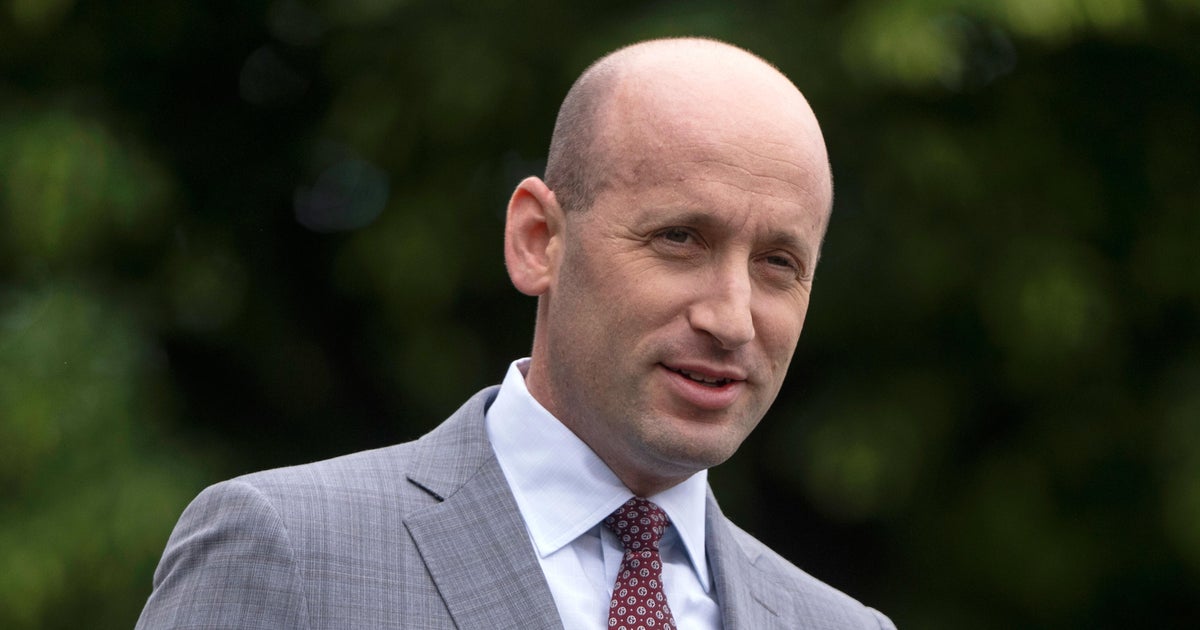
White House homeland security adviser Stephen Miller spoke at a training conference for counterterrorism agents at FBI headquarters just over a week ago, days before prosecutors criminally charged a man with making disturbing calls and texts to his wife, Katie, multiple sources told CBS News.
Former Justice Department officials called the visit unusual, given the historical norm of insulating federal criminal investigations from political officials. The administration and FBI have said Miller’s visit was appropriate, pointing to his role at the White House and the administration’s broader focus on cracking down on political violence.
Miller told the agents that President Trump’s initiative to counter domestic terrorism was personal to him, citing the 2025 assassination of his friend, conservative Turning Point USA founder Charlie Kirk, according to a source who was briefed on the meeting and a senior FBI official.
In his comments, Miller spoke about the need for federal law enforcement agents to be more proactive in investigating threat cases and told them that no case is too small, whether the threats are directed toward a congressman, a spouse, friends, loved ones or a speaker at a college campus, the senior FBI official said.
The FBI official said that Miller’s remarks reflect a broader push by federal law enforcement to try to get out ahead of mass-casualty events by stepping up investigations into cases involving threats and harassment because those crimes can be precursors to violence.
The training on Tuesday of last week was attended by FBI assistant special agents in charge who specialize in counterterrorism, as well as officials from other law enforcement agencies, including IRS Criminal Investigation, Homeland Security Investigations and the U.S. Secret Service, multiple sources added.
A White House official said that Miller’s presence at the training was appropriate, given his role as homeland security adviser. In that capacity, he is tasked with carrying out Mr. Trump’s executive order on countering domestic terrorism and political violence.
“As Homeland Security Advisor, Stephen Miller interacts with all law-enforcement agencies on a regular basis related to public safety, national security, and counterterrorism,” a White House spokesperson told CBS News.
She added that Miller is tasked with carrying out the president’s executive order to “investigate, disrupt, and dismantle all stages of organized political violence and domestic terrorism.”
An FBI spokesperson called the executive order “a critical directive for this FBI’s work to combat domestic terrorism and political violence threats all across the country.”
“Stephen Miller has been a valued partner in this work – and the conference was thrilled to have him be a part of discussing the important priority,” the spokesperson said.
But multiple former Justice Department officials told CBS News that his participation at an FBI training conference is not customary, and runs afoul of the post-Watergate norms that historically insulated the Justice Department’s criminal investigations from political interference by the White House.
His appearance at the event is also unusual because he is an alleged victim and potential witness in the Boston-area case involving the man accused of cyber-stalking Katie Miller, they said.
That role is further complicated by the fact that Miller and his wife have repeatedly asked the FBI’s Washington Field Office to investigate political activists and others they allege have threatened or harassed them. In an unrelated case last year, Stephen Miller asked the bureau to allow agents to go undercover in his Virginia neighborhood’s political activist group, several sources with knowledge of the matter told CBS News.
“Politically well-connected people who are related to victims do not have a right to jawbone FBI supervisors to do what they want them to do, and if they are political and throwing around their political connections, it’s even worse,” said Jeffrey Breinholt, a longtime former counterterrorism prosecutor at the Justice Department who frequently provided training to FBI agents.
In the days leading up to Miller’s appearance as a guest speaker at the terrorism training session, the two most senior counterterrorism agents in the FBI’s Washington Field Office were transferred to other roles by its leader, Darren Cox, after the Miller family complained the agents were not moving swiftly enough on an investigation into a man in Massachusetts who was allegedly sending taunting texts and voicemails, sources told CBS News.
Their removal was first reported by Bloomberg Law.
Two days after Stephen Miller made his presentation, the U.S. Attorney’s Office in Boston charged John A. Proia with one count of cyberstalking Katie Miller and her family. Proia has pleaded not guilty.
White House officials have said that the Millers did not speak directly to the agents who were reassigned, nor did they ask for the personnel change.
A White House spokesperson said that senior FBI leadership determined the agents were “stifling investigations into very serious threats and made a unilateral decision to remove them.”
In a statement provided by the FBI, Cox said: “This was a personnel decision made at the Washington field office level alone based on our constant evaluation of mission needs. Any suggestion otherwise is false.”
Chris Raia, the deputy director at the FBI, said in a statement that the personnel decision was based on “a number of factors” that have not been reflected in the media’s reporting on the incident.
Asked about investigations related to the Millers, an FBI spokesperson said the bureau “pursued these cases based on appropriate predicate and evidence of alleged crimes — not because the White House ordered an investigation.”
The Boston case is at least the second one that the Millers pressed the FBI to bring related to alleged acts of harassment or alleged threats.
Last fall, Stephen and Katie Miller asked Virginia state officials and the FBI to investigate local Arlington political activist Barbara Wien after she protested outside their home and distributed flyers containing their address, prompting the Millers to move into military housing.
The federal case hit roadblocks after a magistrate judge twice rejected a search warrant, CBS News previously reported. But Miller repeatedly pressured the Justice Department to act, asking FBI counterterrorism agents to go undercover and regularly calling the U.S. Attorney’s Office in the Eastern District of Virginia for updates, sources with knowledge said.
As recently as December, FBI agents were interviewing Wien’s neighbors and acquaintances, despite not being able to obtain a warrant to search her phone. CBS News could not determine the status of the investigation, which remained open as recently as this summer, one of the sources said.
The state prosecutor who was investigating the case, Arlington and Falls Church Commonwealth Attorney Parisa Dehghani-Tafti, formally declined to bring charges earlier this year, writing in a court filing that “nothing in the proceeds of the search warrant supports criminal prosecution.”
Her office is the same one that is prosecuting Colin DeMarco, who was arrested earlier this year on state charges of attempting to murder Office of Management and Budget Director Russell Vought.
Her office brought the case after federal prosecutors in the Eastern District of Virginia declined to bring federal charges, sources told CBS News.
The training at FBI headquarters was centered on an executive order issued by the White House last fall known as “National Security Presidential Memorandum-7.”
That order called on the FBI-led Joint Terrorism Task Force to coordinate a national strategy for combating domestic terrorism and political violence. It also tasked the attorney general with prioritizing such cases.
While there is no formal domestic terrorism statute, the Justice Department has historically used a variety of other criminal laws to charge violent extremists and pursued terrorism enhancements at sentencing.
Some types of charges, such as providing material support to terrorists or civil disorder, require consultation or approval by the National Security Division.
In December, then-Attorney General Pam Bondi issued a memo to prosecutors and law enforcement that broadened the scope of the kinds of crimes that might be pursued as domestic terrorism cases, such as doxxing members of law enforcement or parading with the intent to obstruct the administration of justice.
The memo also made it clear that law enforcement should focus on people with “extreme viewpoints on immigration, radical gender ideology, and anti-American sentiment” who are willing to commit acts of violence.
The cyberstalking law that Proia is charged with violating — 18 USC 2261A(2)(B) — is not considered a statute that is associated with terrorism-related offenses or that requires any sign-off from the Justice Department’s National Security Division before a case can be brought.
However, it has been used in the past in connection with some national security cases involving harassment targeting public officials.
Although the executive order was sparked by Kirk’s killing, numerous law enforcement officials have told CBS News that there is a heightened threat environment more generally.
In addition to the multiple assassination attempts targeting Mr. Trump in recent years, numerous senior government officials continue to receive credible and pervasive threats.
Both Vought and Health and Human Services Secretary Robert F. Kennedy Jr. have 24/7 security details due to the frequent and credible threats they receive, sources with direct knowledge told CBS News.
Bondi, meanwhile, still maintains a 12-agent detail seven days a week despite having left the Justice Department months ago, a source with direct knowledge said.
The largest percentage of the threats directed toward her relate to the Justice Department’s handling of the Jeffrey Epstein case, the source added.
A senior FBI official stressed that the bureau is not only focused on threats cases involving Trump administration officials, but also cases targeting others as well, such as a recent arrest in San Antonio of a man who is accused of threatening the Texas State Capitol because of anger he felt toward the American Israel Public Affairs Committee.
Although the White House suggested that Miller’s speech at the FBI training was not unusual because of his homeland security position, his interactions with the FBI and Justice Department extend beyond issues of counterterrorism.
Last year, after Mr. Trump announced a violent crime crackdown in Washington, D.C. and ordered the National Guard and federal law enforcement to patrol the streets, Miller and White House Deputy Homeland Security Advisor Tony Salisbury both appeared at an FBI command post together.
A similar violent crime crackdown was later expanded to Memphis as well.
Since both initiatives took effect, Miller has been holding monthly meetings with the heads of the Justice Department’s law enforcement components and special agents in charge in those cities — including the FBI, the U.S. Marshals Service, and the Bureau of Alcohol, Tobacco, Firearms and Explosives, sources with direct knowledge say.
Miller is also in touch multiple times a week with the Deputy Attorney General’s office to discuss fraud and immigration cases, according to sources with direct knowledge of the matter.
In a lawsuit filed last year by former top FBI officials who alleged they were unlawfully terminated, they claim that Stephen Miller was pressuring the Deputy Attorney General’s office to take “symmetrical action at the FBI as had been happening at DOJ” by firing, re-assigning or removing staff who worked on matters that displeased Mr. Trump.
Multiple former Justice Department and FBI officials told CBS News they could not recall any other time in history where a White House official has had such frequent and direct contact with agents and prosecutors at the Justice Department the way Miller has.
One former official who has worked in senior positions at both the White House and Justice Department told CBS News that there was so much concern about the appearance of compromising the bureau’s independence that in-depth discussions took place before a president visited FBI headquarters.
In addition to a few rare instances where presidents have directly addressed the FBI staff, such as President George W. Bush’s address to thank them for their work on the 9/11 investigation, the only other examples people could recall included when President Barack Obama used the basketball court at the FBI’s headquarters and when Bush went biking at Quantico.
“Stephen Miller’s presence at FBI headquarters, including his speech, is a violation of an important norm,” said James Davidson, a former FBI agent who now serves as president of the nonprofit FBI Integrity Project.
“The White House should have little official contact with FBI executive management and virtually no contact with FBI middle management regarding official matters or investigations — especially one in which he and his wife are victims.”

