

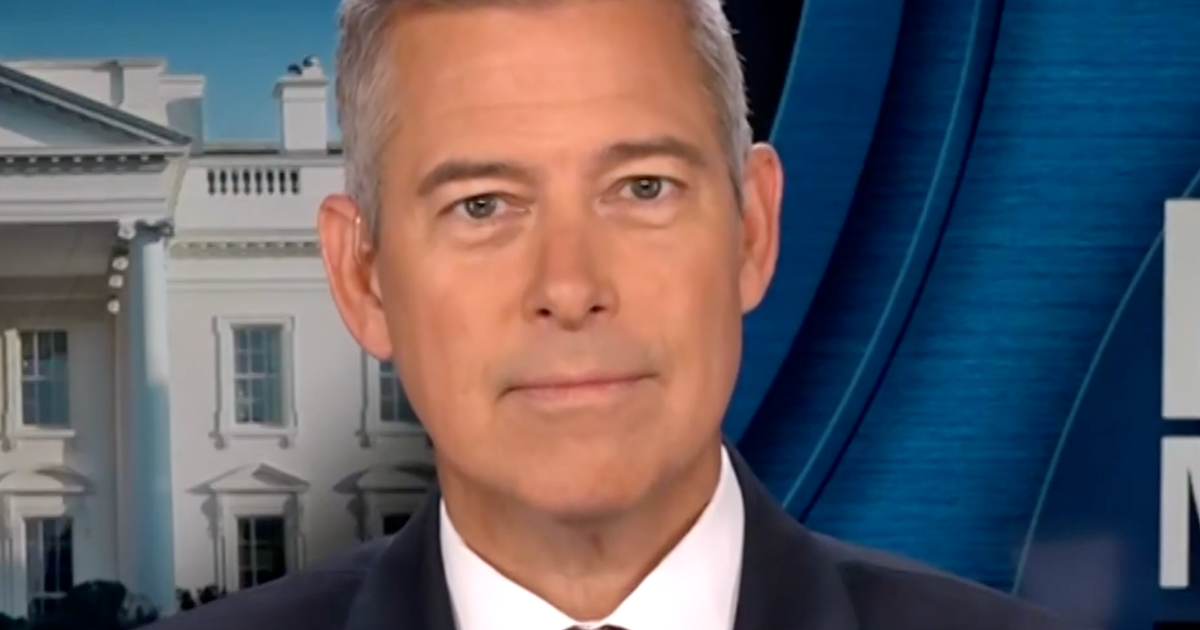
The following is the transcript of the interview with Transportation Secretary Sean Duffy that aired on “Face the Nation with Margaret Brennan” on Nov. 15, 2026.
MARGARET BRENNAN: For more, we go now to the Secretary of Transportation Sean Duffy. Good morning to you, Mr. Secretary. Will the country be back to fully operational with a full flight schedule by the end of today?
SEC. SEAN DUFFY: So we have some delays in the airspace right now, but as we look to the end of the day and into tomorrow, we should be running at full capacity. What happens with a ground stop, like on Friday, we have airplanes and crews that are out of position, so it takes a little bit of time for the airlines to get back and choreographed and at full capacity and operations, but we’re well on our way.
MARGARET BRENNAN: So I know that there was a router in El Dorado, Arkansas, as I understand it, that became an issue on Friday. You said on another network this morning there was a second issue at a radar site in Amarillo, Texas. Are those two things related? And if so, why did they both become problems on Friday?
SEC. DUFFY: Yeah, so the- the Amarillo facility- that work had been done weeks ago, and so why- when we did the install in El Dorado, did that start to broadcast data into our network? But then also the- the facility in Amarillo- why did that happen? We’re investigating that right now. We actually have both routers with L3Harris, who operates and owns our network. FAA is on site as well. FBI is offering support. We’re looking at that right now, and when we know what the root cause of this issue was- was it- was it the install from L3Harris? Was it the router? I’m going to tell you and the American people what we find.
MARGARET BRENNAN: So, was the issue old infrastructure or was it new equipment?
SEC. DUFFY: So first off, the- the- the telecom in El Dorado, it was an old copper wire that basically was- it was going to be decommissioned. They said it can’t be used anymore. So we were forced by the telecom provider to actually update that copper to fiber, and we brought in our routers and did the work, and that’s when we saw the- the flooding of the network. So this was- this is part of our maintenance that we do on this really old architecture of a telecom network that was- I mean, this goes back decades. By the way, the rest of the world, every institution, every company, not just in the U.S. but around the world, they’ve all switched over to digital and fiber. It’s just the FAA is still using this really old telecom network that has to be updated, upgraded, and I think built brand new.
MARGARET BRENNAN: So the union that represents aviation safety specialists, PASS, as they’re called, said the issue was isolated to two contractor-owned and maintained routers that were being updated in the middle of the day, and they said their technicians were not involved in the upgrades. So I wonder, did the FAA do a risk assessment in advance and know that something like this was- happened, or were you totally caught off guard?
SEC. DUFFY: So let’s be clear, the union that works at the FAA, they’ll do the work on the radios- our equipment, or the radar- our equipment. They do all of the work on FAA-owned equipment. This union doesn’t do any work on telecom, and it’s our telecom contractor and providers like L3Harris in this situation. They’re the ones that actually do the work. So the FAA lets L3Harris into our- into our sites, and then L3Harris will do the telecom work. But our- this union only works on our equipment. This telecom is not our- is- that’s not our equipment. It’s L3Harris’s network. So just to clarify that, this- this was done appropriately, which by the way, it’s been done thousands of times by us, by others, and other companies. This has never happened, and so that’s why when you have a remote location like this, we felt comfortable doing it in the middle of the day because it’s been done thousands of times. We’ve never had this situation. We’re going to have to reevaluate now when we do this work. Now, normally, if you have a big facility, a Newark or an Atlanta or an LA, we have work to do, we do that at night, but in a remote location, we can do it during the day because the risk historically has been very low. Obviously, on Friday we saw no, it flooded our network, and we had to take the extraordinary step of issuing a ground stop.
MARGARET BRENNAN: So there was not a risk assessment, or there was a risk assessment, and this was just not foreseen as an issue?
SEC. DUFFY: Oh no, no- listen, we do risk assessments on everything, right? And if you want to talk about a risk assessment, the GAO has done a risk assessment on my network, on all of the old equipment, and they’ll say, “Hey, this is- this is risky America. Make the investments and fix American air traffic control systems.” And by the way, the Congress gave me $12.5 billion dollars.
MARGARET BRENNAN: Yes.
SEC. DUFFY: I’ve- I’ve got ordered new radar, new radios, new voice switches. We’re doing all of that, but it’s also risky to say we’re operating on a 1980s network with copper wires. So we’ve done a risk assessment- assessment: How do you switch over from copper to fiber? We keep airplanes safe in the sky. That’s our number one priority. We’ve done that, and which is why it’s worked thousands of times when we’ve made the switch over.
MARGARET BRENNAN: Well, when–
SEC. DUFFY: –this time it- it didn’t- and the- go ahead.
MARGARET BRENNAN: Yeah. So you just mentioned the- the Government Accountability Office. They also, in a September report, concluded that there is a push to modernize quickly, and that the FAA is buying delivery speed at the risk of cost uncertainty and potential disruptions. So, should you have seen this coming?
SEC. DUFFY: Well, first off, with regard to the GAO, my number one priority is safety, which is why we shut down the airspace on Friday, right? We did the closure–
MARGARET BRENNAN: They’re saying speed.
SEC. DUFFY: No, I’m going to get to that. But I want to make sure that- that Americans get from point A to point B safely. They get back to their loved ones. I want them to be on time, but I want them to be safe, which is why we issued the ground stop. In regard to speed, we are going I think at the- at the right speed, we- we have to get off old network, old telecom. By the way, that’s why I’ve already switched over 70 percent of copper to fiber without incident, without issue. Almost 470 radios have been switched over. New- new- new electronic flight strips and towers. We’re doing incredible work, and just- let’s be clear about one thing.
MARGARET BRENNAN: Yeah.
SEC. DUFFY: For decades, this work in the FAA has not been done. It hasn’t been done because it’s hard. I don’t want to be dishonest. It’s a hard problem to solve. The Trump administration, with my leadership, we are solving the problem. We’re building and deploying new technology. One of the problems I have is I need more money to- to build a new–
MARGARET BRENNAN: Yeah.
SEC. DUFFY: –telecom network. I need new software, but we’re doing the right thing by- by way of the American people by fixing this really really old system that was left to us.
MARGARET BRENNAN: But respectfully, the American people have put a lot of money into infrastructure upgrades. In 2021, it was $25 billion for upgrades under Biden. Under your administration, the Trump administration, as you just said, $12.5 billion for upgrades. Democrats say the lion’s share of the money that was provided to you- you just have not obligated or spent. Why? And if the White House has allowed for reprogramming of funds, why do you keep saying Congress is stopping you from spending the money they’re giving you?
SEC. DUFFY: So first off, there was a lot of money that was given to the FAA in the past, and I can’t answer for other secretaries or other FAA administrators. A lot of money was given, not a lot of work was done. So when I asked for a massive amount of money to fix the system, what the Congress did is they said, “Okay, we’ll give you a partial funding, $12.5 billion dollars,” in One, Big Beautiful Bill. And they were very specific in how we spend it. Now I can’t- I can’t go buy radar off the shelf. This is a massive order. So we’ve asked those who won the contract, I want them to build the radar in America. They’ll start to deliver those radar to us in the spring. All of them will be deployed by the end of 2028. So all that money hasn’t been spent, but it’s been obligated to radar. Radio is the same thing. I’m buying radios, but they’re not on the shelf. They have to be built. They specifically said how I spend the money, and I’ve- and I’ve got it all spent, ready to be deployed by the end of the- the president’s tenure in office. But what I don’t have money for is a new telecom system. I don’t have money for new software. Those- those are critical pieces to the infrastructure, and it’s been historically underinvested in. I’m making the case to the American people and the Congress. For the first time, the FAA is taking your money, and we’re actually building with your money. Let me continue. Let’s finish the job. Let’s not see what happened on Friday. Let’s not let it happen again
MARGARET BRENNAN: Is $50 billion the total ask?–
SEC. DUFFY: Let’s make sure we keep the American people safe- yeah, $50 billion.
MARGARET BRENNAN: All right, Mr. Secretary. I’m told you have to get to another network. Thank you for your time this morning. ‘Face the Nation’ will be back in one minute. Stay with us.

