

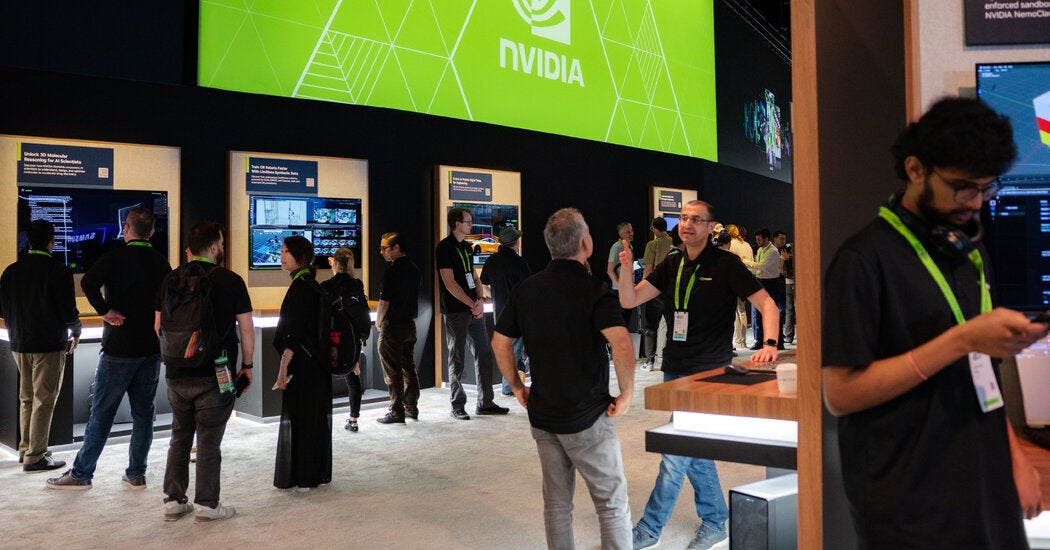
A week ago, we learned the news that Jensen Huang, the rock star C.E.O. of the chip-making company Nvidia, had acknowledged an affair with a woman U.S. intelligence officials believe to be a Chinese spy. It turns out that may have been just the beginning. Shortly after revelations of a second affair, this time with a subordinate, Huang resigned.
Nvidia’s stock has tumbled in the days since, losing hundreds of billions of dollars in value, and analysts have begun trying to process just how the downfall of one of the most important figures in the A.I. industry is going to play out. One Silicon Valley venture capitalist recently called him “irreplaceable.”
But why are Huang and Nvidia so irreplaceable — and is anything that cannot be replaced automatically vulnerable? Today I’m writing about power, vulnerability and choke points.
Why there’s only one Nvidia
Last week, as it became clear that Jensen Huang’s future at Nvidia might be in jeopardy, a meme began making the rounds on the internet. It showed a complicated, multitiered structure, delicately balanced on a tiny block. The structure was labeled “entire global economy”; the block was labeled “Jensen Huang’s wife.”
The meme is already outdated: Huang has resigned from his role as Nvidia’s C.E.O. (and it never made sense to put any of this on his wife). But the image still captured the idea that so much of the business world somehow came to depend on one man and his — now, it seems, questionable — judgment.
Just as there is no clear successor to Huang at Nvidia — as my colleagues have written, he actively avoided grooming one — there is currently no real substitute for Nvidia itself. It is arguably the most important company in the most important industry in the world. It’s also vital to the U.S. economy and American national security.
Which raises the question: With the stakes this high, why were so many chips in one basket? Why isn’t there another Nvidia?
A big head start
It’s hard to overstate Nvidia’s importance.
The company controls an estimated 90 percent of the market for the chips used in the big A.I. projects that are driving the U.S. economy. When you talk to, for example, ChatGPT, its computer chips in A.I. data centers are what make it talk back.
Outside the United States? More Nvidia chips. Even Chinese labs, which are barred from buying the most advanced models, often use earlier versions.
Competition? It has very little. Tech giants like Google and Amazon have made chips that have saved them some money and reduced their dependence on Nvidia. A longtime rival, Advanced Micro Devices, has also grabbed a share of the market, as have some start-ups. But companies keep coming back for Nvidia chips.
I spoke to Don Clark, who has been covering chips for over four decades, including for The New York Times. He told me that the story of Nvidia’s stunning dominance is largely thanks to the savvy and the foresight of … Jensen Huang.
Huang spotted the potential of A.I. early on, and pivoted a decade before any other chip makers did. That head start allowed Nvidia to build up layers of widely used software and specialized models needed for A.I., which require Nvidia chips to run.
And Nvidia isn’t just the world’s dominant chip maker. It is also what some have called the “central bank of A.I.” It has helped to finance the industry’s growth through a series of complex deals with its customers and suppliers — and it’s not clear any other company is ready to step in and fill that gap.
With great power comes great exposure
Nvidia has long been a crucial American asset. Its chips have given the United States a strategic advantage over China. The company has allowed the U.S. to exercise control — to some degree, anyway — over who has access to these chips and, specifically, to prevent China from obtaining its most advanced models. To use a term that’s become increasingly important, Nvidia is a choke point.
Nvidia isn’t the only choke point in A.I.; the industry is replete with them. Nvidia designs the chips, which are then manufactured by one Taiwan-based company, TSMC. TSMC, in turn, depends on manufacturing tools produced by one Dutch company, ASML.
I spoke to Edward Fishman, who recently wrote a book called “Chokepoints: American Power in the Age of Economic Warfare.” He described a manufacturing ecosystem of “exquisite” complexity with “so many different sub-components that even the sub-components themselves can become their own choke points.”
But the Huang affair has crystallized something important. Choke points offer strategic advantages; they can also become vulnerabilities.
For China, Fishman said, compromising Nvidia could “weaken the leverage of the U.S. in this industry, and maybe even have a macro impact on the U.S. economy.”
Roughly half of economic growth in the U.S. last year was powered by the A.I. boom. Roughly a third of America’s total stock market value comes from big A.I. companies. And even after its recent decline, Nvidia still accounts for roughly a quarter of the value of those A.I. stocks.
Nvidia’s dominant position is not going to disappear overnight. Its next three years of chip production are already largely under contract and won’t be affected much by Huang’s departure, Don said. But further down the line, his absence might be felt more. The company is also likely to continue facing scrutiny from Congress, which is still pushing for answers, despite Huang’s departure, and could even face legal risks.
Nvidia will get another C.E.O., Don said. An interim one is in place already. But “there won’t be another Jensen Huang,” he added. “It’s just like there’s not another Steve Jobs. He’s one of a kind.”
Which is why things suddenly feel so wobbly.
The latest:
-
Huang’s resignation shocked people in Taiwan, his birthplace, where he is called “the people’s dad.”
-
Huang concealed the nature of his relationship with an executive at the tech firm Megaspeed for months. Read how it eventually led to his downfall.
-
Megaspeed said that the executive, Alice Huang, left the company in August 2025.
-
Our White House correspondent Maggie Haberman explains in the video below what’s behind the close relationship between Huang and President Trump.
MORE TOP NEWS
Iran attacks Bahrain
Iran launched a drone attack against Bahrain yesterday for the second time in days. The Islamic Revolutionary Guards Corps said that Iranian forces had targeted a radar system at a Bahraini air base.
The attack occurred just as the U.S. appeared to have stepped back from efforts to reach a peace deal with Iran. The U.S. military said it shot down two drones fired by Iran toward Bahrain on Friday. The attacks were the first to target Bahrain in about two months.
Related: Officials believe Iran or its proxies are behind a number of cyberattacks and attempted attacks across Europe.
It’s rare for male mammals to participate in parental care. So when a marine biologist noticed Franciscana dolphins minding calves off Brazil, he was astonished. He and his team recorded males babysitting nearly 300 times in a year and a half. What could explain the behavior? “A potential reason is that they’re trying to impress the females,” one scientist said. “‘I’m a nice guy, wouldn’t you like to mate with me?’ kind of thing.”
When my colleague Jason Horowitz first moved to Rome in the 1990s, he said it felt as if he was living in the past. But as it turns out, the land of the past was pointing to the future.
When Silvio Berlusconi invited the far right to help him govern, he created a blueprint for the rise of nationalist movements in France, Germany, Britain and beyond. Read more about how Italy’s past became Europe’s present.
A jungle trek to a World War II site
Isoroku Yamamoto, the Japanese admiral and mastermind of the Pearl Harbor attack, died in 1943 on Bougainville Island, Papua New Guinea, after American fighters shot down his plane.
The wreck of Yamamoto’s Mitsubishi G4M1 — a Betty, as that type of plane was code-named by the Allies during World War II — has remained deep in the jungle for some 80 years. Visiting the site is not for the faint of heart. Machetes prove handy. Yet war history buffs, Japanese pilgrims and, lately, YouTubers have made the journey. So did my colleague Victoria Kim.
RECOMMENDATIONS
Gaze: A French designer’s home in Marseille is filled with bright ideas.
Read: “Rome’s Age of Revolution” looks at how the Roman Empire made Christianity what it is today.
Strut: A 1970s-inflected fashion brand has men thinking about how to dress sexy.
Train: These are the five muscles experts say you need to strengthen as you age.
RECIPE
If you haven’t tried Iranian nargesi esfenaj, a sauté of spinach and eggs, you might underestimate its deliciousness. The undercurrent of garlic, softened onions and turmeric transforms simple ingredients into a meal that tastes lavish.

