

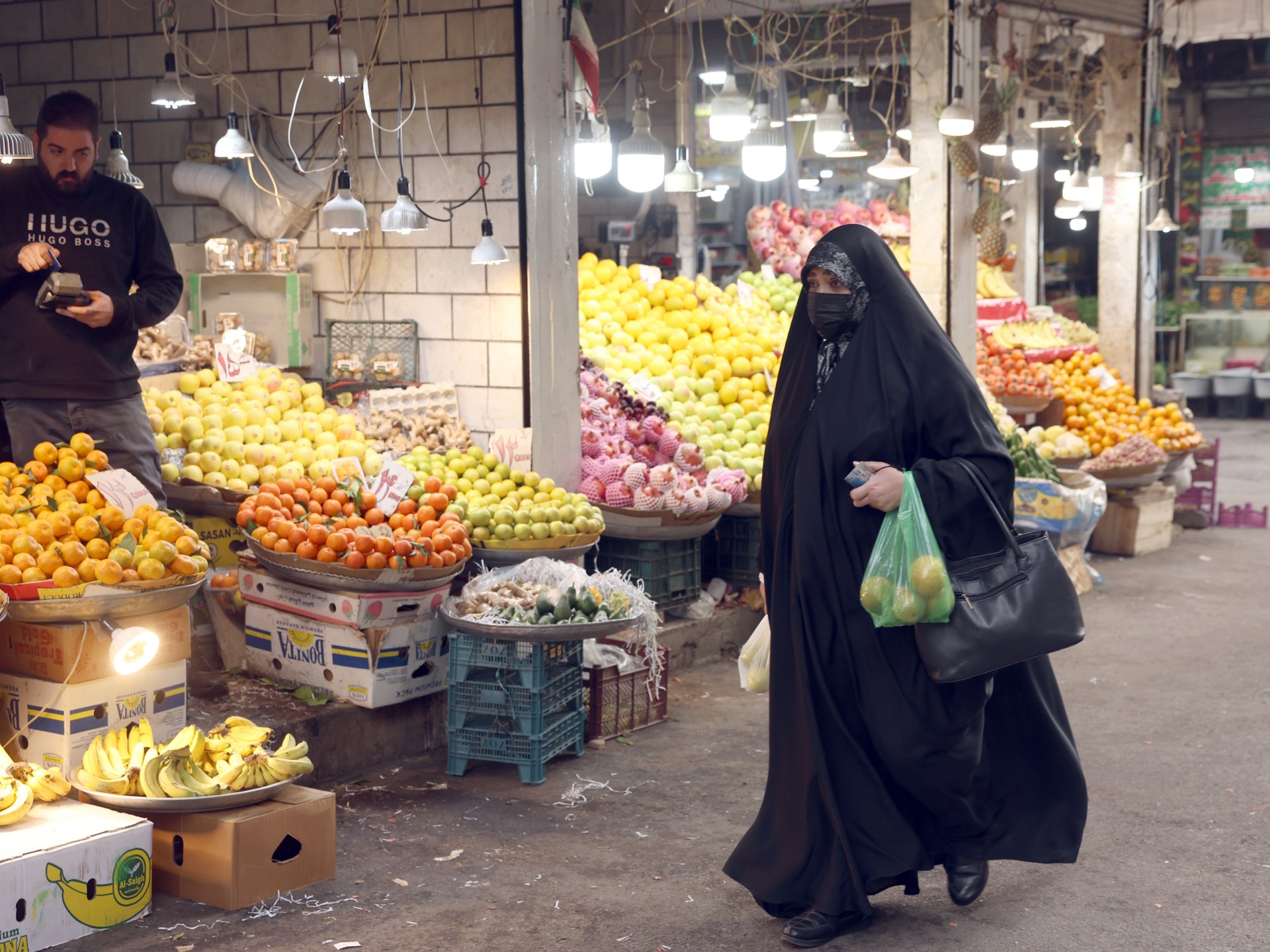
Tehran, Iran – Iran’s economy is expected to contract further due to the ongoing blockade of its ports by the United States, inflicting pain on tens of millions of Iranians. But experts say it is too early to tell whether Washington’s economic embargo on Tehran is having the desired outcome of either collapsing the Iranian government or forcing it to concede to US demands.
The US believes its naval blockade on Iran, overland trade disruptions and sanctions – part of its maximum pressure campaign on Tehran – are working. The US has also brought a third aircraft carrier into the region to support a potential military escalation, in what appears to be an attempt to force Tehran to capitulate further to its demands.
Recommended Stories
list of 3 itemsend of list
After a deadlock in the US-Israel war on Iran, which began with strikes that killed Iranian Supreme Leader Ayatollah Ali Khamenei on February 28, Washington has demanded Tehran reopen the Strait of Hormuz and curb its nuclear programme.
However, Iranian authorities insist they can withstand the economic pressure and have put forward their demands. Strikes on US interests in the region this week, including radar systems in Bahrain, have been viewed as a defiant response to the US military and economic pressure. But there are signs that the country’s economy and common Iranians are suffering from the current conditions.
Tehran-based economist Peyman Molavi said if current conditions persist, Iran’s inflation could rise considerably over the coming months.
“This will impact parallel markets like foreign currencies, gold, the stock market and housing,” he told Al Jazeera. “But it will unfortunately have the largest impact on the commodities market, from energy to agricultural products, metals, and industrial products.”
For decades, Iran’s governments have increasingly plugged their budget deficits by printing more money, which has saddled the country with a growing money supply, feeding chronic inflation. The foreign currency crunch from disrupted oil exports due to the US military blockade has only exacerbated the situation.
Molavi estimates that the year-on-year growth of the money supply in Iran could rise to 55-60 percent from its current figure of nearly 51 percent by the end of the Persian year in late March. Paired with negative economic growth, he said annual inflation could grow to about 85 percent, and point-to-point inflation to 100 percent.

‘Count your chickens’
Iranian Central Bank Governor Abdolnaser Hemmati hit back at US Treasury Secretary Scott Bessent, who has led Washington’s sanctions regime against Tehran.
“Like I said, he must still count his chickens at the end of autumn before moving to winter,” he said in reference to an Iranian proverb – “It’s too early to talk about winter”.
Bessent has claimed the economic embargo will result in a 25 percent contraction of the Iranian economy by the year ending March 2027. Iran’s official figures indicated that the country’s gross domestic product (GDP) shrank by 10.1 percent year-on-year between March 21 and June 20, the first quarter of the Persian calendar year.
Hemmati said the central bank has secured $30bn in foreign currencies to weather the pressure over the coming months, prioritising procurement of essential goods for its citizens.
“American officials believe they can achieve their goals through threats and raise something new each time; from the possibility of collapse to military threats and intensified economic pressure,” Economy Minister Ali Madanizadeh said on Sunday.
All overland routes to and from Iran, except for one with Iraq that was closed due to security reasons, remain open despite the US efforts to isolate Iran from its neighbours, Madanizadeh insisted.
For the seventh Iranian month of Mehr that ended on October 22, the 12-month average annual inflation was at 76.8 percent, according to the Statistical Centre of Iran. Point-to-point inflation, which compares just that month with the same month of the previous year, was at 88.7 percent.
Essential goods have already been experiencing triple-digit inflation for months, with the category of food, beverages and tobacco experiencing year-on-year inflation of 113.4 percent in October, the centre said.
Iranian social media is increasingly filled with personal stories of how most people in the country of about 90 million are rapidly losing their purchasing power.
“Everywhere you look, you could have bought the same commodity with one-fifth of the money last year,” one user wrote on X. “That’s no joke, millions of people have been crushed in between.”
Markets suffer
Saleh, a 37-year-old shopkeeper at Tehran’s Grand Bazaar who deals in electric motors for small industrial units, said both domestic and Chinese-made goods can still readily be found in the market. But supply and demand have decreased since US sanctions began to bite.
“The reason is that commodities are expensive, and there’s been a stagnation in the market and also uncertainty over what will happen next,” he told Al Jazeera, asking not to use his full name due to security reasons.
“Everyone’s looking at the dollar price, and manufacturers and clients are making their decisions based on price changes. If we sold 10 items before, now we’re selling three or four, but the price increase maintained some profit. I don’t see the market being near collapse, but there’s less business.”
Companies with an established client base are proving more resilient, he added.
Bessent hailed what is happening in Iran as “one of the fastest collapses in history”, and described the Trump-directed sanctions campaign against Iran as “the greatest economic isolation in the history of the world against a single country”.
He also compared the situation in Iran with the period preceding the fall of the Soviet Union in 1991, saying the country’s economy had shrunk 22 percent over three years before the union collapsed.
Economist Molavi said the comparison may not necessarily translate into immediate economic collapse for Iran as they have fundamentally different economic models.
But he pointed out that Iran’s nominal GDP has fallen from $645bn in 2012 to about $300bn now and that it could decline further if the sanctions continue.
“With the current [level] of underinvestment, halted oil sales, disrupted exports and the sense of suspension in the economy, our economic growth will become even more negative,” he said.

