



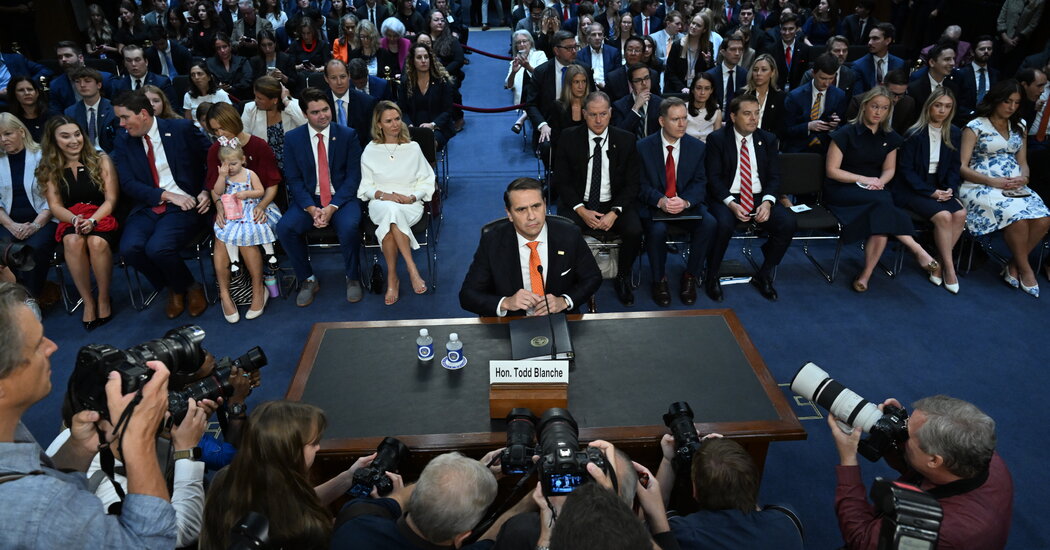
The fate of Todd Blanche’s nomination as attorney general remained uncertain on Wednesday after a rocky confirmation hearing in which a Republican senator raised serious questions about his role in creating a $1.8 billion fund for purported victims of Justice Department persecution.
The senator, John Cornyn of Texas, who was defeated by a Trump-backed opponent in a primary election, grilled Mr. Blanche about the fund and a related agreement granting President Trump and his family sweeping immunity from tax investigations.
Mr. Cornyn, a former judge, displayed text of the tax provision on a poster behind him and noted that Mr. Trump “has not agreed in writing” to nixing the fund.
After the hearing, he said he had not made up his mind. “I don’t have to make a decision now, so I’m not,” he said during a brief interview at the Capitol.
Even a single Republican “no” vote on the Judiciary Committee would block Mr. Blanche’s nomination from consideration by the full Senate, which could sink his confirmation. A second lame-duck Republican on the committee, Senator Thom Tillis of North Carolina, is also undecided but has said he is leaning toward voting “yes.”
Mr. Blanche’s confirmation is somewhat symbolic. He could serve in an acting capacity for the remainder of Mr. Trump’s term. But the referendum on Mr. Blanche is in a broader sense one on the president’s vision of the department as a projection of his power and extension of his will.
The unusual two-part deal approved by Mr. Blanche, intended to resolve Mr. Trump’s lawsuit demanding at least $10 billion from the Internal Revenue Service over the leak of his tax returns, emerged as a major issue in a confirmation already clouded by questions about Mr. Blanche. As a top Justice Department official, he has had a role in protecting the president’s interests in the Jeffrey Epstein case and complying with Trump-ordered investigations of political opponents.
It is not clear when the committee will schedule a vote. First, Republicans must find a replacement for Senator Lindsey Graham, the South Carolina Republican whose death over the weekend cast a shadow on the proceedings.
Mr. Blanche, a former Trump defense lawyer, has served as acting attorney general since the president fired his predecessor, Pam Bondi, in April for not moving quickly enough to prosecute his perceived enemies.
Defying a president’s choice for such an important position would be an extraordinary gesture of defiance, even from a senator, like Mr. Cornyn, on his way out.
Justice Department officials have expressed confidence that Mr. Blanche will, ultimately, have the votes in the committee and the Senate at large. After he concluded his appearance, he walked back to a legislative conference room where the din of cheers and applause could be heard through an open door.
It would be the capstone of a career that a few years ago seemed destined to be confined to the middle rungs of the New York-area legal community.
Before joining the president’s legal team a few years ago, Mr. Blanche earned a reputation as a highly competent federal prosecutor in the Manhattan U.S. attorney’s office. Democrats turned that perception against him.
Senator Adam B. Schiff, Democrat of California and a former federal prosecutor whom Mr. Trump has targeted for prosecution, accused Mr. Blanche of abandoning his ethical principles to serve his boss.
“What happened to the Todd Blanche who was a prosecutor in the Southern District of New York?” he asked. “What happened to the prosecutor people had respect for?”
Mr. Blanche, riled up, demanded the right to respond. “I am still here — I am the same exact person I was when I was a federal prosecutor,” he said, adding that his personal credo was “do the right thing, enforce the laws and put bad guys in jail.”
Mr. Blanche, typically a cautious and well-prepared congressional witness, made a significant unforced error that could fuel Democrats’ criticism of him as a Trump loyalist who has continued to act as the president’s personal lawyer in a post that requires a commitment to independence in the public interest.
Senator John Kennedy, a Louisiana Republican known for his folksy asides, asked Mr. Blanche what seemed to be a softball question: Did he consider the president to be his friend?
“I’m his lawyer,” Mr. Blanche replied, instantly correcting himself to add “was his lawyer.”
When Senator Chris Coons, a Delaware Democrat, asked Mr. Blanche whether Mr. Trump was eligible to run again in 2028, Mr. Blanche replied, “I don’t believe he is.”
Later, under questioning from a Democrat on the committee, Mr. Blanche maintained that he was unafraid to push back against Mr. Trump and prided himself on offering dispassionate legal counsel.
“Counsel does not mean yes-man,” said Mr. Blanche, craning forward in the witness chair in a dark navy suit.
Mr. Blanche put a bit of distance between himself and Mr. Trump on the issue of judicial impeachments. He said he did not believe that federal judges should be removed for issuing rulings against the president or the administration, a position counter to the one Mr. Trump has boisterously embraced.
Mr. Blanche said he personally authorized the subpoenas that the Trump administration issued to New York Times journalists over reporting on the insufficient defenses of an airplane donated by Qatar that was retrofitted to serve as Air Force One.
“We’re not targeting reporters — they’re material witnesses, just like a reporter would be a material witness to a car crash,” Mr. Blanche said, adding, “The question we want to ask them is who provided them with classified national security information.”
Mr. Blanche’s comments came in response to questions from Senator Peter Welch, Democrat of Vermont, who emphasized that it was “extremely important to protect the right of the press to have confidential sources.”
Senator Charles E. Grassley of Iowa, the committee chairman, sought to fend off criticism of Mr. Blanche in his opening statement, calling investigations of Mr. Trump during the Biden administration an attack on the rule of law.
Senator Richard J. Durbin, the top Democrat on the committee, cast Mr. Blanche as a partisan actor. He said the department had charged James B. Comey, the former F.B.I. director, “for taking pictures of seashells,” referring to an image of shells arranged on a beach as “86 47” that the Justice Department said constituted a threat against the president.
That elicited scattered laughter in the spectators gallery.
Mr. Blanche was pressed repeatedly on his views about Mr. Trump’s mass clemency for his supporters who attacked the Capitol on Jan. 6, 2021, a presidential action that Mr. Tillis has identified as a potential justification for voting “no” on the nomination.
He trod a gingerly path, dodging the question of his personal feelings about it, saying he was not “celebrating” pardons of about 200 violent rioters while asserting Mr. Trump’s right under the Constitution to pardon whomever he chose.
Mr. Blanche distanced himself from Jared Wise, a Jan. 6 rioter who served on Mr. Blanche’s staff before resigning this year, and whom Senator Sheldon Whitehouse, Democrat of Rhode Island, cited in his questioning. “I did not hire the person referenced,” Mr. Blanche said.
Mr. Blanche was, in general, less voluble and more decorous in his responses than Ms. Bondi, whose reliance on clunky, prepared attacks on Democrats contributed to her dismissal. But he did bare his teeth several times.
After Mr. Whitehouse asked how long he intended to “put up with that Kash Patel character” as F.B.I. director, citing reports of Mr. Patel’s lavish government-funded travel and the use of agents to guard his girlfriend, Mr. Blanche shot back with, “That’s an extraordinarily obnoxious question.”
He became particularly angered when Senator Cory Booker, Democrat of New Jersey, grilled him about arrests of Mr. Trump’s political adversaries, allegations of ethical impropriety regarding his public appearances and how he had handled aspects of the case against Ghislaine Maxwell, who was convicted of working with Jeffrey Epstein to sexually exploit underage girls.
“You can ask the questions, but you cannot control my answers,” Mr. Blanche said.
What made the hearing, with all its predictable partisan sniping, different was the acute and persistent questioning by Mr. Cornyn, who arrived in the Senate in 2002 — a year before Mr. Blanche graduated Brooklyn Law School, taking night classes while working as a paralegal.
Mr. Cornyn immediately zeroed in on Mr. Blanche’s refusal to put on paper claims that the $1.8 billion fund was dead, noting that Mr. Trump, as a plaintiff in the lawsuit, had also not signed any document saying it had been killed.
Mr. Tillis was notably less adversarial. But he echoed Mr. Cornyn’s concerns about the fund and said he wanted “to stick a fork in it” by passing a bill to kill it once and for all. Senate Republicans largely rejected a previous effort to use legislation to bar such taxpayer-funded payouts to Jan. 6 defendants and others.
He seemed reassured with the answers he got from Mr. Blanche, suggesting that some of his concerns about the department’s support of Jan. 6 rioters had been allayed.
“You’ve done a great job today,” Mr. Tillis said at the end of his questioning.
Mr. Cornyn also believed that Mr. Blanche did a good job. But he appeared skeptical about his capacity to balance the department’s needs with the president’s demands.
“It’s a very difficult position to be in, as I also said, to be the president’s personal lawyer and then to end up being a member of the cabinet,” he told reporters.
Karoun Demirjian, Andrew Duehren and Carl Hulse contributed reporting.

