



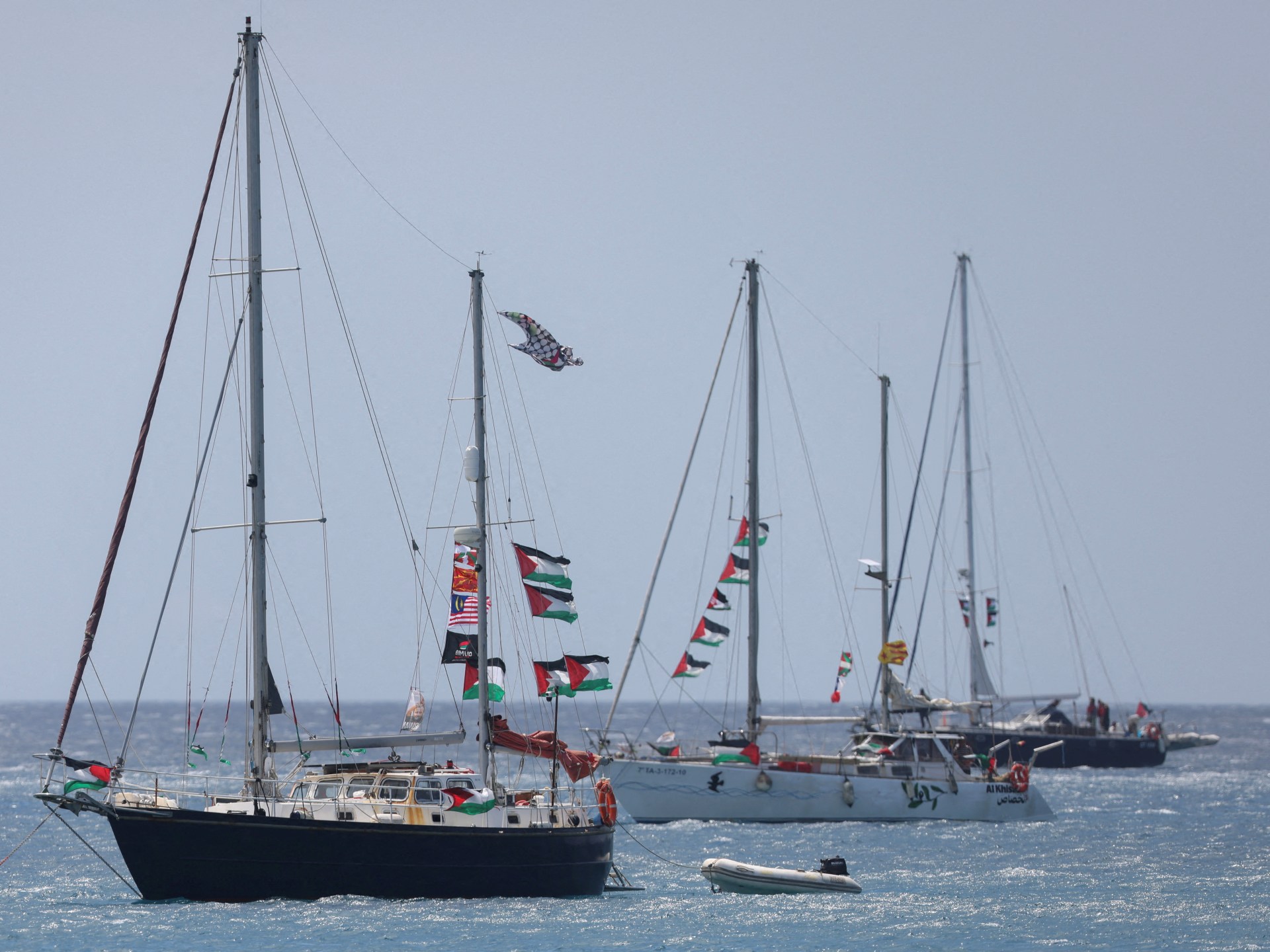
Imagine the following scenario: you are scheduled to board a sailing boat as part of a large fleet carrying humanitarian aid. Some boats in the fleet had already departed ahead of you, yet days before you are scheduled to join them, the boats are violently intercepted in international waters by a foreign power acting 600 nautical miles (1,100km) from its own coast in flagrant violation of international maritime laws.
At least 30 of your fellow sea travellers were injured, and at least four have since come forward to report incidents of sexual assault. Another two, Saif Abu Keshek and Thiago Ávila, were forcibly taken to Israel, where they faced terrorism charges and were beaten and tortured while in detention. Both undertook hunger strikes in protest until their release was announced.
Hand on heart, knowing all this, would you continue sailing? More so, would you expect the overwhelming majority of your fellow travellers to do so as well?
For the great majority of the remaining participants of the Global Sumud Flotilla (GSF) – those who have not been kidnapped at sea by the Israeli navy – the answers to these questions are clear: We are sailing on.
In defiance of Israel’s genocide, and in solidarity with the Palestinian people, our fleet is moving forward. Despite experiencing or being informed of the violent interception, we are en route to the Turkish port of Marmaris, where we will regroup. I am sailing on board one of the boats as I write this.
In their long history, Gaza flotillas have often been decried as performative, except, of course, they have yielded some very concrete results: back in October, despite being violently intercepted once again, the GSF mission contributed to the mounting pressure on Israel to accept a ceasefire, which was announced days after the violent interception.
The word “performative” should instead be applied to this “ceasefire”, during which the Israeli army has continued to massacre Palestinian men, women and children and deny them humanitarian aid in adequate quantities.
Each of our missions has helped further delegitimise the Israeli state’s genocidal and warmongering tactics. And this is true for this mission as well. Already, more than 600 nautical miles from Gaza’s shores and even before it had the opportunity to fully assemble, the flotilla managed to stir international debate when 22 of its vessels were targeted.
An array of geopolitical questions has arisen, and longstanding maritime sovereignty conventions have been challenged, evincing the violation of international law. Should the Greek coastguard not have responded to the distress signals issued within its search and rescue zone? Should they not have barred the Israeli naval prison-ship from leaving the Greek port of Ierapetra, Crete, given that they were already in possession of reports of the torture and beating of the international activists inside?
As our fleet now sails eastwards, it enters a contested maritime space: the decades-long Greek-Turkish dispute over Aegean jurisdiction, where overlapping claims to airspace, territorial waters and search-and-rescue zones have remained unresolved since the 1970s. Here, the question of who is responsible when a foreign navy operates in your waters becomes harder, not easier, to answer.
Despite all this, we sail on. What we still have with us is the unwavering desire and resolve to eventually make it to Gaza. What we are faced with is an Israeli state determined to create new facts at sea, just as it has spent decades creating new facts on the ground.
Illegal Israeli settlements in the occupied West Bank have been designed to render a future Palestinian state impossible. These interceptions, increasingly ever further from Palestinian waters, are doing the same to the freedom of the seas.
Far from performative, the GSF mission has become a litmus test of Western complicity in the genocide and Israeli extraterritorial claims.
Terrifying as it might be, none of us on the boats is a fearless hero, nor did we ever claim to be; our mission has become all the more important because of what just happened in those waters. From complicit states to citizens and activists facing Israel’s wrath, it forces us all to re-evaluate. The GSF invites everyone to choose a side.
The views expressed in this article are the author’s own and do not necessarily reflect Al Jazeera’s editorial stance.

