



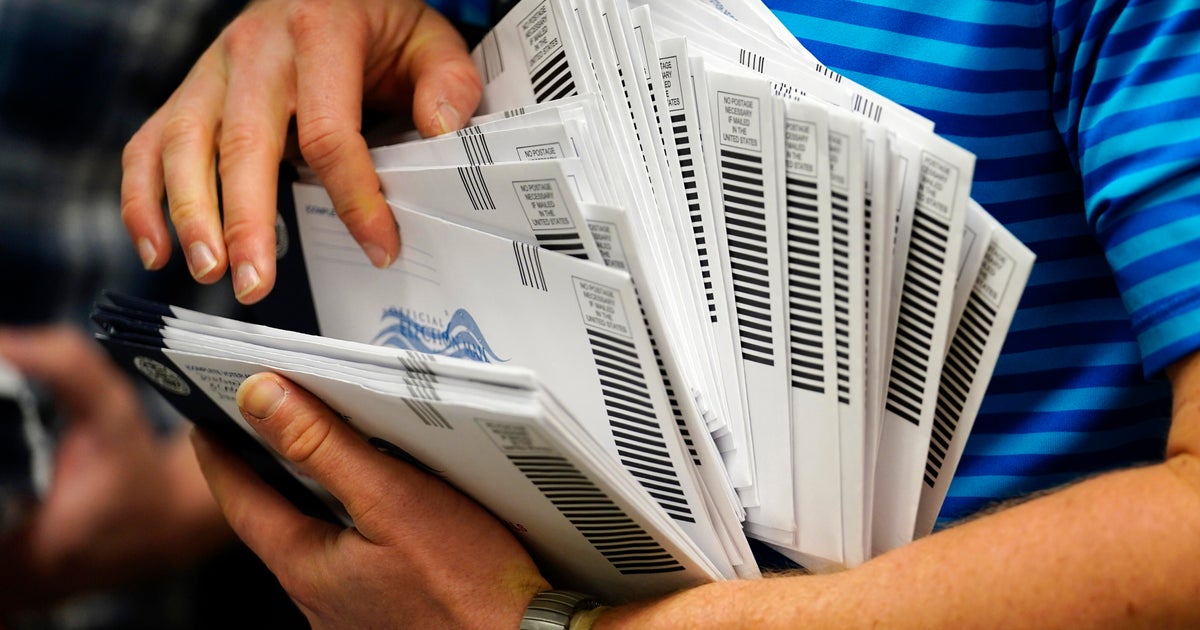
Washington — The Supreme Court on Monday ruled that states can count mail ballots that are cast by Election Day but arrive later, rejecting a GOP challenge to Mississippi law’s for late-arriving ballots.
In the closely watched election dispute known as Watson v. Republican National Committee, the high court split 5 to 4 in finding that Mississippi’s measure does not conflict with federal statutes that set Election Day as the Tuesday after the first Monday in November in certain years.
Justice Amy Coney Barrett authored the majority opinion, joined by Chief Justice John Roberts and the three liberal justices to uphold Mississippi’s law.
“The Framers recognized the difficulty of crafting election laws ‘applicable to every probable change in the situation of the country.’ So instead of constitutionalizing election law, they decided that ‘a discretionary power over elections’ needed to be lodged ‘somewhere,'” Barrett wrote. “Suffice it to say, that power was not lodged in this Court. The election-day statutes say nothing about ballot receipt, and we cannot add to the words Congress chose.”
Federal election laws requires the electorate to make its choice on Election Day, she said, which happens as long as that is the deadline for voting, like it is in Mississippi.
“But the election-day statutes do not set a deadline for ballot receipt, so they do not prevent Mississippi from counting ballots postmarked before election day yet received afterward,” she said.
With the November midterm elections just months away, the case threatened to upend similar laws in more than a dozen states that allow ballots that are postmarked by, but arrive after, Election Day to be tallied.
President Trump frequently criticizes mail voting, claiming without evidence that it leads to election fraud, and he has attempted to unilaterally curtail the practice. His administration backed the challenge to Mississippi’s law brought by the RNC, arguing that Election Day is the day the ballot box closes, and when election officials must have all ballots.
In response to the Supreme Court’s decision, Mr. Trump urged Congress to pass legislation called the SAVE America Act. The bill would impose stringent voting rules, including eliminating mail ballots, with some exceptions, and set voter ID and proof-of-citizenship requirements.
“There is no excuse for a politician, or otherwise, to be against the above three requirements,” he wrote in a Truth Social post.
Mississippi Attorney General Lynn Fitch, a Republican, urged state lawmakers to eliminate the post-Election Day deadline for mail ballots.
“With the bedrock constitutional principle of federalism now affirmed, I am hopeful that the Mississippi Legislature will take this opportunity to amend the law and require absentee ballots be received on the same day ballots are cast at the polling place,” she said in a statement. “President Trump is right to prioritize improving public trust in our elections.”
All 50 states require ballots to be marked and submitted by the day of the election. But in 14 states and the District of Columbia, election officials will accept and count mail ballots that are postmarked by Election Day but received after that day. Twenty-nine states and D.C. allow at least some military and overseas ballots to be received after Election Day.
Under the Mississippi law at issue in the case, ballots received up to five days after the election are tallied so long as they were postmarked by Election Day.
The case is one of four involving elections that the Supreme Court heard in its current term. In January, the court revived a Republican congressman’s lawsuit that challenged Illinois’ law for counting late-arriving ballots, though its decision was procedural. The Supreme Court’s conservative majority also weakened a key provision of the Voting Rights Act, setting off a redistricting scramble in some Southern states just as primary season got underway.
The high court is also weighing a significant campaign finance case involving the legality of federal caps on the amount of money a political committee can spend in coordination with a candidate.
The dispute over Mississippi’s law dates back to 2024, when the Republican National Committee and Mississippi’s Libertarian Party filed lawsuits challenging the ballot-receipt deadline. The parties argued that federal statutes enacted in the 1800s, which set a uniform day for the election for president and Congress, require ballots to be received by the day. Mississippi’s grace period, they said, was in conflict with those laws.
A U.S. district court upheld Mississippi’s five-day deadline for late-arriving ballots, but the U.S. Court of Appeals for the 5th Circuit found that federal law preempts the state’s law. The Supreme Court’s ruling Monday reversed that decision.
Since he returned to the White House, Mr. Trump has sought to exercise more control over federal elections, including through a pair of executive orders that seek to change election rules, including by tightening the rules for mail voting and requiring documentary proof of citizenship to register to vote in federal contests.
The president has defended the measures as necessary to protect the integrity of elections, but both have been blocked by the courts from taking effect.
Barrett, writing for the majority, acknowledged the concerns that some practices, like Mississippi’s deadline for late-arriving ballots, may lead to the appearance of fraud. But she said any efforts to address those issues must come from either Congress or state legislatures.
“Election fraud and its appearance are serious issues. Like other such issues, however, they must be addressed through the democratic process,” she wrote, adding, “If varied deadlines for ballot receipt similarly call for a national solution, the American people must choose it through their elected representatives.”
But in a dissent, Justice Samuel Alito warned that the majority’s decision risks undermining public trust in elections.
“Allowing absentee ballots to pour in over the days and weeks after election day, by which point preliminary election returns are being publicly reported, creates greater opportunity for fraud and risks further undermining the public’s confidence in election integrity,” he wrote.
Alito was joined in his dissent by Justices Clarence Thomas, Neil Gorsuch and Brett Kavanaugh.

