

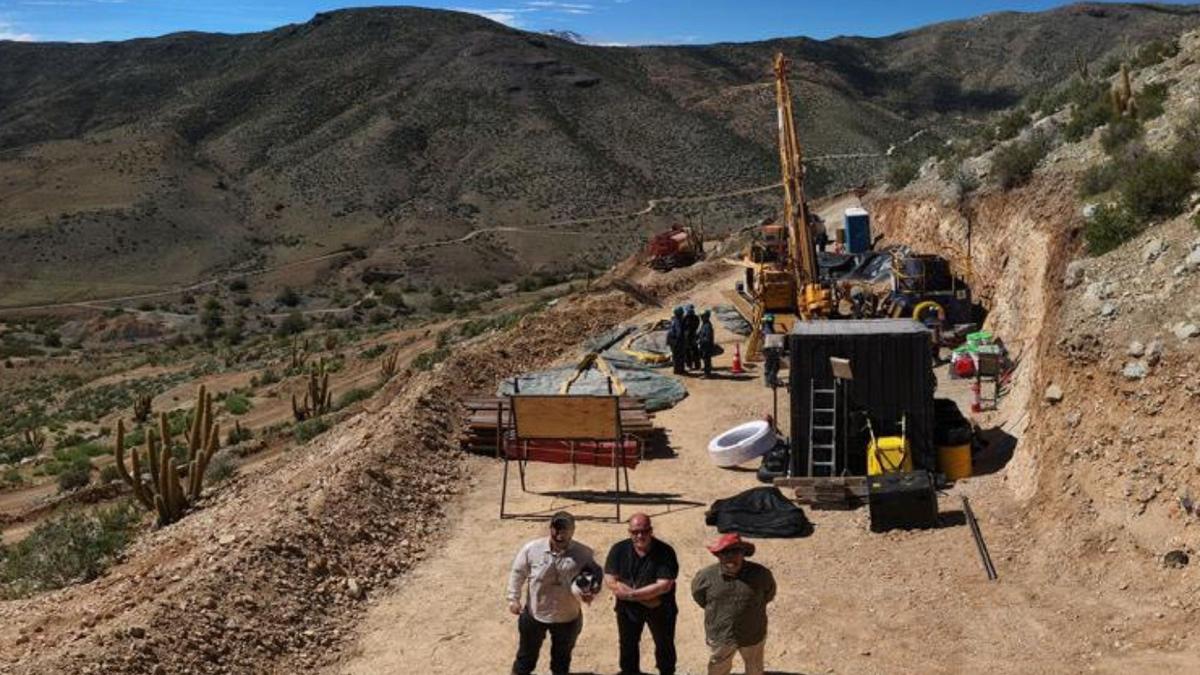
Southern Hemisphere Mining has kicked off a diamond drilling campaign at its newly discovered Ferro South zone, part of the company’s 100 per cent-owned Llahuin copper-gold-molybdenum project in Chile.
The company’s initial 2000-metre program, set to run over ten weeks, has been designed to test the extent and continuity of the fresh copper discovery, with the rods now spinning in search of potential feeder zones that could point to a much bigger mineralised system at depth.
The campaign builds on a string of impressive recent results from Ferro South, including a massive 241-metre intercept grading 0.42 per cent copper equivalent. That hit contained a higher-grade core of 143m going 0.51 per cent copper equivalent from a relatively shallow depth of 36m. Other recent successes include a 180-metre hit at 0.39 per cent copper equivalent from surface.
Southern Hemisphere’s initial drill holes will run to 300 metres downhole; however, the company says it has the flexibility to extend them to 500m if geological observations in the core justify a deeper look at what might be lurking below.
Notably, the program is being guided by a recent copper isotope study, which potentially identified a deeper mineralised source within the broader system. Isotope analysis is an emerging exploration technique that examines subtle variations in naturally occurring copper elements, helping geos home in on the source of metal-rich fluids that drive big porphyry copper systems.
The current drilling program forms part of a broader strategy to dramatically expand Llahuin’s already hefty 218.2-million-tonne JORC-compliant resource. Southern Hemisphere has its sights set on an even bigger prize, outlining an exploration target of between 260 million and 340 million tonnes that could significantly bulk up its existing resource base.
Southern Hemisphere Mining is working in Chile to discover a serious copper-gold-moly mine at Llahuin to supply copper metal into predicted future supply shortages. Our drilling is getting closer to the game-changing drill hole or two as we vector towards the anticipated copper-gold feeder zone(s).
Llahuin is best viewed as a mineralised district rather than a single deposit, with its existing resource spanning the Central, Cerro and Ferro deposits across four kilometres of strike. However, the broader mineralised system extends more than 6km, when the Southern Porphyry prospect is included.
Southern Porphyry is held under a joint venture arrangement with FMR Resources, where FMR have agreed to spend up to A$13 million on exploration over five years to earn a 60 per cent interest. FMR counts famed gold explorer Mark Creasy as one of its senior shareholders.
The project’s potential is underscored by its position in the highly prospective Early Cretaceous Coastal Metallogenic Belt of central Chile, a region known for hosting world-class porphyry copper deposits. Llahuin sits just 8km west of Chilean miner Pucobre’s majority-owned El Espino copper-gold mine, which is currently under construction and contains a measured and indicated mineral resource of 145 million tonnes grading 0.55 per cent copper and 0.22 grams per tonne gold.
Southern Hemisphere’s new work comes at a time supportive of new in-country discoveries. Chile’s state copper commission, Cochilco, recently trimmed its 2026 national output estimate to 5.27 million tonnes, 8.3 per cent lower than previously forecast in 2025, reflecting recent production setbacks at some of the country’s biggest mines, including declines at state-owned giant Codelco and BHP’s massive Escondida operation.
Simultaneously, Cochilco lifted its average copper price forecast for the year to US$5.95 (A$8.54) per pound, a level already comfortably eclipsed by the current spot price sitting at US$6.70 (A$9.62) per pound. Adding further tailwinds to the Chilean copper narrative, the government is touting a US$100 (A$143) billion mining investment wave over the next decade, while pushing for faster project permitting, providing some welcome policy grunt for explorers on the ground.
Southern Hemisphere plans to log and sample the drill core before submitting it for laboratory analysis, with initial assay results anticipated towards the end of November, subject to lab turnaround times.
With a significant resource already in the bag, a string of recent wide intercepts near surface and a clear path to probe for the system’s high-grade heart, Southern Hemisphere appears to be building its case for a major copper operation. All eyes will now be on those late November assays to see what the drill bit uncovers.
Is your ASX-listed company doing something interesting? Contact: matt.birney@wanews.com.au

