



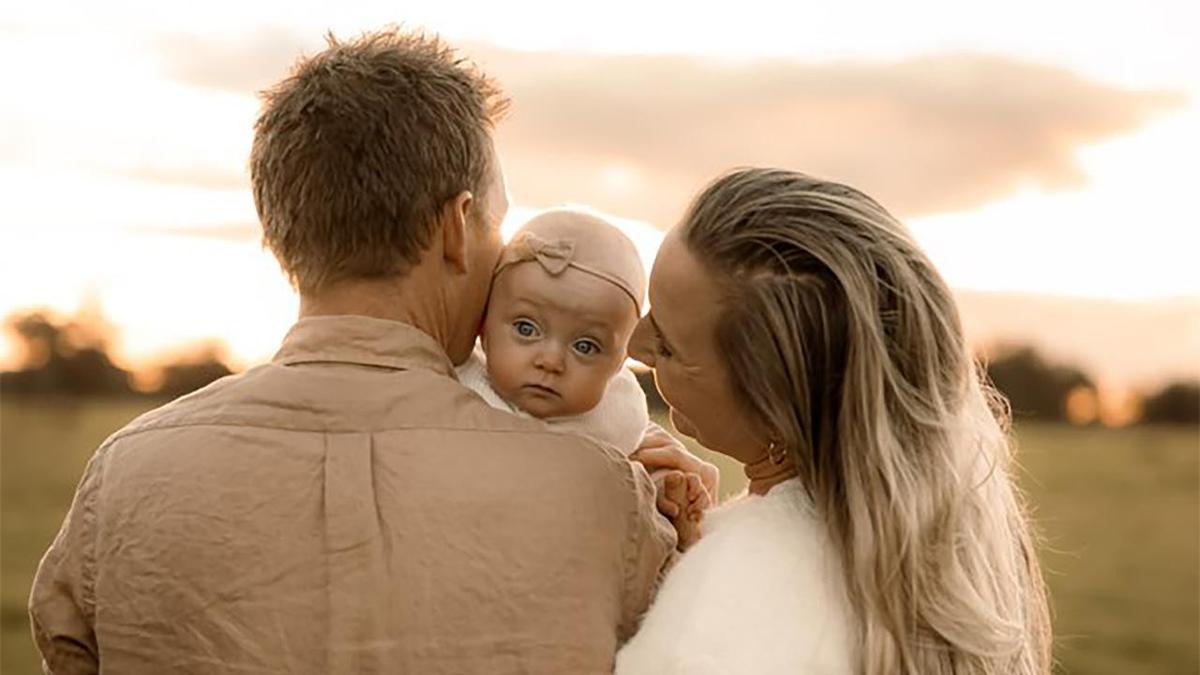
When Melissa Hourigan gave birth, she was unable to hold her daughter for the first nine days of her life.
After returning an abnormal scan, she was diagnosed with a life-threatening infection and rushed to Melbourne’s Mercy Hospital for an emergency caesarean.
Sienna Grace Magnay came into the world 15 weeks early, weighing less than 900 grams.
“I look back on the first photo I had of Sienna in my arms – that girl was so naive with what was about to happen,” Ms Hourigan told AAP.
“That NICU (Neonatal Intensive Care Unit) journey is a rollercoaster ride and you really don’t know how big those drops are until you’re in it.”
Ms Hourigan spent 122 days of 2025 in the NICU and Special Care Unit while partner Nick Magnay rushed back and forth between the hospital and their home in Wangaratta, about three hours away.
Each day, the parents would sit by Sienna’s humidity crib, staring at the tubes and wires keeping her alive and praying she would be okay.
The newborn fought through infections, anaemia, jaundice, a brain haemorrhage and more.
At one point, the director of the NICU had to be honest about the situation.
“He put his hand on my shoulder and said, ‘Look, I don’t think you’re going to walk away with a little girl,'” Mr Magnay said.
Sienna’s health had deteriorated so quickly, the couple weren’t sure their priest could make it to the hospital in time.
But she held on, strengthened by time and treatment, specifically blood transfusions.
Almost all pre-term babies born under 1kg need multiple red blood cell transfusions in their first weeks of life due to the anaemia of prematurity.
Complications related to early-term births can require more treatment, with Sienna receiving three transfusions after her lungs collapsed.
For months, the family would not allow themselves to think more than a few days ahead.
It left them unable to plan out their nursery or life with Sienna, as they worried about the next potential dip in her health.
“I didn’t want to get my hopes up or have this room set up and not have a baby come home,” Ms Hourigan said.
“It wasn’t until early December that one of the care co-ordinators came up to me and said, ‘It’s now time that you can start planning.
“‘It’s okay to go and buy that car seat, it’s okay to go and buy that cot.'”
The parents finally took Sienna home on Christmas Eve and, along with their two older boys, spent their first holiday as a family.
World Blood Donor Day on Sunday coincides in Australia with with National Blood Donor Week (June 8–14) run by Red Cross Australia Lifeblood.
Both honour blood and plasma donors across the country.
Yet with one in three Australians in need of blood or blood products in their lifetime and only one in 30 actually donating, the two events are more a call to arms.
Ms Hourigan is therefore taking the opportunity to thank those whose generosity gave her daughter a chance and urge others to donate.
“It gave Sienna energy when her little body was fighting for life,” she said.
“Blood donation is one of the most selfless acts we can perform.
“As a family who benefited from the kindness of others, we can see the incredible compassion that exists within our communities.”

