

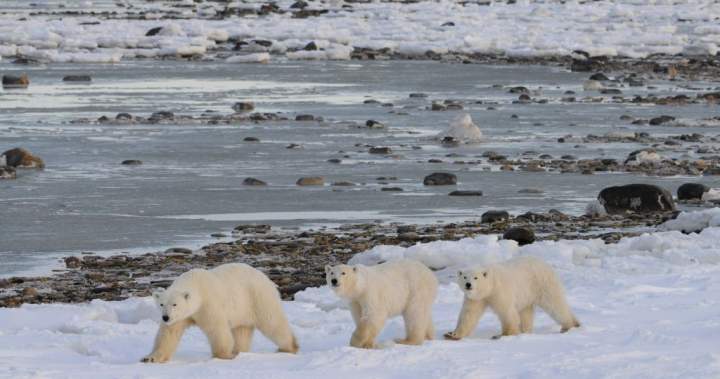
Work is underway to ensure polar bears can safely coexist with people in Churchill, Man., as the Arctic animals arrive by the hundreds in the coming days.

Polar Bears International (PBI) is a nonprofit dedicated to protecting the future of polar bears and Arctic sea ice. It marks polar bear week during the first seven days of November to align with the time of year that the bears arrive in Churchill near Hudson Bay in anticipation of the waterway freezing.
Once frozen, the bears use the bay to hunt for seals and other prey.
“A couple of things happen, the weather starts to cool off, ice starts to freeze,” Geoff York, vice-president for science and policy at PBI, told Global News in an interview, noting that the land freezes first.
“That cooling weather sort of triggers something in the bears that they know it’s the time to come back towards the coast. And so, we see increased polar bear activity.”
That activity can lead to more polar bear-human interactions than usual in the polar bear capital of the world, he added.
The number of contacts between people and polar bears has risen in recent decades because Hudson Bay takes approximately one month longer to freeze than it has historically, due to climate-related sea ice loss, according to PBI.

Get breaking National news
Get breaking Canada news delivered to your inbox as it happens so you won’t miss a trending story.
To prevent negative interactions between the animals and residents, the nonprofit has put deterrent measures in place.
“One thing we really strive to do is increase tolerance for the people who live, work and recreate around bears, and for polar bears in particular, that means keeping people and bears safe when they have interactions,” York said.
“It’s pretty shocking to see a large bear, and not just one typically, but several.”
This year, the organization is using drones to monitor and herd the animals away from potentially dangerous areas or situations. Researchers are also using the aerial camera to safely monitor and track the polar bears’ activities, York continued.
The drone project is being done in collaboration with the Utah-based Brigham Young University (BYU). Kyle Garrett, a master’s student at BYU who is currently in Churchill, said the noise of the drone prompts the bears to move.
“(It is) a little bit bigger than the average drone but nothing too big. And with the noise that’s caused by the drone we’re able to fly it towards the bears and then use the noise as kind of a scare tactic to push them in the direction we want them to go. Then, if we need to change directions, we just change the position of the drone,” Garrett continued.
Based on the team’s work thus far, Garrett said the drones seemed to be effective as a method of moving the bears.
Work was also done at the town’s waste site, as garbage attracts bears.
Part of that work involves the installation of an electric fence, which PBI has dubbed “Bear-vision.” It involves a camera that is used for early warnings of polar bear detection near the waste facility. In PBI’s news release, Bear-vision was described as “a doorbell camera that tells you if a polar bear is outside.”
This work is essential for the long-term conservation of the polar bear population, York said. He added that identifying non-lethal deterrents against the bears will ensure more stay alive for longer after human interactions.
“I think for the long-term conservation of any large animal, but especially a large predator, it is incumbent on those of us working in these areas making sure that the people who live with an animal like polar bears can feel safe,” he said.
“It’s through that that we can kind of grow tolerance and make sure we can keep these large predators on the landscape, hopefully for a very long time to come.”
Churchill’s western Hudson Bay polar bear subpopulation has declined by almost half since 1979 due to climate-driven sea ice loss and fewer females getting pregnant, according to PBI.
© 2026 Global News, a division of Corus Entertainment Inc.

