



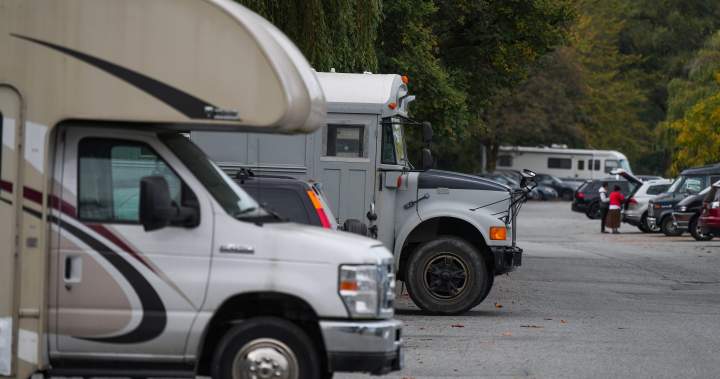
If you’re planning to enjoy a vacation by hitting the road this summer, it’ll still be one of the “most expensive” summers for a road trip in a car or an RV, experts say.

That’s because even as flying to vacation spots this year is only getting pricier amid rising fuel costs and flight cancellations, gas prices are showing no signs of relaxing any time soon.
According to the Canadian Automobile Association (CAA), the national gas price average in Canada currently stands at 190.4 cents per litre.
At the same time last year, the national gas price average was 132.0 cents per litre.
“It could be one of the most expensive summers that we’ve ever seen,” said Patrick de Haan, a petroleum analyst at GasBuddy.
Looking at past gas prices compared with now, the difference is stark. De Haan said there is currently “a profound difference that’s for gasoline and for diesel” across Canadian provinces.
“Last summer, most of the time gas prices across Canada were held between a range of about $1.30 to $1.40 a litre for most of summer,” de Haan said.
“You may want to budget for a much bigger fuel expense this year if you’re hitting the road this summer.”
He also said there could be “the distinct possibility that we could rival that all-time record high of $2.10 from 2022.”

According to GasBuddy data, Quebec has seen a 43-cent rise in gas prices compared with a year ago, while Newfoundland and Labrador has seen a 58.2-cent-a-litre rise compared with a year ago.
British Columbia and Prince Edward Island face prices almost 82 cents a litre higher than a year ago and in Saskatchewan and Alberta, those increases range from 64 to 74 cents higher than a year ago.

Get breaking National news
Get breaking Canada news delivered to your inbox as it happens so you won’t miss a trending story.
“No matter where you’re heading, it’s going to be a much more expensive summer to hit the road, especially for a larger vehicle like an RV,” de Haan said.
“The tank on an RV is going to be much larger. So, if you’re driving coast to coast in an RV, you might be filling up with close to three or four hundred litres of fuel compared to the average car, less than a quarter of that. It’s going to be much more expensive to fill that larger tank, especially if the RV is, is diesel.”
Justin Boyd, owner of Great Escape RV, said Canadians are “hesitant to make the final call” with purchasing RVs.
“There’s good volume on the lots, we’re seeing people, but we are seeing people downsizing their trailers, trading in larger trailers for smaller trailers, trading in larger motor homes for six-cylinder transit van-based motor homes,” he said.
“You are seeing a cautionary thought process.”

Still, the president of Go RVing Canada, Chris Mahony, said more Canadians want to spend more time outdoors and within the country, adding that the demand is “very, very high” for camping this year and the majority of campgrounds will be booked out this summer.
“During COVID, people really wanted to explore Canada and that was on their radar, and I feel like, for different reasons, Canadians are craving travel plans within the country this year,” he said.
Jamie Cox, executive director for the British Columbia Lodging and Campgrounds Association, stated that B.C. saw “the largest growth in tourism” in 2025, and is anticipating higher numbers in 2026.
“Looking at summer operations and summer sectors, outdoor recreation sectors in B.C., domestic travel is becoming more intensified,” he said. “There’s been a huge uptake in those ventures.”
Are there ways to save on a trip this summer?
When dealing with rising costs, cutting down on other areas of road trips can help keep prices manageable even with higher fuel costs, experts say.
“People still want to go outdoors, they’re probably just not going to go quite as far, and that means they’re going to camp more locally, so I think that type of freedom and flexibility that are being afforded is absolutely unchanged,” Mahony said.
President of the RV Dealers Association of Canada Eleonore Hamm also added that instead of spending additional money on food, Canadian campers are more interested in spending on attractions and activities.
“Canadians tend to be using it [money] more to see attractions, being able to go visit the parks, going to a museum or going to experience something that you might not have done because if you’ve only got a limited budget,” she said.
The RV Dealers Association of Canada’s 2024 economic statement shows that more than seven million Canadian RV trips were taken in 2024, with $16.2 billion being added to the country’s gross domestic product. More than 141,000 jobs were also created in this industry.
Part of this growing interest has also been credited to the “Buy Canadian” movement in Canada that largely deals with avoiding spending and travel to the U.S.
“There’s the political situation where some people are more comfortable remaining in Canada at this moment,” Hamm said. “We are getting a lot of people who want to stay here [in Canada].
“I think that’s all helping people discover the beauty that we have here.”
© 2026 Global News, a division of Corus Entertainment Inc.

