



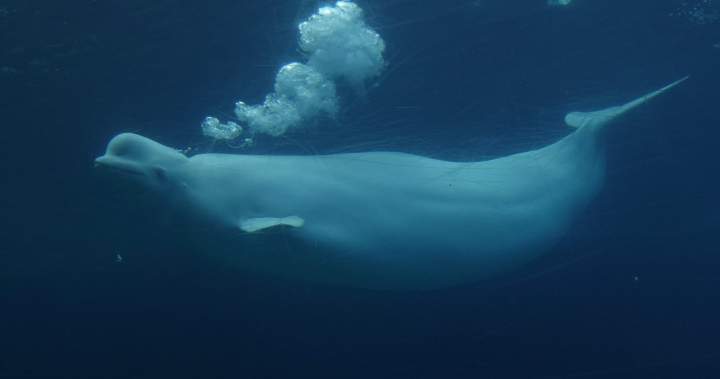
The 30 beluga whales at Marineland in Niagara Falls, Ont., are one step closer to new homes.

Last week, Fisheries and Oceans Canada endorsed a rescue plan led by an international team of aquariums, said Johnny Ford, a spokesperson for Shedd Aquarium. He spoke on behalf of the U.S. aquariums involved in the proposal.
That plan would divide the remaining whales between four aquariums in the United States — Georgia Aquarium in Atlanta, Shedd Aquarium in Chicago and two SeaWorld facilities in San Diego and San Antonio. Whales would also be sent to Oceanogràfic València in Spain, which is Europe’s largest aquarium.
“I think this is a positive step forward,” Fisheries Minister Joanne Thompson said Wednesday. “There’s still more work to be done, but it’s a step forward.”
The fate of the belugas has been in question since the park shut its doors in 2024 following the death of the attraction’s last surviving owner.
Marineland said it is “fully committed to the safe and timely relocation of our beluga whales, and we want to be clear: this is our top priority.”
“Relocating these animals is an extraordinarily complex undertaking,” Marineland said in a statement to The Canadian Press.

In the fall of 2025, Marineland drew up a plan to send the remaining whales to Chimelong Ocean Kingdom, an aquarium in China.

Get breaking National news
Get breaking Canada news delivered to your inbox as it happens so you won’t miss a trending story.
Fisheries and Oceans Canada denied this request, with Thompson saying it violated federal law.
Thompson was referring to the Free Willy bill, which passed in 2019. This bill banned whale and dolphin captivity with a limited exemption for scientific research. Marineland’s ability to operate was grandfathered into this legislation.
Thompson said at a press briefing in October 2025 that the decision was made to “not allow the further exploitation of the belugas.”
Marineland had also threatened euthanasia of the whales if the federal government didn’t enact emergency funds for the continued care of the whales. The aquarium said it could no longer afford to keep the animals alive.
In April, a federal government source with direct knowledge on the matter told Global News that funding in the range of an eight-figure number was ready to provide assistance.
Further financial details have yet to be released.
Ford said the Department of Fisheries and Oceans (DFO) concluded moving the belugas to the five accredited aquariums is “in the best interest of the animals’ wellbeing.”
While he said the endorsement represents an important milestone for the whales, “several additional logistical steps and permits are still required before a rescue can begin.”
“Rescue details are expected to continue to change based on the individual needs of the whales, and the aquariums are committed to providing progress updates as appropriate,” he added.
A spokesperson for Minister Thompson’s office told Global News permits have been issued under the Convention on International Trade in Endangered Species of Wild Fauna and Flora, otherwise known as CITES permits.
They said final animal health checks are required before final authorizations under the Fisheries Act will be granted.
“DFO is coordinating with Canadian Border Services Agency (CBSA), Health Canada, and other partners across the Government of Canada to ensure all requirements are met for a safe and timely transfer,” the spokesperson said.
A copy of the plan laying out the complex movement of the whales was obtained by The Canadian Press.
It states the move will involve a number of staff from Marineland and the American aquariums, specialized containers to hold each whale, transport trucks and a police escort.
“A rescue of this scale is extraordinarily difficult,” the plan notes.
“The proposed plan was developed with input from experts at several accredited aquariums, drawing on decades of hands-on care experience, the latest animal‑welfare science, prior beluga rescue efforts, and direct observations of the individual whales and their needs.”
Since Marineland closed, the park has been working to relocate its remaining animals.
Last month, Marineland sent its 12 black bears to the Wild Animal Sanctuary in Colorado which houses 1,000 large carnivores, including bears, lions and tigers.
Erin Ryan, wildlife campaign manager for World Animal Protection Canada said that the federal government’s decision to move forward on this plan is welcomed.
“We are relieved to know that the whales will no longer be subjected to a standing and persistent threat of euthanasia by Marineland,” she said in a media release.
“As these animals are relocated, we urge the receiving facilities in the United States and/or Spain to uphold the spirit of Canadian law by not breeding and refraining from using them in performances or other forms of entertainment.”
Ryan said the situation unfolding at Marineland is a “tragedy” and is the result of “decades of inadequate oversight and weak protections for captive wild animals.”
According to provincial data obtained by The Canadian Press through freedom of information laws, 19 belugas and one orca whale have died at Marineland since 2019.
–with files from The Canadian Press
© 2026 Global News, a division of Corus Entertainment Inc.

