



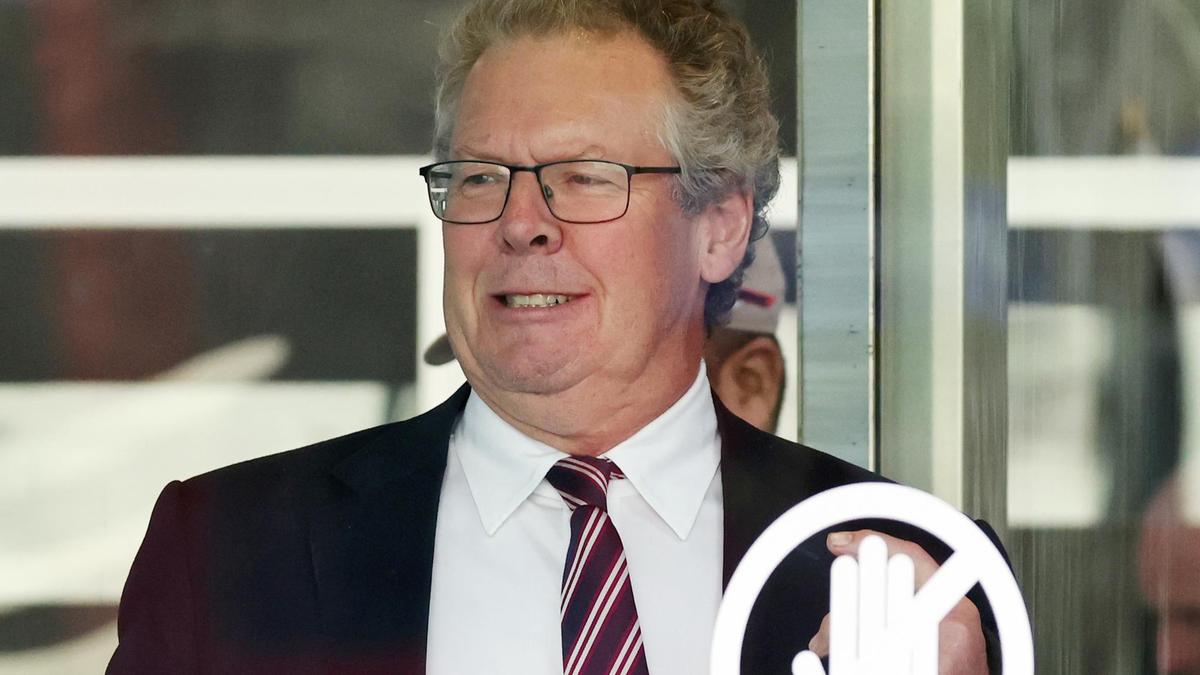
A former top lawyer will not spend a day behind bars after admitting he tried to defraud clients who had already lost hundreds of millions of dollars.
Norman O’Bryan, 68, was sentenced to a four-year community corrections order and ordered to perform 600 hours of community service in the County Court of Victoria on Thursday.
The sentence came after the former Senior Counsel pleaded guilty to a charge of attempting to obtain a financial advantage by deception earlier this year stemming from a legal scandal once labelled “one of the darkest chapters in the legal history of this State”.
O’Bryan, who comes from one of Victoria’s most esteemed legal families, was tapped to lead a class action representing 16,000 investors caught up in the collapse of Banksia Securities in 2012.

WA’s biggest courts and crime stories to your inbox
Sign-up to our weekly newsletter for free
Sign up
The non-bank lender offered loans backed by investor funds and entered receivership owing about $663 million.
In late 2017, an in-principle settlement between the class action participants and Trust Co, which acted as the trustee for Banksia Securities, was reached for $64m.
But several members of the class action raised concerns about $19.3m of claimed expenses, including legal fees, disbursements and litigation funding costs, and challenged the settlement.
“Not a subtle crossing of the line”
An investigation into the fees followed, which resulted in Supreme Court Judge John Dixon issuing a scathing judgment in 2021 finding several lawyers, including O’Bryan and the fraud’s architect Mark Elliott, inflated their claims for fees and misled the court in an effort to cover it up.
“It was plain that Mark Elliott, together with O’Bryan, masterminded the misconduct at the heart of the fraud attempted against the settlement fund,” Justice Dixon wrote.
O’Bryan was charged by police in June 2024 with the criminal case limited to his actions between November 9, 2017, and February 16, 2018, where he tried to claim more legal fees than he was owed.
“This was not a subtle crossing of the line,” Judge Fran Dalziel said.
“The dishonesty was blatant and would have been obvious to Mr O’Bryan as he carried it out. He breached the trust of his clients and failed to act with the integrity required of lawyers in general and senior counsel in particular.”

The court was told O’Bryan had failed to keep records of the work he’d actually done on the case yet instructed his assistant to prepare invoices after the settlement was reached.
In the first invoice, O’Bryan billed just over $1 million by claiming 954 billable hours at a $990 per hour and $9,900 per day rate.
After Elliot, who has since died, wrote back saying he should claim $2.65 million, O’Bryan began increasing his rate and billable hours.
In a final set of fake invoices, he claimed 1,876 hours for $2.35 million.
Previously, the court was told it was not alleged the first invoice represented the true work O’Bryan had performed and prosecutors conceded “some additional work” had been done between the first and last invoice.
Judge Dalziel said O’Bryan ultimately did not get paid and there was no way to accurately quantify how much he was actually entitled to.
While the investors were not left out of pocket by the fraud, the judge said the impact on O’Bryan’s conduct was felt by his clients.
Keith Pitman, a 90-year-old retiree who helped expose the fraud by challenging the settlement, described it as a “slow motion robbery”.
“The effect on me and my wife has been devastating. Not so much the monetary part of it, more the principle,” he said.
“I don’t understand how a lawyer of such high standing; he was Queen’s Counsel, could think that he might get away with such deception.”
Judge Dalziel accepted O’Bryan was remorseful for his actions and had suffered significant personal impact, including the loss of his career and shunning by the legal fraternity, since.

