

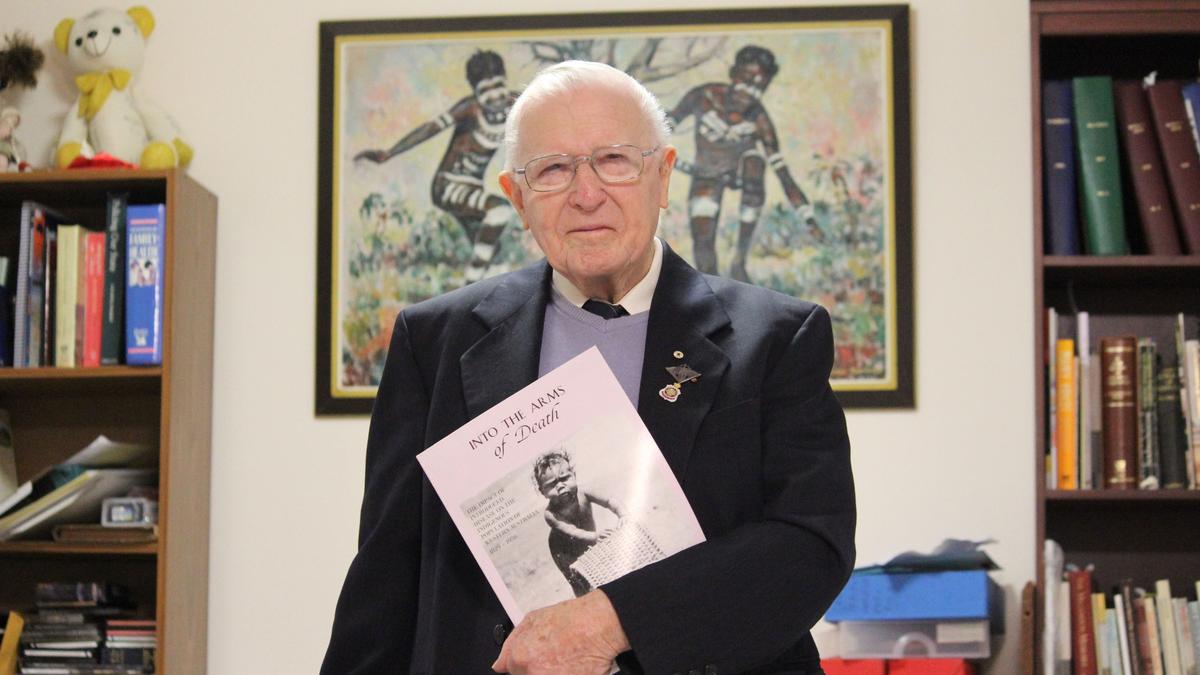
Dr Neville Green AM was a pioneering Western Australian historian, author and educator who dedicated his life to documenting Aboriginal history, perhaps one of the State’s first “truth-tellers”, particularly in Noongar and Kimberley history.
He passed away peacefully on September 7.
Born in Subiaco in 1933, Neville began his professional journey in the early 1950s, engaging in six years of service in the Royal Australian Air Force. Determined to pursue education, he completed his schooling requirements to enter Claremont Teachers College, a qualification he regarded with immense personal pride.
He was a “native welfare officer” and his early teaching career took him to remote northern corners of Western Australia, where he taught in Aboriginal schools and worked closely with hearing-impaired children. Neville worked at the Warburton United Aborigines Mission on Ngaanyatjarra Country and with his typical sensitivity to traditional Aboriginal lifestyles and experiences of education, in 1983, published Desert School.
His profound immersion in Aboriginal community life shaped the trajectory of his career, leading to his appointment as a lecturer at Western Australia’s first Aboriginal teacher education program at Mt Lawley College of Advanced Education. Over many decades he was a fastidious researcher and a common sight at the State Records Office of Western Australia, and left voluminous records and audio recordings of himself and Aboriginal elders held at the State Library of Western Australia.
While there were earlier brilliant WA histories such as Paul Hasluck’s 1942 Black Australians: A Survey of Native Policy in Western Australia, 1829-1897, Peter Biskup’s 1973 Not Slaves, Not Citizens: The Aboriginal Problem In Western Australia, 1898-1954, and Leslie Marchant’s 1981 Aboriginal Administration in Western Australia, 1886-1905, these were largely on administration of Aboriginal people and “native policy”. Neville wrote books that saw Aboriginal people not as a “problem” but as people, bringing their history to life in an accessible way.
He became a monumental figure in Australian historiography, bridging the fields of education, history and anthropology. Neville wrote a detailed history of the Anglican Forrest River Mission in the Kimberley following his experience as a schoolteacher at Forrest River — real name Oombulgurri on Balanggarra Country — in the 1970s.
His influential publications include the seminal Nyungar — The People (1979) and the influential Broken Spears (1984), where he documented (the first to do it) detailed lists of the widespread conflict between south-west Noongars and the arriving colonists. Then The Forrest River Massacres (1995) was published, bringing the entire atrocious massacre events of June 1926 to a wider public light. A rigorous royal commission found 11 Aboriginal people had been shot and murdered and their remains burnt (to hide all evidence) at multiple sites with the condemned often having to collect the wood to burn their own bodies. Not one person was ever convicted despite commissioner George Wood reporting all the Aboriginal eyewitnesses had mysteriously “disappeared”, likely killed, and all the defendants had colluded or were outright lying. Neville endured a lot of criticism (at a time when police and associated commercial parties did not like this sort of attention) from those who denied it, and the massacre is still denied by some to this day, but Neville stayed firm and was, of course, right.
He completed two PhDs from the University of Western Australia and Murdoch University, which earned him the affectionate moniker “Doctor Doctor”. He also published multiple articles including From Princes To Paupers: The Struggle For Control Of Aborigines In Western Australia 1887-1898.
In 1997 he and his daughter Susan Moon (now Aguiar) compiled a list of Aboriginal prisoners at Wadjemup and their original location and sentences — usually for cattle-related offences — entitled Far From Home: Aboriginal Prisoners Of Rottnest Island 1838-1931.
Prisoners were often charged and convicted with zero evidence or knowledge of what they were being charged with and gaoled.
In recognition of his monumental written contributions to Western Australian Aboriginal history and truth-telling and his service as an author, he was appointed a Member of the Order of Australia in 2012. Neville Green’s legacy survives through his invaluable reference lists, biographical dictionaries, and recorded oral histories of Aboriginal elders held at the State Library of Western Australia, preserving vital cultural knowledge and truth for generations to come. His research led the way for many notable historians, including Anna Haebich, Christine Choo and Kate Auty, to follow.
He will be remembered as not only a brilliant scholar but also a generous and kind mentor and an institutional pillar who strove to speak the truth and make Western Australian history accessible and transparent for all Australians. He bravely stayed the course and continued researching until he could not any more.
Husband to Mary (nee Emery, dec. 2020), whom he married in 1956, Neville is survived by children Sue, Jenny, Tricia and Andrea, six grandchildren and eight great-grandchildren.
Neville James Green AM
Historian, author and educator
Born: Perth, 1933
Died: Perth, aged 93

