




NEWYou can now listen to Fox News articles!
The House voted 215-214 Tuesday night to make approval the default when qualified service members and Pentagon civilian employees ask commanders for permission to carry personal firearms on military installations.
Three Democrats joined most Republicans to approve the measure, while three Republicans and independent Rep. Kevin Kiley of California opposed it.
The amendment from Rep. Jeff Crank, R-Colo., would not automatically authorize personnel to carry firearms on military property. It would establish a presumption that installation commanders approve requests from qualified service members and civilian employees.
The vote came less than a year after an Army sergeant allegedly used a personal handgun to shoot five fellow soldiers at Fort Stewart, Georgia, in August 2025. Other soldiers tackled and disarmed him, and all five victims survived. Personal firearms were prohibited on post at the time, military officials said.
MAJOR APPEALS COURT DECLARES NEW JERSEY AR-15 BAN UNCONSTITUTIONAL IN LANDMARK SECOND AMENDMENT RULING

A picture of an entrance to Fort Bragg in North Carolina. (AP Photo/Chris Seward, File)
The National Defense Authorization Act has become law every year for more than six decades and is traditionally one of Congress’ most bipartisan major bills, but the firearms and transgender-policy provisions adopted Tuesday threatened to erode Democratic support, potentially forcing Republican leaders to rely on their narrow majority for final passage and creating new sticking points in eventual negotiations with the Senate.
Lawmakers approved an amendment from Rep. Nancy Mace, R-S.C., prohibiting TRICARE from covering transition-related hormones, puberty blockers and surgeries for service members and military dependents.
The provision passed 219-208, with five Democrats voting yes and one Republican voting no. It would broaden existing Trump administration restrictions and write the prohibition into federal law.
SENATE REPUBLICAN PUSHES MERIT-BASED MILITARY PROMOTIONS, TARGETS BIDEN-ERA DEI POLICIES
The House also voted 221-203 to approve a second Mace amendment barring transgender girls from participating in girls’ sports at Department of Defense Education Activity schools serving military families.
But lawmakers rejected a separate amendment from Rep. Lauren Boebert, R-Colo., that would have codified President Donald Trump’s 2025 executive order barring transgender troops from military service and requiring personnel to serve according to their biological sex.
The amendment failed 217-212, with four Republicans joining all voting Democrats in opposition.
Lawmakers also rejected an effort from Rep. Eli Crane, R-Ariz., to largely eliminate funding for the Pentagon’s Ukraine Security Assistance Initiative. The amendment would have permitted funding only for security at the U.S. Embassy in Kyiv.
Seventy-six Republicans supported the proposal, highlighting continued opposition within the GOP conference to military assistance for Ukraine.
The House rejected another proposal that would have barred foreign nationals from attending U.S. military academies in a 360-61 vote. The amendment would have ended longstanding programs that train officers from allied and partner nations at institutions including West Point, the Naval Academy and the Air Force Academy.
Among other amendments, lawmakers voted to eliminate a proposed pilot program that would have used voice-based risk-assessment technology to identify service members for drug testing.
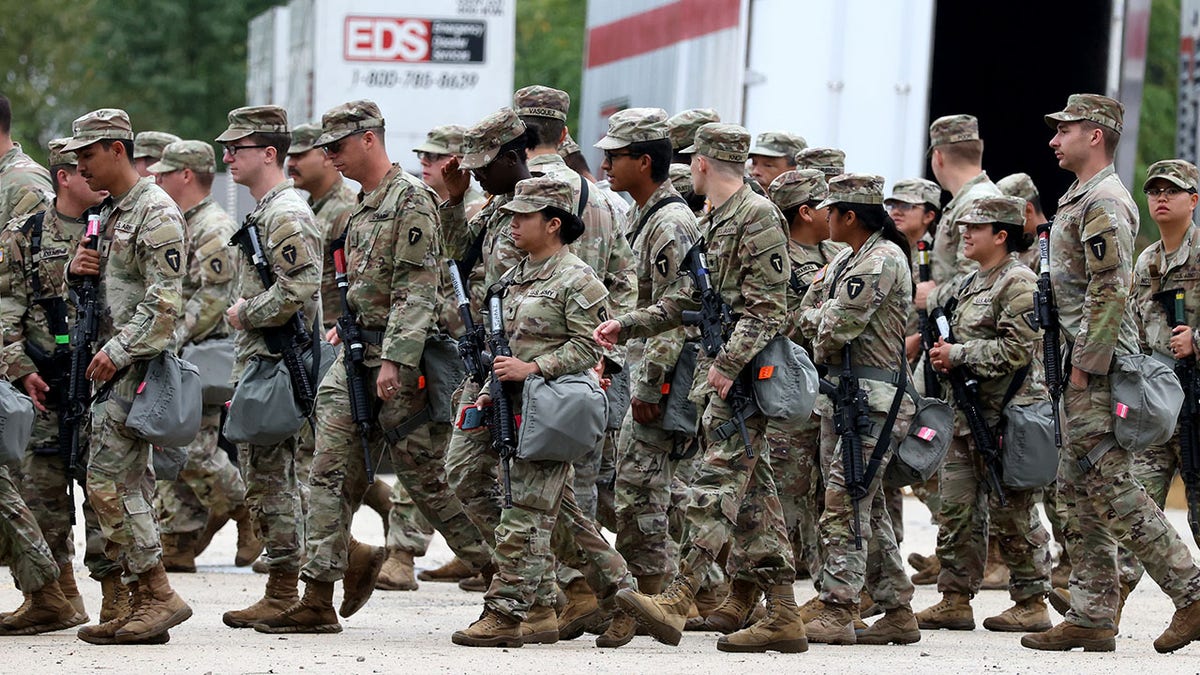
Members of the Texas National Guard assemble in Elwood, Illinois, at the Army Reserve Training Center in the southwest suburb of Chicago, on Oct. 7. 2025. (Getty Images)
The House also narrowly approved language intended to ensure the continued operation of California’s Santa Ynez Pipeline System, which transports crude oil to refineries supplying military installations. That measure passed 215-214.
The votes came as lawmakers began working through amendments to the fiscal year 2027 National Defense Authorization Act. The House made 320 amendments eligible for consideration, eight more than were included in the procedural package that collapsed last month amid a Republican revolt over the SAVE America Act.
Amendment debate is expected to resume Wednesday, with a vote on final passage after lawmakers finish considering the remaining proposals.
The underlying bill would authorize roughly $1.15 trillion for national defense, about $252 billion more than Congress appropriated for defense programs in fiscal year 2026. It would provide pay raises ranging from 5% to 7% for service members, expand weapons and munitions production and accelerate investment in missile defense, autonomous systems, hypersonics and other emerging technologies.
The NDAA sets defense policy and authorizes spending levels, but it does not provide the money itself. Congress must separately pass defense appropriations legislation to fund the programs and priorities included in the bill.
The legislation would also formally change the Department of Defense’s name to the Department of War, deeming references to the defense secretary and department in federal law to mean the secretary and Department of War.
Consideration of the legislation had been delayed for three weeks by a separate Republican fight over the SAVE America Act, Trump’s election legislation requiring documentary proof of citizenship to register to vote and identification to cast a ballot in federal elections.
The House approved the SAVE America Act in February by a 218-213 vote, but the measure stalled in the Senate, where Republicans lacked the 60 votes needed to overcome a filibuster.
Republican leaders initially sought to revive the election legislation by directing the House clerk to merge it with the NDAA after the defense bill passed but before the combined package was sent to the Senate. That approach would transmit the two measures as a single bill without making the SAVE America Act part of the NDAA text debated on the floor.
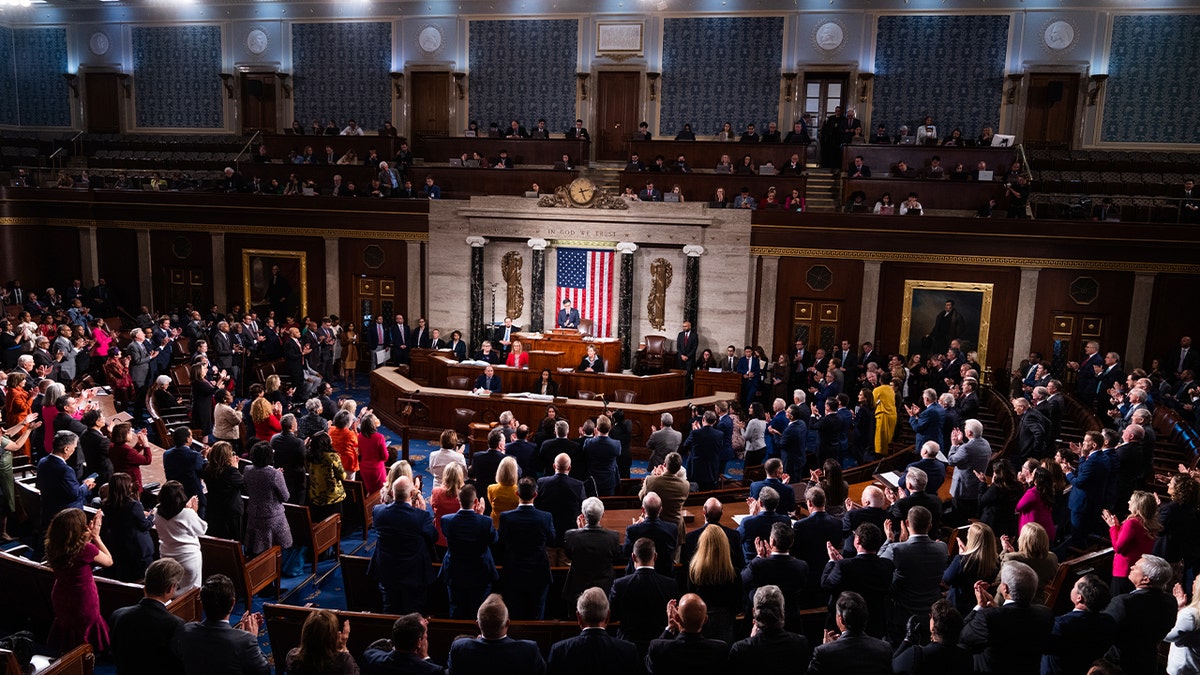
Speaker of the House Mike Johnson, R-La., addresses the House chamber of the U.S. Capitol after winning the speakership on Wednesday, Oct. 25, 2023. (Tom Williams/CQ-Roll Call, Inc via Getty Images)
But the procedural rule authorizing that plan failed 198-224 on June 30, when 13 Republican holdouts joined Democrats in opposition. House Majority Leader Steve Scalise, R-La., also voted against the rule for procedural reasons.
Rep. Anna Paulina Luna, R-Fla., argued that attaching the election measure through the procedural maneuver would make it easier for the Senate to remove and demanded that lawmakers add it directly to the NDAA.
Luna later accepted the original approach after Speaker Mike Johnson committed to attaching the SAVE America Act to appropriations and other must-pass legislation.
The House approved a replacement rule Tuesday that again directed the clerk to merge the election legislation with the NDAA before sending it to the Senate while expanding the number of defense amendments eligible for consideration from 312 to 320.
The SAVE America Act was still expected to face opposition in the Senate and could be removed when lawmakers reconcile the House and Senate versions of the defense bill.
The Senate’s NDAA has faced problems of its own. Senate Democrats blocked consideration of their chamber’s defense bill last week in protest of the Trump administration’s war with Iran, leaving both chambers with work to do before they can negotiate a final package.
CLICK HERE TO DOWNLOAD THE FOX NEWS APP
The debate comes as the Pentagon seeks additional money to cover the Iran war and replenish weapons stockpiles. The White House has requested an $87.6 billion supplemental package, including $67.1 billion for defense needs.
House Republicans are also considering a new reconciliation package that could provide $60 billion through the Armed Services Committee and $13 billion for intelligence programs. Reconciliation would allow the package to bypass a Senate filibuster and pass without Democratic support, but the proposal still faces resistance from GOP fiscal hawks and an uncertain path through Congress.

