



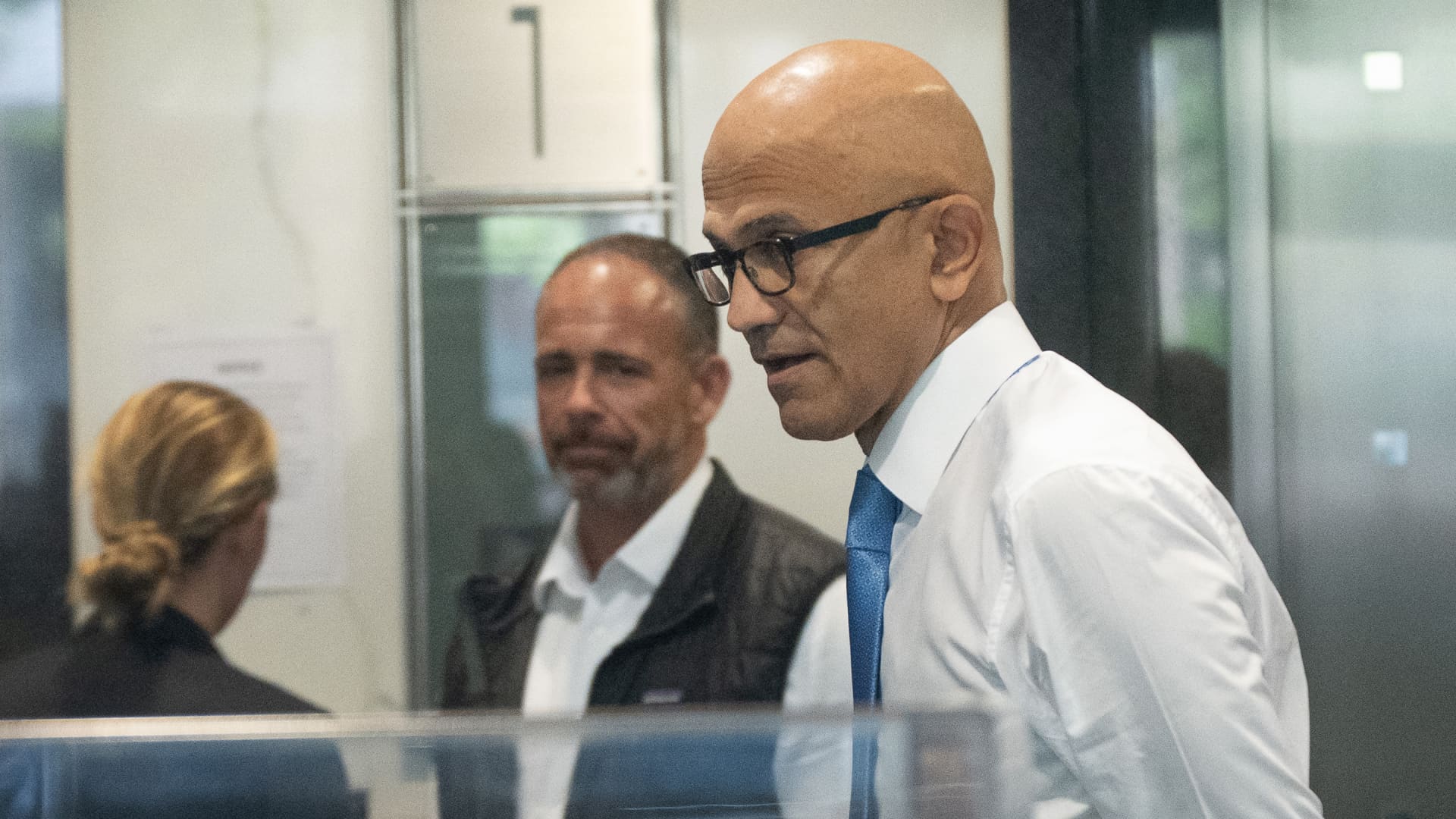

Microsoft CEO Satya Nadella took the stand in the Musk v. Altman trial on Monday, where he testified that Elon Musk never contacted him with concerns that Microsoft’s investments in OpenAI were in violation of any special terms or commitments.
Nadella, wearing a navy suit with a blue tie, began his testimony in federal court in Oakland, California by answering questions about the early days of the Microsoft’s strategic partnership with OpenAI. He said he was “very proud” that Microsoft took the risk to invest in OpenAI when “no one else was willing” to bet on the fledgling lab.
In 2024, Musk sued OpenAI, its CEO, Sam Altman, and its president, Greg Brockman, alleging that they went back on their vow to protect the artificial intelligence company’s nonprofit structure and follow its charitable mission. Microsoft is named as a defendant in the lawsuit, as Musk accuses the company of aiding and abetting OpenAI’s purported breach of charitable trust.
Microsoft has been one of OpenAI’s major backers since 2019, years before the company rocketed into the mainstream with the launch of its ChatGPT chatbot in late 2022. Microsoft’s more than $13 billion worth of investments in OpenAI, including a $1 billion investment in 2019, a $2 billion investment in 2021 and $10 billion in 2023, have come up repeatedly over the course of the trial.
Nadella said from the stand that he did not believe Microsoft’s investments in OpenAI were donations, and that there was a clear commercial element to their partnership from the outset.
He said during the partnership’s early years, Microsoft gave OpenAI sharp discounts on computing resources, and Microsoft believed it would reap marketing benefits from doing so.
Musk, who testified late last month, said Microsoft’s $10 billion investment was the key tipping point that made him believe OpenAI was violating its nonprofit mission. He testified that the scale of the investment bothered him, and it prompted him to open a legal investigation into OpenAI.
“I was concerned they were really trying to steal the charity,” Musk said from the stand.
Musk co-founded OpenAI alongside Altman, Brockman and a handful of other executives and researchers in 2015. After a number of disagreements about OpenAI’s direction, including a failed effort to join it with his automaker Tesla, Musk left the OpenAI board in 2018. He went on to launch a competing AI startup, xAI, which he merged with SpaceX earlier this year.
OpenAI established a for-profit subsidiary in the months following Musk’s departure, which allowed the company to raise outside funding more easily. Investors, including Microsoft, have since poured billions of dollars into OpenAI’s for-profit arm, and the company’s valuation has swelled to more than $850 billion.
In October, OpenAI completed a recapitalization that cemented its structure as a nonprofit with an equity stake in its for-profit business. As part of that announcement, Microsoft disclosed that it held a roughly 27% stake in OpenAI’s for-profit unit that was valued at around $135 billion.
The relationship between OpenAI and Microsoft has shown signs of strain in recent months, even as both companies continue to tout it as strategic and core to their businesses. Late last month, the same day that jury selection kicked off in Musk v. Altman, the companies announced a revamped partnership agreement that allows OpenAI to cap revenue share payments and serve customers across any cloud provider.
OpenAI said in a release that the agreement aimed to “simplify our partnership and the way we work together.”
Musk testified that he is not entirely against OpenAI having a for-profit unit, but he said it became “the tail wagging the dog.” He repeatedly accused Altman and Brockman of enriching themselves from a charity while also reaping the positive associations that come from running a nonprofit.
“Microsoft has their own motivations, and that would be different from the motivations of the charity,” Musk said from the stand. “All due respect to Microsoft, do you really want Microsoft controlling digital superintelligence?”
During a videotaped deposition shown in court last week, former OpenAI director Tasha McCauley recalled a discussion with Nadella and her fellow board members after the 2023 decision to dismiss Altman as OpenAI’s CEO.
“To the best of my recollection, Satya wanted to restore things to as they had been,” McCauley said. The board members didn’t think that was the right move, she said.
WATCH: The Musk vs. OpenAI trial is underway — here’s where things stand


