

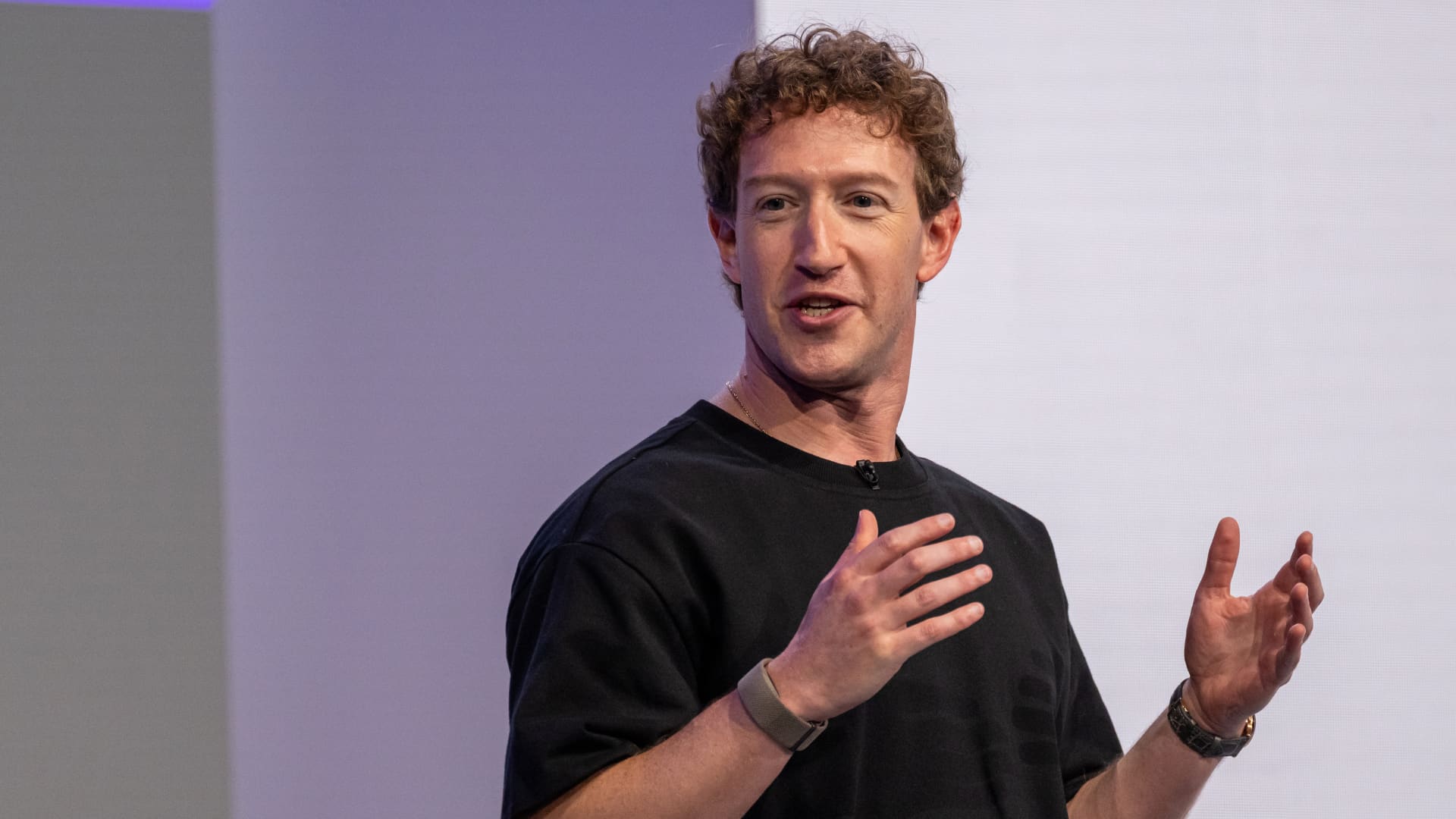
In case there were any doubts, Mark Zuckerberg is staying in California.
Meta was apparently concerned enough that its founder and CEO might depart its home state that the company put in place a new stock plan that could help offset the burden of higher taxes should a billionaires tax, known as Proposition 40, pass on Election Day on Nov. 3.
The disclosure came in a filing on Wednesday that coincided with Meta’s third-quarter earnings report, and represents a first among California’s megacap tech companies. Zuckerberg, the sixth-richest person in the world, is one of the few among his peers to still reside in the state, along with Nvidia CEO Jensen Huang.
Elon Musk and Michael Dell live in Texas, while Amazon founder Jeff Bezos’ primary residence has always been elsewhere. Google co-founders Larry Page and Sergey Brin moved out of California ahead of the election and bought luxury homes in Florida, the same state that Oracle founder Larry Ellison officially calls home.
Prop. 40 would impose a 5% tax on Californians worth over $1 billion. Zuckerberg’s net worth is currently about $225 billion.
“If the California wealth tax is enacted and Mr. Zuckerberg becomes liable for a tax payment, Mr. Zuckerberg would effectively be paying to serve as the Company’s chief executive officer while residing in California,” the filing said, noting the CEO’s “salary of only $1 each year.”
Meta said in the filing that Zuckerberg committed to remaining in California for eight years, “unless there are material unforeseen circumstances that would render it prudent or advisable for Mr. Zuckerberg to reside elsewhere.”
The company created a new class of non-voting Class C common stock to take effect in January. Zuckerberg will essentially be granted a portion of the new stock via a dividend. He will be able to “immediately sell or transfer up to 20%” of the shares he’s granted “for any reason, including so that he may pay his potential tax liability under California Proposition 40, if enacted into law, without affecting his majority voting control,” the filing said.
The tech industry, by and large, has been unified in its objection to the ballot measure.
In addition to the Google co-founders, a number of big-name techies have put spending into opposing Prop. 40. They include former Google CEO Eric Schmidt, Stripe CEO Patrick Collison, venture investor Peter Thiel and DoorDash CEO Tony Xu, according to various media reports based on campaign filings.
Collison and Xu are members of Meta’s board of directors while Thiel left the company’s board in 2022, having served since 2005.
Brin told The New York Times in April he fled the Soviet Union with his family in 1979, and said “I don’t want California to end up in the same place.”
Huang, however, recently told CBS Sunday Morning that it would be a “privilege” to pay the tax. Huang is just behind Zuckerberg in Forbes’ billionaire ranking, with a net worth of $185 billion.
Although Prop. 40 advocates, including Sen. Bernie Sanders, I-Vt., have been urging voters to pass the ballot measure, recent polling has suggested that it may fail to garner the majority support required to make it law. A recent Citrin-Politico poll showed 46% are in favor of the measure compared to 43% who oppose it.
Meta, with the help of a special committee, views Zuckerberg as key to the company’s future and its efforts to become a major player in artificial intelligence, according to the filing. In particular, the company said it doesn’t want to jeopardize Zuckerberg’s close working arrangement with the Meta Superintelligence Labs, which is led by AI chief Alexandr Wang.
“The Special Committee believes that Mr. Zuckerberg’s talent and leadership have been crucial to our growth, strategy, and stability since our inception, and the Special Committee wants that to continue,” the filing said.
Although Meta considered the possibility of issuing Class A common stock to help raise funds, the filing noted that Zuckerberg made clear “that he would not support a significant equity financing that would have the effect of reducing his voting power in the Company.”
Doing so will help Meta receive “critical equity capital without impacting Mr. Zuckerberg’s voting power and the unique and creative vision and exceptional management abilities which helped to deliver the long-term value as noted above,” the filing said.
WATCH: ‘Fast Money’ traders react to Meta’s Q3 results as stock climbs in extended trading.

