



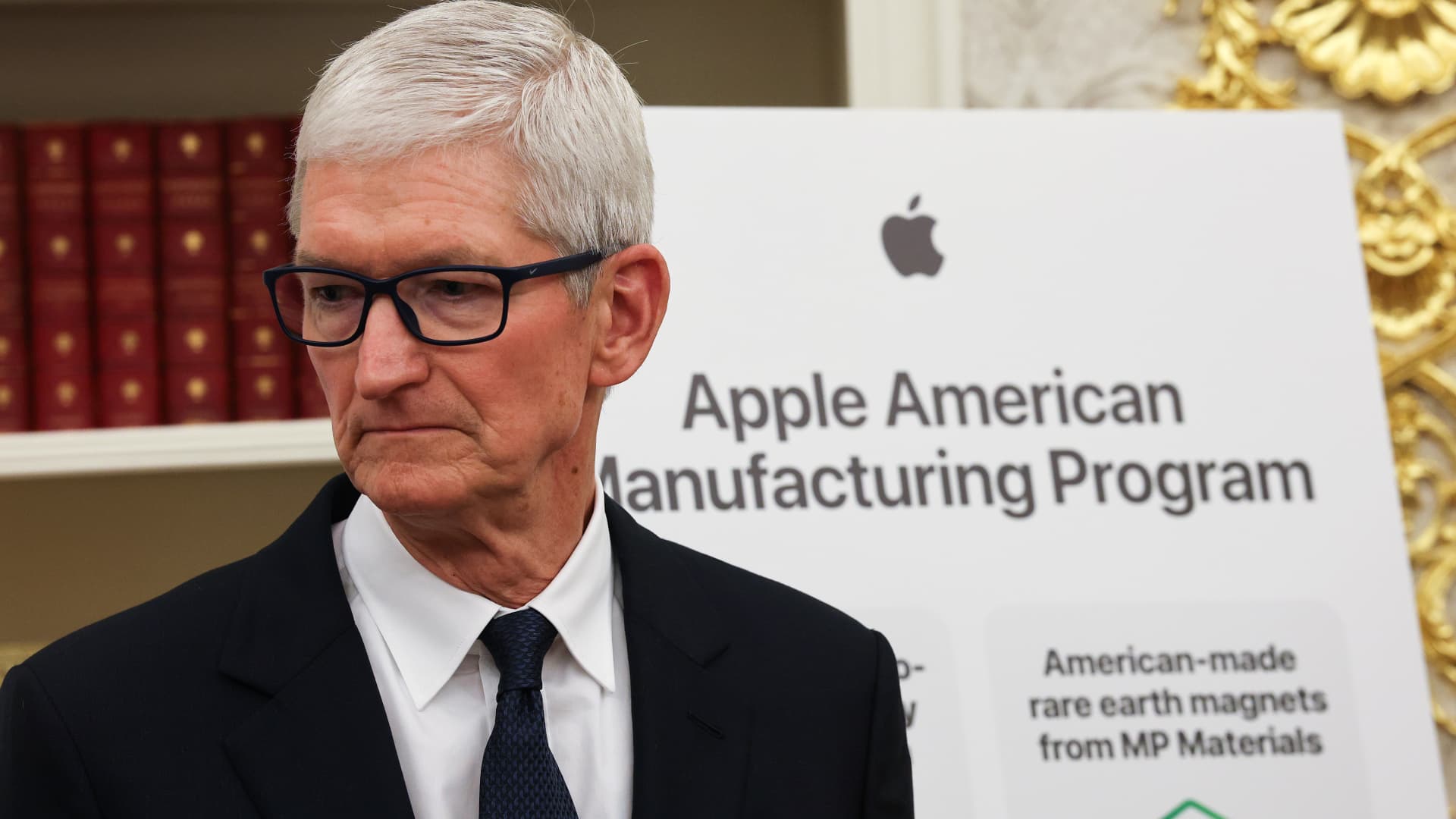
Apple CEO Tim Cook looks on during an event with President Donald Trump in the Oval Office of the White House on Aug. 6, 2025.
Win Mcnamee | Getty Images
Earlier this year, Mono Technologies assembled and shipped nearly 1,000 units of its flagship product, a $600 router development kit. Co-founder Tomaž Zaman, who started Mono in 2024, found early traction with networking aficionados, who use the product to speed their internet connections.
Then came the memory crunch, which has driven up the cost to produce practically every electronic device on the planet. Now, Zaman isn’t sure what to do, especially for the 1,300 prospective customers who put down a $100 deposit for his next production run.
Mono’s cost for 8 gigabytes of a type of DRAM from Micron shot up from $35 when he was first developing the product to $300 today. At his three-person company, Zaman said he hasn’t decided if he’ll go ahead with a second batch and increase the price by at least one-third, or introduce a new model with 75% less memory.
“Even a router of our class, it’s a poor value if you make it at $900, $1,000,” Zaman told CNBC in an interview. “But we have to, or we trim it down to the bare minimums.”
Zaman’s experience is becoming common across the consumer electronics market, from iconic devices like iPads and Xbox consoles to niche products that are barely past the testing phase. Costs are soaring due to a global supply crunch caused by the artificial intelligence boom, which has led chipmakers like Nvidia to suck up ever-increasing amounts of memory for their processors and advanced systems.
But while tech giants like Apple and Microsoft, which both announced price hikes this week, have a hefty cash cushion, supply chain leverage and customers numbering in the millions or billions, a much wider swath of businesses face potentially dire straits. Most consumer electronics companies have little margin to spare and can’t confidently raise prices in an economy already grappling with inflationary pressures.

GoPro, the struggling maker of action cameras, warned this month that it might go out of business after memory costs shot up between 80% and 115% at the end of the first quarter. And shares of speaker maker Sonos are down 23% this year as memory prices pressure margins.
Nabila Popal, an analyst at IDC, described the current situation as an “absolute existential crisis” for companies such as smaller Android phone manufacturers or “local players that are making devices below $100.”
“They won’t be able to get the memory because memory suppliers are only answering calls of the big players,” Popal said.
Pain is Micron’s gain
The flip side of the story was also on display this week.
In its quarterly earnings report on Wednesday, Micron said revenue in the latest period more than quadrupled, and its gross margin more than doubled to almost 85% from 39% a year ago. Micron shares jumped 16% on the results and are now up about 800% over the past year, rallying alongside rivals SK Hynix and Samsung.
Micron said the average selling price of its dynamic RAM in the third quarter rose more than 260% from a year ago. Sumit Sadana, Micron’s chief business officer, said in an interview that the company has struck long-term supply agreements with consumer-oriented smartphone and PC companies.
“We spend a lot of time thinking about how do we manage the business and the supply and the allocation of these scarce volumes to customers and segments and markets and geographies to ensure that we are being thoughtful, responsible and fair in our approach,” Sadana said.
Micron CEO Sanjay Mehrotra speaks at a groundbreaking ceremony for the company’s semiconductor manufacturing facility in Clay, New York, on Jan. 16, 2026.
Heather Ainsworth | Bloomberg | Getty Images
A day after Micron’s results, Apple raised prices on a wide range of iPads and Macs, saying in a statement that the company has “never seen a component price increase this much, this quickly.” CEO Tim Cook, in a Wall Street Journal interview published last week, said increases were coming, calling the memory situation a “hundred-year flood.”
Within hours of Apple’s announcement, Microsoft said the price of the Xbox Series S would increase by $100 to about $500. The company said in a blog post that consoles are typically sold for less than they cost to make.
“Console storage and memory prices have increased by more than 2.5x and we expect another doubling by the fall of 2027,” Microsoft said in the post. “The entire consumer electronics industry is struggling with the current components crisis, but the effects are particularly hard on consoles.”
Wall Street has its concerns, as both stocks fell this week and are underperforming the broader indexes this year. But panic levels are much higher at companies that lack close ties to component suppliers and are subject to constant cost changes and swings in availability.
Industries ranging from telecommunications and medical devices to retailers are concerned about the price increases, according to a letter from lobbyists sent to the Department of Commerce earlier this month.
GoPro said in its warning to investors that it heard from memory suppliers in April about “planned reductions in the production of the memory used in its products,” leading to lower projected sales volumes. The company didn’t respond to a request for comment.
Elaine Ferguson, co-founder of W5 Technologies, is wrestling with how to deal with crippling RAM costs and lead times for the communications equipment her company makes for defense contractors.
Earlier this year, W5 placed an order for a server from a major manufacturer to include in a satellite communications simulator that the company planned to deliver in May. Ferguson said the price when she ordered it was $8,839, up from $5,373 in 2020.
Since that purchase, the price has almost doubled.
“We just ordered another one for another sale,” Ferguson said. “It is now just under $15,000 and the lead time is anytime we get it, we’re lucky to get it.”
Instead of getting it in May, Ferguson said she’s now not expecting it until August. Ferguson said W5 offered the defense contractor client a used server that’s currently being tested and payment to fly her team out for installation.
Meanwhile, at Mono Technologies, Zaman said he’s working on development and qualification for the company’s next model, though he’s not sure when it will come to market. He’s also fundraising, hoping to find investors to back a new and larger production run.
“Product manufacturing is very expensive,” he said.
WATCH: The AI boom is making your tech more expensive


