



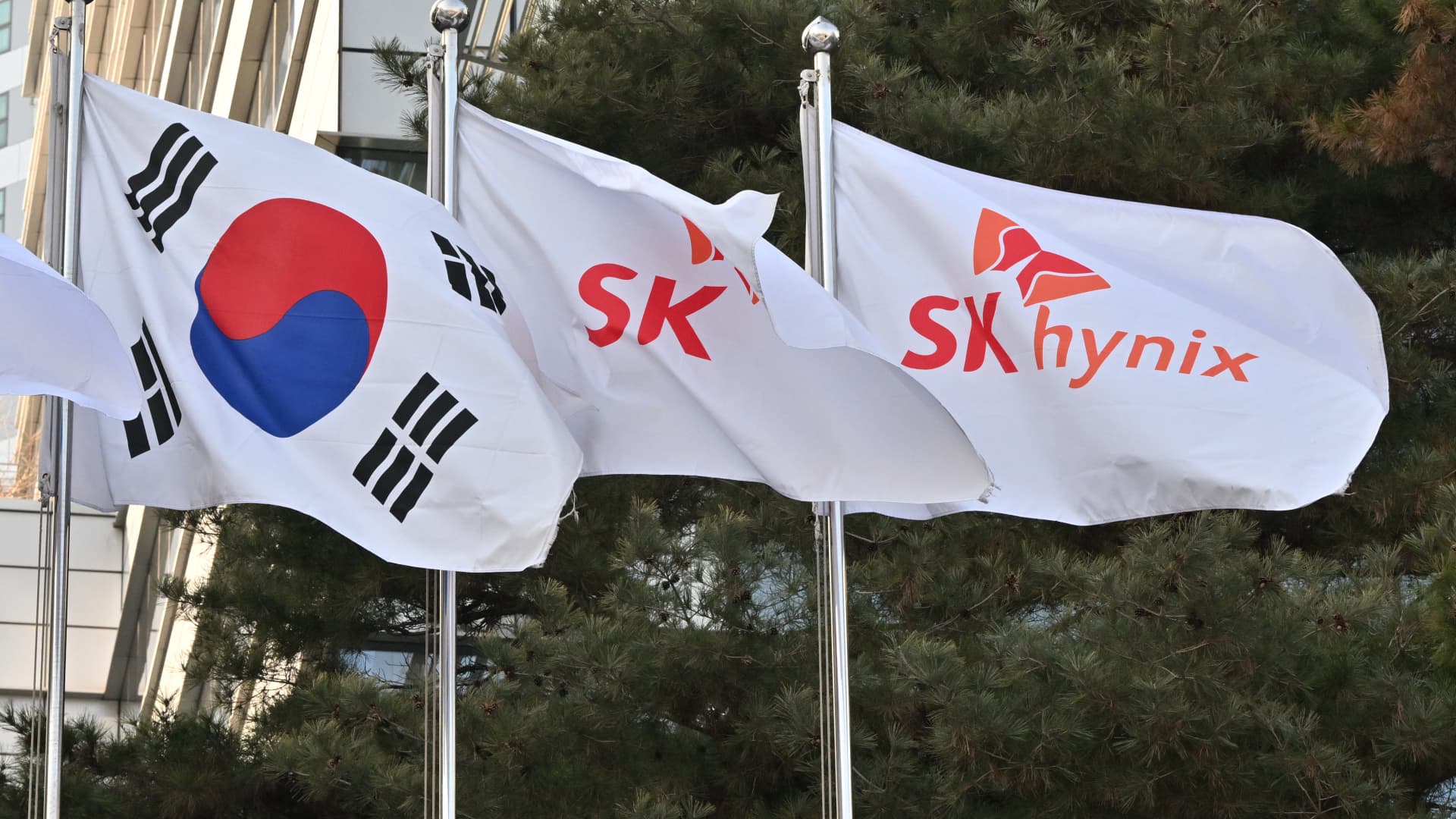
A SK Hynix flag (R) and a South Korean national flag (L) flutter outside the company’s Bundang office in Seongnam on Jan. 26, 2024.
Jung Yeon-je | Afp | Getty Images
U.S. investors are getting a new way to buy into the memory boom.
SK Hynix, the second most valuable company in South Korea, behind only Samsung, is slated to begin trading on the Nasdaq on Friday. The market debut, coinciding with the company’s hefty expansion plans for the U.S., comes after a more than sevenfold increase in its stock price over the past year, a rally that’s lifted SK Hynix’s market cap to about $1 trillion.
Many Americans don’t know the name SK Hynix, but they’ve likely had plenty of exposure to the company’s products. Along with Micron and Samsung, SK Hynix is one of three primary makers of computer memory used in laptops and phones sold by companies such as Apple and Dell.
Memory has long occupied a sleepy corner of the semiconductor market. That’s changed dramatically over the last couple years as surging demand for artificial intelligence has upended the industry, creating severe shortages for the chips and sending prices to all-time highs.
SK Hynix is the leader in the high-performance memory that’s used in AI chips from Nvidia, the world’s most valuable company. While memory components are typically relatively simple chips, often called RAM, that every computer needs to store data, high-bandwidth memory, or HBM, is more complicated, as it stacks many layers of traditional memory together. SK Hynix was the first to do it, and analysts project the company will capture more than half the market this year.
In June, Nvidia CEO Jensen Huang visited SK Hynix on a trip to Seoul, as the two companies announced a multiyear partnership. Nvidia is the biggest HBM buyer.
“That advantage has positioned SK Hynix as one of the biggest beneficiaries of the rapid growth in AI infra,” said TrendForce analyst Ellie Wang.

SK Hynix will trade on the Nasdaq under ticker symbol SKHY (initially SKHYV). The company plans to raise around $29 billion by issuing American depositary receipts, or ADRs, in order to fund new factories and equipment, according to a regulatory filing.
Some of that build-out is taking place in the U.S. SK Hynix is constructing its first production facility in the country, scheduled for completion in 2028. The $4 billion plant in West Lafayette, Indiana, will be used for what’s known as advanced packaging, an essential part of the process for producing HBM that involves connecting and stacking individual chips into larger systems that can be used in a computer.
SK Hynix expects to receive up to $458 million in funding from the U.S. CHIPS and Science Act, passed in 2022 as the centerpiece of a plan to build up the domestic chip industry. The company could also receive up to $570 million of loans from the U.S. Commerce Department.
It’s not just HBM that’s boosting SK Hynix. The whole memory industry is experiencing soaring prices due to the AI crunch, which means there’s also a shortage for traditional memory needed for phones, tablets, PCs, cars, medical devices and other products. Profit margins are hitting record levels.
More than three-quarters of SK Hynix’s revenue comes from RAM, including HBM. The company also makes NAND flash, or hard drives, and is the market leader, with 19% share in the first quarter, according to IDC.
SK Hynix’s financials are as eye-popping as its stock price. Annual revenue almost tripled from 2023 to 2025, when sales reached about $65 billion. For 2026, analysts polled by LSEG expect that number to more than triple again to about $235 billion.
History of boom and bust
The company’s path to the Nasdaq hasn’t been a consistent track up and to the right.
SK Hynix was founded in 1983 as Hyundai Electronics, a subsidiary of Korean conglomerate Hyundai. In 1997, during a financial crisis, it merged with LG Semicon as memory prices were slumping from a supply glut. Four years later, the company rebranded as Hynix Semiconductor, and then became SK Hynix when SK Telecom purchased a controlling stake in 2012.
As of March 31, according to the Securities and Exchange Commission filing, SK Square, “which was demerged from SK Telecom in 2021, held a 20.5% interest in us.”
Betting on memory booms has proven risky due to the cyclical nature of the business. Big tech shifts like the dot-com frenzy, the growth of smartphones, or the transition from packaged software to the cloud have brought huge demand for memory to power new devices. That’s often led to oversupply, followed by a collapse in prices.
The concern is pervasive today given the hypergrowth of AI. But the industry is trying to prepare for whatever volatility is to come.
SK Hynix, along with Micron and Samsung, are implementing long-term contracts for memory, using their market power to lock in prices and orders years into the future. In the past, memory companies often sold their supply on a quarterly or annual basis.
Companies of all sizes, including giants like Apple, are scrambling to secure memory.
“These agreements typically require customers to provide longer-term demand visibility,” said TrendForce’s Wang, allowing SK Hynix to plan its spending with more confidence.
Daniel Newman, an analyst and Futurum Group CEO, said investors have to weigh the risks of buying in at these levels, knowing what they know about the past.
“This is how memory always acts in any megacycle or supercycle,” Newman said. “The problem is, it always crashes hard.”
But, Newman added, if AI demand stays high in the years ahead, memory companies like SK Hynix are a bargain. Industry experts say that AI needs increasing amounts of memory in order to operate without hitting “the memory wall,” and memory vendors say the shortage won’t subside until at least 2027.

SK Hynix is banking on it.
In South Korea, SK Hynix is planning to spend up to $720 billion on expanding facilities to meet memory demand for AI, according to the company.
One cluster of chip fabrication plants in Yongin, just south of Seoul, will cost $390 billion. The company is speeding up the timeline for the project by more than a decade, with four fabs now scheduled for completion by 2033. Elsewhere in South Korea, SK Hynix is expanding its production facilities in Cheongju, and developing a new cluster of fabs in the southwestern region of the country.
The factories require that SK Hynix shell out large amounts of capital for crucial chipmaking equipment known as extreme ultraviolet lithography, or EUV, machines, which are necessary for etching the advanced circuitry needed to make and stack advanced chips like HBM. They’re hard to come by, cost up to $400 million and are only made by ASML in the Netherlands. SK Hynix plans to spend around $7.8 billion on new EUV machines by the end of 2027, according to the company’s filing with the SEC.
“If you go to Korea they are building lots of fabs,” said MS Hwang, research director at Counterpoint. “But it takes time. The earliest time frame that they can bring out manufactured wafers is end of 2027.”
In the U.S., SK Hynix has big expansion plans on top of its Indiana project.
The company said in January that it had set aside $10 billion to make investments for what it’s calling AI Company, an effort to find new product lines and back U.S. businesses.
AI Company’s biggest component is Solidigm. That business makes NAND flash memory and was purchased from Intel in 2021 for $9 billion. It’s now headquartered in Rancho Cordova, California, near Sacramento, where it develops new products, like solid state drives that can store more data.
The bulk of the action is still back home.
“Everybody is coming,” said Hwang, referring to companies swarming to South Korea to sign big contracts.
Hwang said word on the street is that nearby hotels are “fully booked” as cloud companies and chipmakers “are all lining up to sign a long-term contract.”
WATCH: Nvidia snaps up capacity for a key part of AI chipmaking, and the U.S. buildout may not be enough to keep up


