

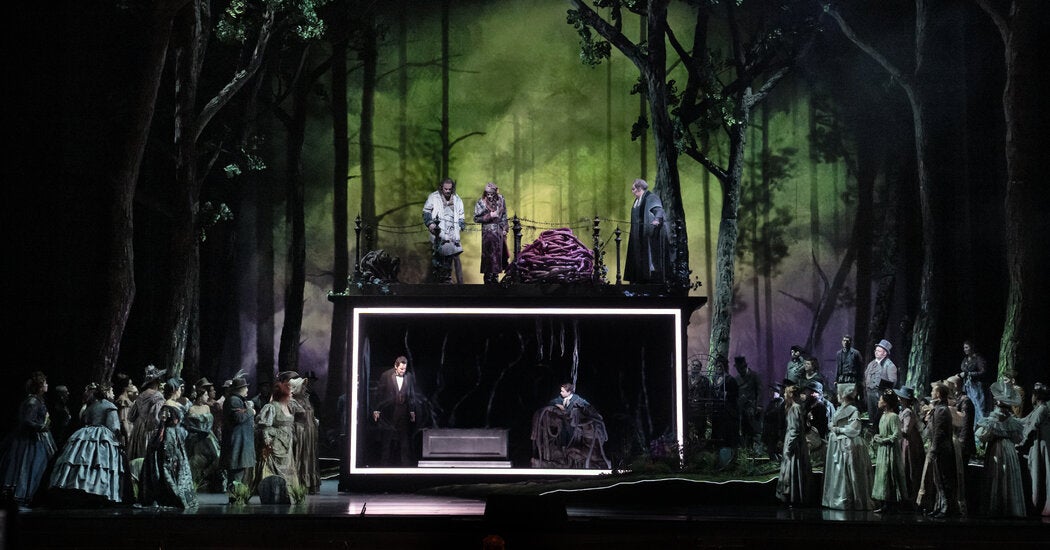
Lifted by celebrity endorsements, strong social media interest and favorable reviews, the Metropolitan Opera’s world premiere of “Lincoln in the Bardo” quickly sold out all nine of its performances this fall.
It is an unusually strong showing by a new opera, even one based on a book as popular as George Saunders’s 2017 novel, and it presented a quandary for the Metropolitan Opera. Given the inflexibility of its long-planned season schedule — not to mention the schedules of its sprawling, starry cast — the Met couldn’t simply pop a few more performances on the calendar. And Met executives had not included “Lincoln” on its roster of performances to be simulcast to 1,900 cinemas in 53 countries as part of its Live in HD series.
A solution was found. The final performance of “Lincoln,” on Saturday, will be livestreamed on the Met’s YouTube channel, which has 336,000 subscribers and is typically used for promotion. (It will be available through Nov. 18.) This is the first time the Met has streamed an entire opera on YouTube, a move that could potentially transform the way its productions are made available to a wider audience, particularly new operagoers and those who do not live in New York.
Paul Cremo, the director of the Met’s opera commissioning program, said: “We are really excited that people are getting to see it for free across the country and around the world, as well as people who wanted to see it again and couldn’t get tickets. There’s a lot of interest in it.”
There are risks. This was an ambitious undertaking: A technical rehearsal on Wednesday night required eight cameras in the hall and a line of big rigs along Amsterdam Avenue, including one that housed a small master control room crammed with 12 people, including Peter Gelb, the Met’s general manager. The $1 million cost of the transmission will be covered by Met donors.
But since the Met’s YouTube channel is free, there will be no revenue for the financially struggling company. The last time the Met streamed performances was during the pandemic, when it posted archive Live in HD recordings on its website. The Met sells an average of 100,000 tickets for Live in HD broadcasts, which produced $3 million in revenue in the 2024-25 season, said Gillian Brierley, the Met’s assistant general manager for marketing and communications.
Nevertheless, the Met is using the YouTube stream as a tool in its $1.5 billion fund-raising campaign: an onscreen fund-raising appeal allowing viewers to make contributions, starting at $1. (Viewers can disable the fund-raising button.)
“This is unknown territory,” Gelb said. “We haven’t done something quite as populist, in terms of free programming to a mass audience, since the pandemic. I don’t know how many people will watch it.”
Given the intimate nature of the small screen, some accommodations had to be made. A dummy used to depict Willie Lincoln in his coffin needed to be more lifelike for the cameras, so the Met made lifelike rubber casts of the head and hands of Everett Sobers, the 12-year-old singer who depicts Willie.
The success of “Lincoln,” with a score by Missy Mazzoli and a libretto by Royce Vavrek, comes as the Met has sought to add new works to a repertoire once dominated by traditional opera. Since the pandemic, it has presented 17 operas by living composers, including two world premieres: the staged version of Kevin Puts’s “The Hours,” and “Lincoln.”
“The audience has changed,” Cremo said. “I have been here 21 years. I have seen a real sea change in the sea of white-haired heads out in the audience. And there are a lot of young people who have grown up on cool indie films and TV. They are narratively very sophisticated. They are interested in diversity. And they want to see a world that reflects the world that they are living in.”
On average, new operas have sold about 10 percent more seats per performance than works from the traditional repertory. Some new operas have sold particularly well, among them Mason Bates’s “The Amazing Adventures of Kavalier & Clay” and Gabriela Lena Frank’s “El Último Sueño de Frida y Diego.” Others — including Kaija Saariaho’s “Innocence” and Jeanine Tesori’s “Grounded” — have been less successful.
Gelb said that “Kavalier,” “Frida” and “Lincoln” have done so well that they will be revived. Some operas given revivals faltered the second time around. “The Hours” and Terence Blanchard’s “Fire Shut Up in My Bones” fell short of their first runs.
Several factors contributed to the success of “Lincoln in the Bardo,” starting with the novel’s status and Saunders’ role in promoting the opera. Dua Lipa made a video about it that will be shown during Saturday’s intermission. And Mazzoli’s opera is the first Met world premiere of a work written by a woman.
“I’m thrilled that it’s selling so well,” Gelb said. “A new work — you never know until the curtain comes down and the audience reacts. But I have been hopeful for some time that this was going to be a big hit for us.”

