


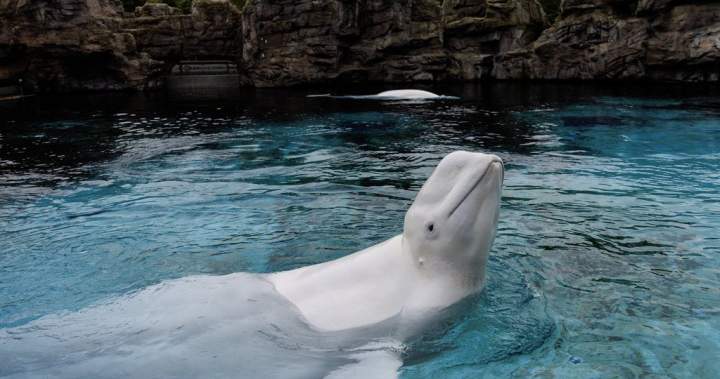
Canada’s last captive whales are set to leave the country on Monday as six belugas from Marineland are shipped to two aquariums in the United States.

The closed Niagara Falls, Ont., tourist attraction is up for sale and the park has said it is running out of money and can no longer care for its animals.
“There will no longer be any beluga whales or any other type of whales in captivity in Canada at the end of today,” said Andrew Burns, Marineland’s adviser.
Two of the belugas will be en route to Shedd Aquarium in Chicago and four to SeaWorld in San Antonio later on Monday.
Once the journey is complete, Marineland will have shipped 30 belugas and four dolphins over six moves to five different aquariums in the largest collective relocation of captive whales the world has ever seen.
The park has also shipped its marine mammals to SeaWorld in San Diego, Georgia Aquarium in Atlanta and Oceanografic Vdealencia in Spain.
Canada banned whale and dolphin captivity in 2019, but grandfathered in the animals at Marineland. The law also forbade breeding, which forced Marineland to separate its male and female belugas, and banned performances.
That was the beginning of the end of Marineland, whose founder, John Holer, died the year before in 2018.
Whale captivity in Canada began in 1964 with a killer whale named Moby Doll. Vancouver Aquarium initially sought to kill and display a killer whale, but when the harpoon didn’t kill Moby Doll, officials brought the animal ashore and put it in a makeshift tank.

Get breaking National news
Get breaking Canada news delivered to your inbox as it happens so you won’t miss a trending story.
People flocked to see the animal, but Moby Doll died after 88 days in captivity. But by then, a new industry in Canada came to life.

Holer had already been smitten with the circus world and he bought a small parcel of land not far from Horseshoe Falls in 1961. He built up Marineland over years, leaning heavily on acquiring and showing off marine mammals such as killer whales, belugas and dolphins, along with building roller-coasters and other rides.
Marineland was at one point the country’s most popular amusement park.
Holer’s widow, Marie Holer, took over after his death in what would prove to be difficult years, as the COVID-19 pandemic wreaked havoc on Marineland and other tourist attractions. As the world recovered, Marineland did not.
By early 2024, Marie Holer put the park up for sale before she died in September of that year.
It was also a difficult time for the animals. One killer whale, one dolphin and 19 belugas have died at Marineland since 2019, according to an ongoing tally by The Canadian Press based on internal government documents and official statements.
At one point in 2021, the provincial government, which enforces animal cruelty laws, declared all marine mammals were in distress at the park due to poor water quality.
Marineland poured in millions of dollars to fix its water. The province’s chief animal welfare inspector would later say the water problems did not cause or contribute to the animals’ deaths and the park has pointed the finger at the 2019 law as the reason behind a few of those deaths.
Over the past few years, the park has slowly relocated many of its animals, though several hundred deer still remain. The bison heard was moved, as were its penguins. A dozen bears moved to a sanctuary in Colorado in the spring.
Sources say a deal for the land is done, but is conditional upon the park removing its animals.
Last year, Marineland finalized a deal to sell all of its belugas and dolphins to Chimelong Ocean Kingdom in China, which holds a Guinness World Record for the world’s largest aquarium. It was the only place in the world Marineland could find that was capable of taking the largest collection of captive belugas on earth.
However, the federal government blocked Marineland’s request to export the belugas there. Fisheries Minister Joanne Thompson said it would not be in the whales’ best interests because China did not have the same laws against breeding and performing.
That decision set off Marineland and its top adviser, Andrew Burns. The park threatened to euthanize its whales unless it received an emergency cash infusion from the federal government.
Burns scrambled to find another partner and eventually a consortium of aquariums, largely from the U.S., came together to help.
The whale and dolphin moves have not been without risk.
Peekachu, a 23-year-old beluga that moved to the Shedd Aquarium on Aug. 12, died two weeks later. The Chicago aquarium said blood work revealed Peekachu was severely dehydrated before she died.
© 2026 The Canadian Press

