

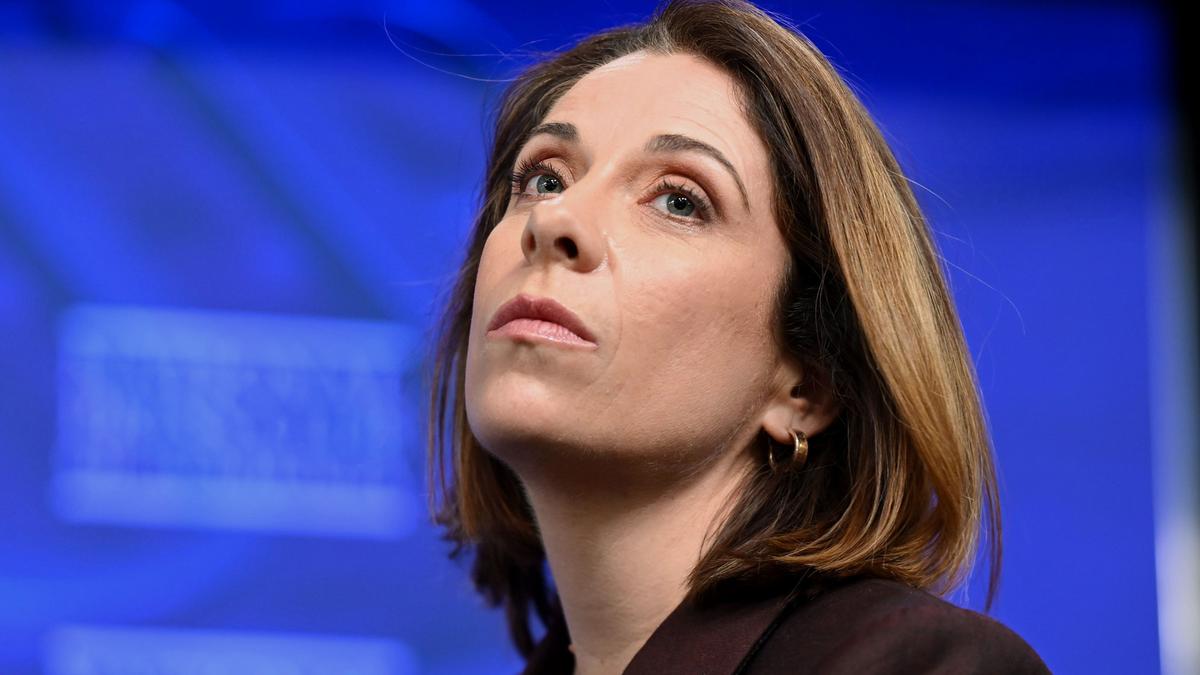
Labor is open to a key Greens demand to let individuals and class actions sue big tech companies over harm caused by their platforms, Communications Minister Anika Wells has revealed.
Ms Wells acknowledged the success of “private right of action” laws in the US in pushing tech companies to make their platforms safer, and said it was an option she would consider during negotiations over Labor’s Digital Duty of Care laws.
The revised legislation was introduced to Parliament on Wednesday after several changes were made following consultation on an exposure draft released in early September.
Labor will need to negotiate with either the crossbench or the Coalition to get the laws through the Senate.
The Greens and Coalition have vowed to push for a Senate inquiry before the final sitting week in late November, with Greens Senator Sarah Hanson-Young setting November 20 as the committee’s reporting deadline.
Addressing the National Press Club on Wednesday, Ms Wells urged parliamentarians to put politics aside, arguing the laws could become a “proud Australian achievement” regardless of which party delivered them.
“In time, nobody will remember my name, or the politics of the day on which MPs and senators walked into the chamber and voted on this Bill. They’ll only remember whether we got it right,” she said.
While Labor could shift on some of the Greens’ key demands, Ms Wells also revealed the Coalition had reached out to engage with her on the legislation.
It comes after shadow communications minister Sarah Henderson attacked the Bill at a conservative forum in Brisbane at the weekend, describing it as a Labor “Trojan horse” designed to “impose political censorship”.
Her concerns about freedom of speech were echoed by One Nation leader Pauline Hanson and outspoken American free speech activist Michael Shellenberger.
Ms Wells dismissed the critics as the “yeah … but brigade” and hecklers, insisting the Bill was not “a stepping stone for regulating misinformation and disinformation”.
“If adults listen to manosphere podcasts, or people post their views about the Government, or make memes, or want to say the moon landing was fake — they can continue to do so without restriction.
“We are not controlling free speech. And we are not conducting covert surveillance.”
One of the main points of contention is a provision allowing the eSafety Commissioner and researchers to create “sock puppet accounts” — false online identities used to investigate platforms undercover.
Ms Wells said the accounts were crucial to allowing online safety experts to test how tech companies complied with the laws.
“In many cases, the only way eSafety or researchers can examine those questions is to create a test account as a 14-year-old for the purpose of investigation,” she said.
“These provisions simply make that lawful and the evidence they collect usable. Australian researchers used sock puppets to show how they responded to complaints about eating disorder content on their platforms.”
Ms Wells rejected suggestions a government could use the provision to create multiple undercover accounts to spread propaganda online.
“I would say it is just absolutely nothing of the sort,” she said.
Ms Wells said that eSafety and accredited researchers wanted the protections so they could conduct investigations in Australia, rather than operate from overseas without legal cover, and use the evidence they gathered in compliance and enforcement action.
Under Labor’s plan, tech companies would be required to proactively protect users from online harm.
A centrepiece of the legislation is the “My Feed, My Way” initiative, which would give users the choice to opt out of algorithm-driven feeds served up by tech companies.
Ms Wells and Prime Minister Anthony Albanese had proposed that a push notification could be sent to users asking them what type of feed they would prefer.
That proposal, however, still falls short of advocates’ calls for an opt-out default feed, which would require users to actively “opt-in” to algorithmic feeds.
Despite this, founder of advocacy group Teach Us Consent Chanel Contos welcomed that Australia was seeking to implement algorithm choice.
She said the algorithm choice should be “prominently available (and) that the choice sticks with platforms unable to revert users back to a default every time they open the app”.
“We’re glad to see this reflected in the proposed user empowerment tool,” she said.
“We’ve been clear throughout that opt-in algorithms are one actionable policy that must sit within a much broader suite of reforms to make online spaces safer and prevent gender-based violence.”

Ms Contos said the following-based feed shouldn’t be harder and less desirable to navigate than an algorithmic as seen as a tech tactic in other jurisdictions.
“These rules directly address the malicious compliance we’ve seen from tech companies in other jurisdictions, notably the EU, where platforms found ways to technically comply with weaker rules while defeating their purpose in practice,” she said.
Unlike the social media ban for under 16s, the digital duty of care will cover a wide range of digital providers, including messaging and gaming platforms, search engines, app stores, generative AI models, chat forums and more.
Tech giants will likely be forced to take down harmful content, conduct regular safety audits, and be transparent about data collection and algorithms.
UNICEF Australia’s Head of Digital Policy John Livingstone said the laws, which amend the Online Safety Act 2021, were an important opportunity “to put children’s safety at the centre of Australia’s digital world”.
“This will mean that when an Australian teenager opens their social media feed, they’ll see less harmful content, their feed will not scroll endlessly, and the strongest safety settings will be switched on automatically,” he said.
“It would help ensure that safety is not an optional extra, but a fundamental responsibility for the companies shaping children’s online experiences every day,”
While Ms Wells has indicated she’s open to some of the Greens demands, Senator Hanson Young said another red line was around tying penalties to a percentage of a tech company’s global profits.
She said it would be more of a deterrent than a set monetary amount which would be chump change compared to their multi-billion-dollar yearly revenue.
If a tech company fails to comply with the Act they could face fines of up to $109 million.

