



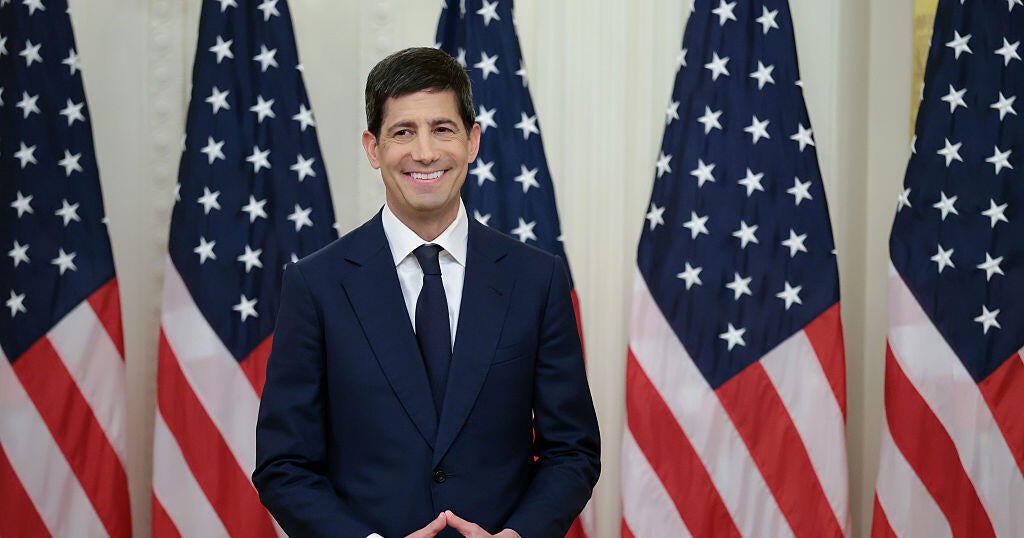
Washington — Kevin Warsh was sworn in as the chairman of the Federal Reserve on Friday, taking the reins of the central bank from Jerome Powell after a ceremony at the White House.
“With this oath, I’ve accepted a high and solemn responsibility,” Warsh said.
“Our mandate at the Fed is to promote price stability and maximum employment,” he said. “When we pursue those aims with wisdom and clarity, independence and resolve, inflation can be lower, growth stronger, real take-home pay higher and America can be more prosperous. And no less important, America’s place in the world more secure.”
Warsh said he will “lead a reform-oriented Federal Reserve, learning from past successes and mistakes both, escaping static frameworks and models, and upholding clear standards of integrity and performance.”
President Trump introduced Warsh in the White House East Room, addressing a crowd that included Supreme Court justices, members of Congress, Cabinet members and business leaders. Justice Clarence Thomas swore Warsh into office. He took the oath on a Bible held by his wife.
“Honestly, I really mean this, this is not said in any other way, I want Kevin to be totally independent,” Mr. Trump said. “I want him to be independent and just do a great job. Don’t look at me, don’t look at anybody, just do your own thing and do a great job, OK?”
Roberto Schmidt / Getty Images 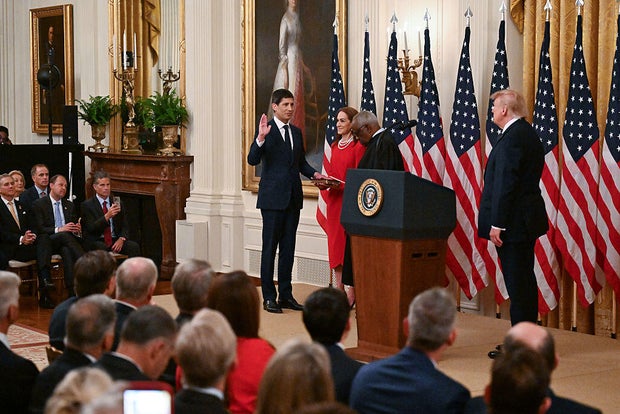
The president said he thinks Warsh “will go down as one of the truly great chairmen of the Federal Reserve that we’ve ever had,” adding that he has “abilities that very few people have” and is “respected by everybody.”
Mr. Trump hasn’t been shy about his goals for the Federal Reserve. Over the last year, he has pushed the central bank to rapidly slash interest rates, and he’s attacked Powell relentlessly for lowering rates at a slow and cautious clip. Lower rates could boost economic growth and cut borrowing costs, but they could also cause inflation to resurge.
The president branded Powell a “numbskull,” a “stubborn mule” and a “moron,” and openly flirted with firing him. Powell alleged that the Justice Department launched a criminal investigation in order to intimidate him, which prosecutors denied but a judge agreed with. Prosecutors closed the probe last month because the Fed’s internal watchdog is taking it over.
Powell has chaired the Fed since 2018, steering the central bank through the COVID-19 pandemic and a severe run-up in inflation.
Warsh has vowed to preserve the Fed’s independence over monetary policy, telling lawmakers he will never “predetermine” interest rates at Mr. Trump’s request. He has suggested he’s open to working with the Trump administration on other issues, arguing last year that the Fed and the Treasury Department could strike a new “accord” governing the central bank’s balance sheet.
It’s unclear whether Warsh will deliver on the president’s desire for lower rates. Monetary policy decisions are made by a committee of 12 top Fed officials, and while the chair usually has a lot of sway, Warsh would still need to persuade the panel that rate cuts make sense.
Right now, the Fed is dealing with a tricky economic picture. Inflation is still above the Fed’s 2% target, and it spiked in March due to the Iran war. Some supporters of rate cuts are concerned the labor market could weaken, though employment figures have been strong.
Members of the rate-setting committee are divided — and some of them seem unconvinced that they should ease rates. The panel voted to leave rates stable at its last meeting in April, but three members objected to a sentence in the Fed’s post-meeting statement that hinted at cuts. A “majority” of participants felt that a rate increase would probably be necessary if inflation remains stuck above 2% per year, according to meeting minutes released earlier this week.
Financial markets also don’t expect an interest rate cut any time soon. Investors believe the most likely scenario is for the committee to leave rates stable at its next meeting in June, and by the end of the year, investors think there’s a 70% chance that rates will be above their current levels, according to CME Group’s FedWatch, which tracks market sentiment.
In a break with tradition, one of the deciders will be Powell. He is planning to remain on the Fed’s Board of Governors — entitling him to a seat on the rate-setting committee — until he decides the Justice Department probe is “well and truly over.”
Warsh, for his part, has not hinted at whether he will pursue rate cuts.
When Warsh served on the Fed board from 2006 to 2011, he had a reputation as a hawk, known for preferring tighter monetary policy. But last year, he came out in favor of lower rates, and he has argued that artificial intelligence will push down inflation and boost productivity, giving the Fed room to ease up. That could be a point of debate on the rate-setting committee: At least one other member thinks the AI boom might cause higher inflation.
Randall Kroszner — who served with Warsh on the Fed board and as an economic staffer under former President George W. Bush — told CBS News last week he does not expect Warsh to give into short-term political pressure.
“Kevin is a long-run strategic thinker,” said Kroszner, who is now a University of Chicago professor. “He understands that to get things done, you need to … build a consensus around things. You can’t just come in and say, ‘Off with their heads, I want to do this or I want to do that.’ That’s not going to be very effective.”

