



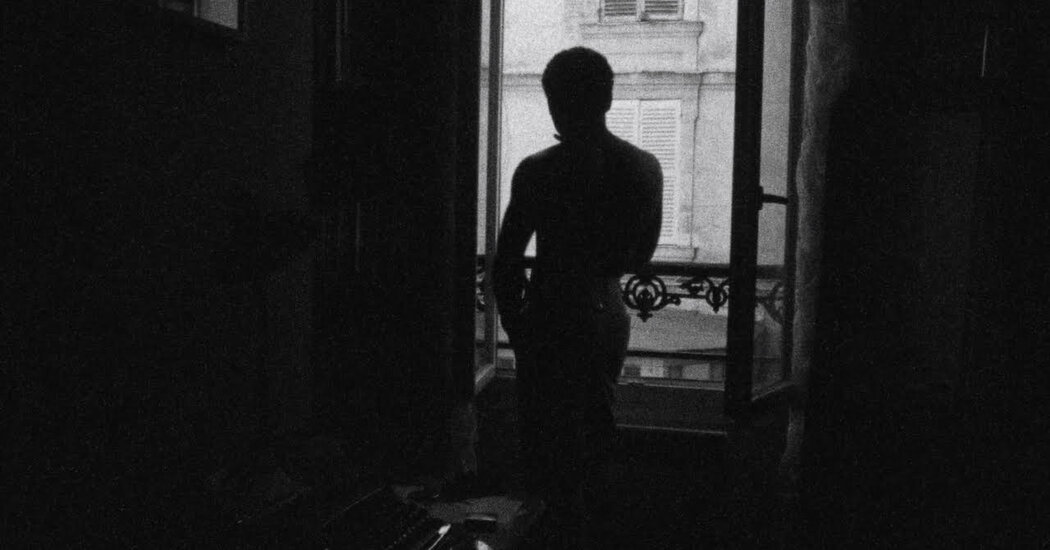
Imitation may be the sincerest form of flattery, but what the writer James Baldwin (1924-87) has called forth is something more profound, expansive — and touching. Posthumously, he has inspired an intergenerational call and response. Those stirred include but are hardly limited to: Ta-Nehisi Coates and his eloquent 2015 epistle, “Between the World and Me”; and the filmmaker Raoul Peck and “I Am Not Your Negro” (2016), his elegiac and personal imagining of Baldwin’s unfinished book about his friendship with Martin Luther King Jr. and Malcolm X.
For his elegant debut feature, “Jimmy” — photographed in black-and-white — the Brooklyn-based director Yashaddai Owens took his Bolex movie camera to Turkey and then onto France to capture, he has said, “the essence” of the young and preternaturally gifted author who spent time in these two countries before he became a literary quasar.
Owens initially drops down into Istanbul, where his camera is a body, walking and watching. The filmmaker, who is the director, writer, cinematographer and editor, is offering a primer on how to inhabit this world as Baldwin had, with myriad glimpses up close, at a remove, blurred, tightly lensed. Gulls’ wings. A cat and man eye each other. Two women sit in front of a window on a ferry. Most memorably, a man appears to offer us a cup of coffee on a tray.
It’s only after “Jimmy” shifts to Paris that we meet its titular subject whose transformational journey is depicted in oblique, glancing ways. From the moment he gets in a taxi, he is often in a state of wide-eyed, heavy-lidded wonder. He’s curious, watchful. And in a twist, this movie about a loquacious thinker and prolific writer is almost word-free. A fact that makes the moment in which Baldwin (Benny O. Arthur) reads from his fourth nonfiction book, “No Name in the Street” (1972), incandescent, and what follows is both rousing and rending.
Arthur embodies Baldwin with an avid grasp of the contemplative and the corporal. Jimmy sees anew. He saunters. He pokes around park and outdoor markets. In his room, he dances birdlike — a duckling turned swan! He conjures Gene Kelly in “Singing in the Rain” as he moves along a boulevard. Only there’s no rain pouring down, just love bubbling up. And, finally, vitally, he begins writing. The scratching of pen to paper heralds a history beginning — his and ours.
Recollection or recounting are not what Owens is after here. The notion of a reimagining falls even further from the truth of this cinematic evocation and deep-welled benediction. “Jimmy” aims to be restorative. It aches to bestow joy to him and to make sure we see this young pensive artist as a Black gay man far from a vexing home.
Owens has made choices both nostalgic and in defiance of place and time. There is little effort to situate “Jimmy” in a set-designed past. The director delivers his visions, at times hallucinatory, other times ecstatic, with the sonic guidance of the composer Paco Andreo, who has concocted a delicious score — with its sneaky, seductive snare, brushed cymbals and double bass — that is evocative of great Black jazz artists. And the film feels just suggestive enough of 1948 — the year Baldwin discovered the City of Light or la ville lumière, a moniker that nods at the cinematic ambitions of the self-taught Owens. With “Jimmy” he is working to capture Promethean lightning in a Bolex.
Jimmy
Not rated. Running time: 1 hour 7 minutes. In theaters.

