

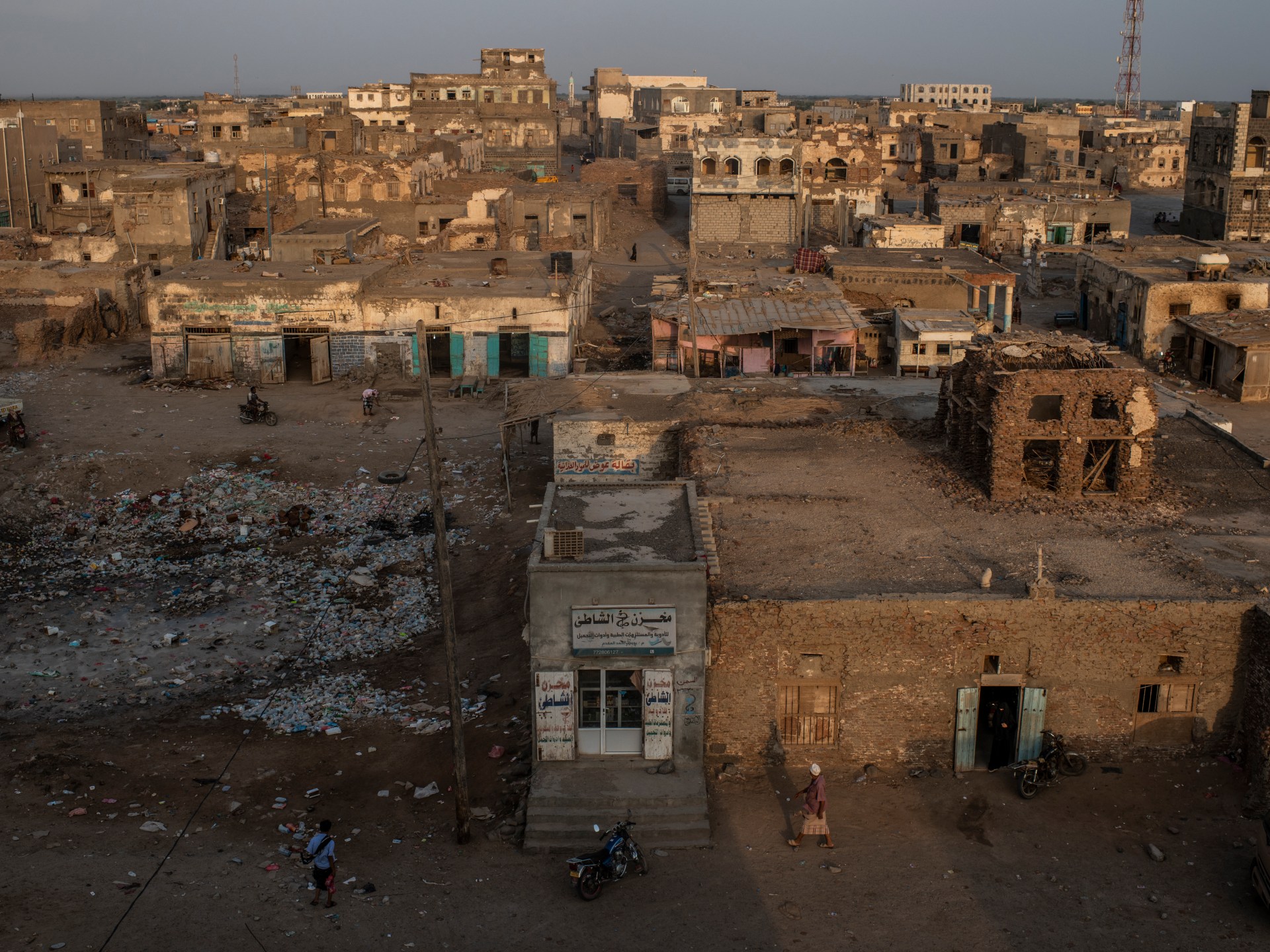
Nabil watched from his balcony as a column of displaced people passed by at dawn on September 10, hours before Houthi forces entered Mocha, a Yemeni city on the Red Sea.
“People were terrified. There was fear everywhere,” he said.
Recommended Stories
list of 4 itemsend of list
Nabil, a daily wage labourer in his 40s, did not join them. He still lives in Yakhtul, a village north of Mocha, alongside relatives, none of whom has left their homes.
“Displacement is humiliation and homelessness,” he said. “I haven’t done anything wrong, so I have nothing to be afraid of, and I don’t belong to any side.”
Weeks after the Houthis took Mocha from forces loyal to Yemen’s internationally recognised government, thousands of civilians remain in the district. The Houthis – an armed group that has controlled much of northern Yemen, including the capital, Sanaa, since September 2014 – have fought the government for more than a decade in a civil war that has drawn in a Saudi-led military coalition. No one knows how many people remain in Mocha, but according to Yemen’s last census in 2004 the city had 62,500 residents.
The government has declared Mocha a military zone and alleged that the Houthis have forced residents to demonstrate in support of the group or join its ranks.
Residents interviewed by Al Jazeera did not describe forced demonstrations, but one who asked not to be identified because he feared for his safety said three of his neighbours have been recruited and armed by the Houthis. They are now on the front lines fighting against government forces.
“Today my wife heard from a woman who came to our house that a Houthi-armed pick-up truck had kept coming to their home, wanting to recruit her sons, but she refused,” he said. “I know these people. They are our neighbours. One of her sons even spoke to me about it himself.”
The truck left after she refused, he said.
A refuge emptied
Mocha’s port lies about 75km (45 miles) north of the Bab al-Mandeb strait, a chokepoint for Red Sea shipping that the Houthis have repeatedly targeted since late 2023.
After government-aligned forces recaptured Mocha in 2017, the city became a refuge for Yemenis fleeing Houthi-controlled territory.
That changed in early September when fighting moved down the coast and families fled towards Aden, Taiz and Lahij. Many had already escaped Houthi rule once before.
On the evening of September 10, the government declared Mocha and its surroundings a “kill box”, a strike zone, warning that any Houthi movement there would be met with available firepower. Attacks began the following day.
Now residents say that leaving Mocha is almost impossible. “After the kill box was declared, the government opened the old al-Barh road so people could leave,” said Fuad, a 27-year-old pharmacist.
“Some got out, some were prevented by the Houthis and some stayed home, fearing the hardship of displacement.”
The Houthis have imposed a nighttime curfew on the city. Prices have soared, and power cuts have grown frequent, Nabil said.
A cooking gas cylinder has more than doubled in price to about 20,000 rials ($13), and a 50kg (110lb) sack of flour has risen by 8,000 rials ($5).
“A day’s work barely covers petrol and lunch,” he said. “Children have stopped going to school.”
Classrooms remain largely empty. “Parents and students are afraid of shelling or of their sons being thrown onto the front lines,” said Mansour, a teacher at a government secondary school who could not afford to flee with his family of seven.
“I am a teacher. I have nothing to do with politics,” he said. “In the end, we only die once.”
For Umm Khaled, a woman in her 60s whose husband is disabled and bedridden, leaving Mocha was never an option. “Where would I flee to? Look at my situation,” she said.

Her son, who had supported the family by fishing, joined the government-aligned National Resistance Forces for a monthly salary of 1,000 Saudi riyals ($267). He fled with them as the Houthis advanced, leaving behind his wife and two children, aged 15 and nine, in her care.
“Now they have fled, and we are lost,” she said. The local grocer has stopped extending credit, and the family survives on a sack of flour distributed by an aid group before the takeover. “Someone brings a fish, someone brings a yogurt and the rest is up to God,” she added.
Hassan, a 40-year-old fisherman who supports nine people, said he could not afford to leave the city. A ride to nearby Taiz costs up to 200,000 rials ($128). “Where would I go when I don’t even have my daily bread?” he asked.
Attacks and collapsed healthcare
Civilians have also been killed in the “kill zone”.
Before dawn on September 22, the bombing of a house in Mocha killed six members of one family, according to Mahmoud al-Otmi, a journalist with Saudi-owned Al-Hadath news channel whose relatives died.

Houthi-run media blamed Saudi air strikes. Saudi Arabia has not commented publicly.
Colonel Abdulbaset al-Bahr, deputy head of moral guidance in the government’s Taiz military command, said the kill box targets Houthi fighters.
“The kill box is for killing the militia, not civilians,” he said. “The statement did not ask civilians to leave the kill box area. Rather it asked them to stay in their homes and keep away from the militia’s barracks, positions and military gatherings.”
Sultan Mahmoud, the government-appointed director of the Mocha district, said no route out of the city was entirely safe as he accused the Houthis of targeting civilians.
Healthcare has nearly collapsed. On the day Houthi forces entered the city, Doctors Without Borders, also known by its French acronym MSF, said nearly all health facilities except Mocha General Hospital had stopped functioning. This was largely because staff had fled although about 30 health workers stayed behind, MSF told The National newspaper.
Residents said conditions in Mocha have since worsened.
“Doctors who were paid by organisations have stopped working because there are no salaries,” Nabil said. Fuad said the Houthis had placed hospitals under a security cordon and some medical equipment had been moved to Sanaa.
Aid has barely reached those who have stayed. Najib al-Saadi, head of the government’s executive unit for displacement camps, said his unit could not reach those in need.
“It is certain that there are families who could not flee because of poverty,” he said, accusing the Houthis of blocking humanitarian work. The International Committee of the Red Cross declined to comment.
In Yakhtul, Nabil said he would not leave, even if the fighting intensifies. “First, money is an obstacle,” he said. “And the house would be looted.”
This story was published in collaboration with Egab.

