



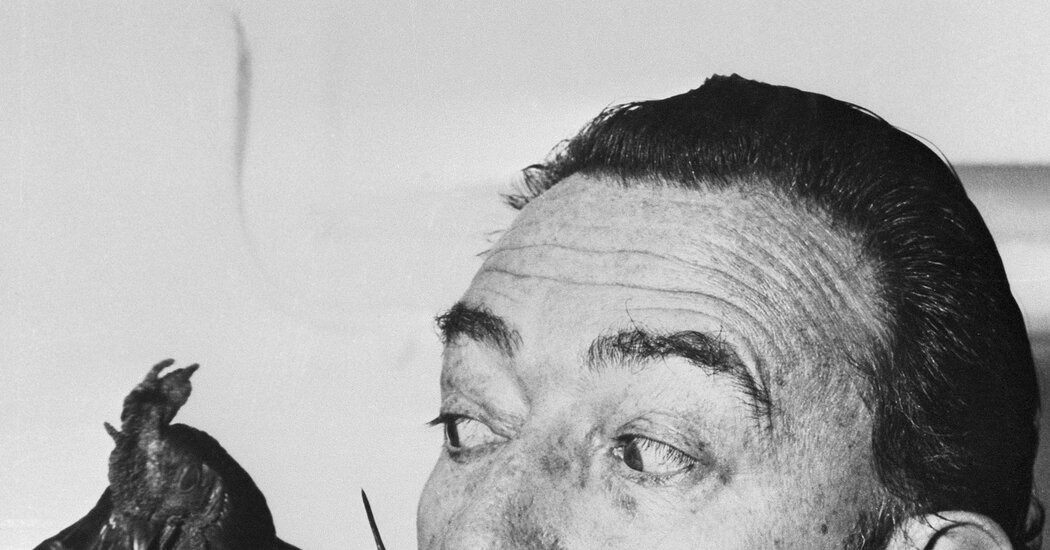
It was a sweaty summer day in London in 1936, and Salvador Dalí was giving a lecture in a deep-sea diving suit.
Through the window of the clunky metal helmet, he told the audience in French that they were “blotches on the face of space,” as The Daily Mirror reported, and demanded that some of his slides be presented upside down.
One slide showed a woman’s foot and something that looked like “a bed of watercress,” according to The Mirror. The image, Dalí said, represented “Greta Garbo protecting herself against journalists!”
Dalí, who had entered the room towing two wolfhounds, got a little too hot in the helmet and had to be pried out, nearly suffocating in the process. He then continued with his lecture.
The presentation was part of the International Surrealist Exhibition, which took place at a gallery in Mayfair from June 11 to July 4. It was the first time a major collection of Surrealist art was shown in Britain, featuring almost 400 works by 68 artists.
It caused a sensation and launched the movement in Britain. Aside from Dalí, the exhibition included other famous names associated with Surrealism, like Pablo Picasso and René Magritte, as well as artists who were well-known in Britain, like Paul Nash.
Ninety years later and about two miles south, the Treasure House Fair is celebrating the gathering with an exhibition called “British Surrealism and Beyond: Treasures from Southampton City Art Gallery,” featuring about 40 works, including by some of the artists who showcased their work in 1936.
The fair, which brings together dealers of rare art works, sculptures, jewelry and other curiosities, runs from June 24 to 30 at the Royal Hospital Chelsea in London.
Surrealism, an art movement known for often bizarre representations of the unconscious mind, was founded in France in 1924 by André Breton, who argued that people should reject realism and embrace the “omnipotence of dreams.”
Though the movement’s influence has endured until today, many of the works that will be on display this month have spent decades in storage, said Thomas Woodham‑Smith, the director and co-founder of the fair. There are “quite a lot of works that will be coming to Treasure House that haven’t been seen for 20, 30, 40, even 50 years,” he said.
Among that work is “Good Shooting” by Roland Penrose, a pivotal organizer of the 1936 exhibition and a proponent of Surrealism in Britain. His painting depicts a woman, believed to be his eventual wife, the war photographer Lee Miller, who appears naked from the torso up, arms over her head, with a seascape in place of a head.
The fair’s exhibition will also feature work by lesser-known British artists, like Eileen Agar, one of only a few women at the 1936 exhibition. “The Object Lesson,” like most of her work, combines an abstract painting and found objects, like a wicker rack and a figurine.
By 1936, Surrealism had already spread through Europe and was “omnipresent” in painting, sculpture, photography and writing, according to a 1986 Times article. But for much of the British public, the London show was a first introduction not just to an unusual aesthetic, but a novel philosophy that rejected rationality and embraced the illogical. As Rupert Lee, the chairman of the 1936 exhibition, wrote, the movement is “an attitude toward life rather than an attitude toward the arts.”
Woodham‑Smith said that Surrealism was also a response to distressing world events, at a time when people were still reeling from the First World War and as tensions were mounting in Europe before the Spanish Civil War. The Surrealists embraced the “feeling that you need another language to express and explain what’s going on,” he said.
Herbert Read, an English Surrealist, wrote in the exhibition’s catalog: “It is not just another amusing stunt. It is defiant — the desperate act of men too profoundly convinced of the rottenness of our civilization to want to save a shred of its respectability.”
Woodham‑Smith said that this attitude toward art “feels very timely now, but it was absolutely shocking then.”
This sentiment was reflected in the British press, where the event was vigorously covered and analyzed.
“Beautiful, horrible, laughable, awe-inspiring, absurd, worthy of the deepest respect? Every sort of judgment can find a justification,” wrote The Bystander, a weekly magazine at the time.
Others were less impressed: “There is something stale about all these. Nobody is so boring as the man who is always trying to astonish you,” wrote the News Chronicle.
Nevertheless, the exhibition drew 23,000 visitors, enough to stop nearby traffic. The antics of the Surrealists — who The Daily Herald described as the “Marx Brothers of Art” — were a hot topic around town.
In one stunt, an anonymous woman, who turned out to be the artist Sheila Legge, paraded around as the “Surrealist Phantom” in a white, satin dress, her face covered in a veil of roses. She carried a mannequin leg (originally a pork chop, but some said it was discarded when it started to smell).
The Welsh poet Dylan Thomas offered attendees cups of boiled string, asking if they liked it strong or weak. Breton, the movement’s founder, “wears green suits, smokes a green pipe and drinks green aperitif,” wrote the Birmingham Daily Gazette. The story continued: “Their works are as weird as their personalities suggest.”
Woodham‑Smith said that following the exhibition, Surrealist work became increasingly popular with British collectors, and other artists were inspired by what they had seen. “Basically anything made in Britain from 1936 onwards would have had in the distance an echo of this show,” he said.
Exhibitions that same year in places like New York continued to broaden the movement’s reach. In the decades since, Surrealism, which celebrated its 100th anniversary in 2024, has become so ubiquitous that people now describe strange occurrences as “surreal.”
Which may have been what some attendees at the 1936 exhibition experienced. According to the Daily Mirror: “Those who went to find out what Surrealism is, came away shocked, amused, scared or just bored.”

