

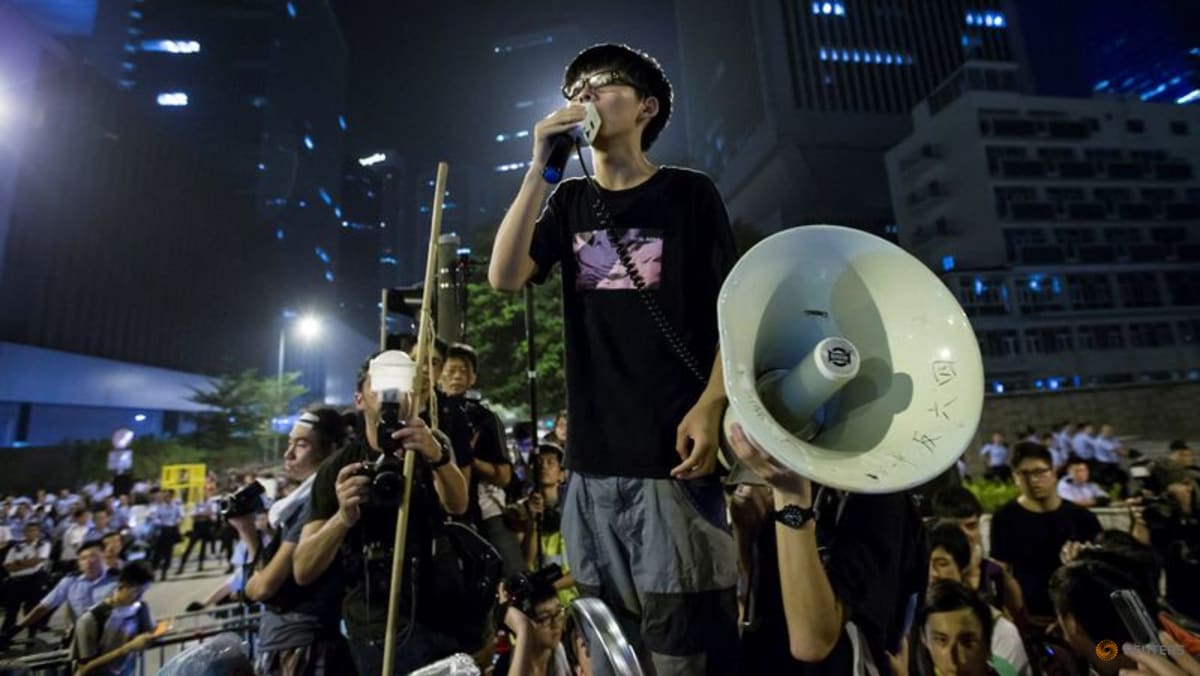
“BLACK HAND”
Wong became a familiar face on the international scene and a thorn in the side of authorities in Beijing and Hong Kong, featuring on the front cover of Time magazine in 2014 and in a Netflix documentary in 2017 that chronicled his political life.
Along with other Hong Kong critics of mainland China, including media tycoon Jimmy Lai, he was repeatedly nominated for the Nobel Peace Prize.
He made it a mission to drum up support for Hong Kong’s democracy movement at home and overseas, meeting politicians from the United States and Europe, drawing the wrath of Beijing, which called him a “black hand” of foreign forces.
Outsiders who met him during this time recall his striking air of quiet determination, and apparently unshakable convictions.
When Wong left jail in June 2019 at the height of the protests, he was not a leading figure in organising the rallies, but he once again became one of the movement’s most globally recognised faces.
Scholarism had morphed into Demosisto, a political party that once backed a referendum on Hong Kong’s sovereignty and installed the youngest candidate ever on the city’s Legislative Council before he was disqualified.
Demosisto was disbanded within hours after the National Security Law was passed.
In 2017, just before another sentencing, Wong told more than 100 supporters who thronged the court lobby, some weeping, that he had no regrets.
“I hope Hong Kong people won’t give up,” he said. “Victory is ours. When we are released next year I hope we can see a Hong Kong that is full of hope. I want to see Hong Kong people not giving up. This is my last wish before I go to jail.”

