

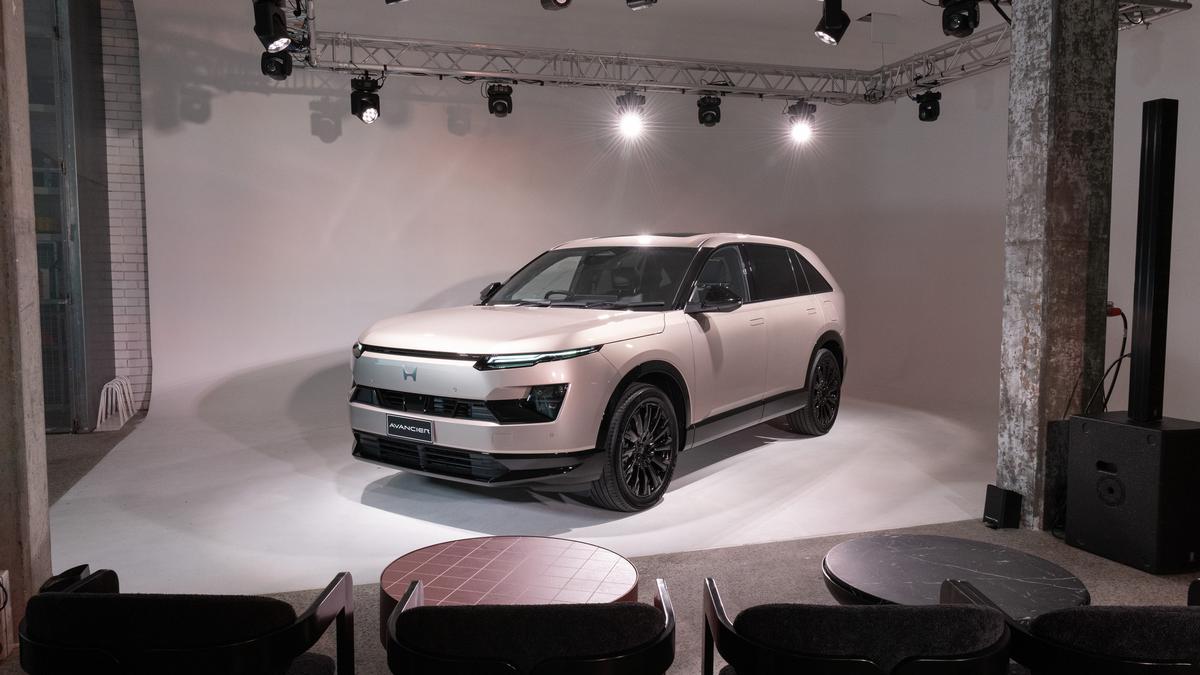
Honda has dusted off an old nameplate with the new Avancier six-seat SUV that made its global reveal last week and marks the brand’s return to the big end of the market — 20 years after the MDX bowed out.
The Avancier badge first appeared in 1999 on an Accord-based wagon for the Japanese market, before re-emerging in 2016 on a five-seat SUV developed for China.
This latest incarnation takes a more luxurious tack, with Honda describing the concept as a “grand journey” with loved ones that’s more focused on passenger comfort than all-out versatility.
Honda Australia CEO Jay Joseph said it was a bit larger than the CR-V — the brand’s best seller globally and in Australia — and designed to appeal to a different type of customer.
The Avancier will be assembled in Thailand and is the first of 15 next-generation hybrid (e:HEV) models globally to come from Honda by March 31, 2030, showcasing the Japanese brand’s new H badge, latest lightweight chassis architecture with ultra-strength steel and fourth-generation hybrid system, which combines two electric motors in the front drive unit with a separate electric motor on the rear axle for a set-up the company calls DualPower electric all-wheel drive (eAWD).
“Honda was first to the hybrid market in Australia (with the Insight in 2001) and we believe for many customers hybrid makes sense,” said Honda Australia director Robert Thorpe, adding that hybrids make up more than 80 per cent of the brand’s sales here.
“There is, however, a segment (in which) we’ve been missing, and that’s large SUVs.”
What’s it like?
I can’t keep my hands off it.
We’re among the first to see the Avancier at its Australian reveal in a studio in Prahran — and I’m still not sure if it’s pronounced Prar-an, Prawn, Praan or Pruh-ran.
Sure, the Avancier is a big SUV, but doesn’t look like one that’s been hitting the gym.
It has a surprisingly streamlined, minimalist shape, with clean surfaces, a tapered rear profile and distinctively squared-off back end with generous opening.

Forget the familiar Honda interior treatment. There’s no honeycomb detailing on air vents here; instead, the cabin has a sleeker, more considered feel, with beautifully finished surfaces and materials that invite you reach out and touch them.
Styling is elegant and world away from the more functional approach we’ve come to expect from the brand.
A lot of the controls are managed through the centre display, and even the gear selector breaks with convention: no more push buttons, and it’s been relocated from the centre console to the left side of the steering column — an unusual arrangement, given column-mounted shifters are more commonly found on the right.

The second row is where the Avancier really delivers on its “grand journey” promise. The two seats are more lounge-like and divided by a console with (the obligatory) cupholders and a touchscreen for climate control.

So we’re not looking at captain’s chairs.
There’s no walk-through access to the third row, which means you will have to slide seats forward and squeeze in and out.
Really, it’s more for kids back here — and hardly where the Avancier’s main appeal lies.
It will be available in Australia and New Zealand from April 2027, with full pricing and specifications still to be announced.
What’s in a hybrid?
Honda has doubled down on self-charging hybrids in Australia, with six models — the CR-V, ZR-V, HR-V, Civic, Accord and Prelude — currently available here, alongside its recent EV rollout that started just last month with the SuperOne.
It does not offer a plug-in hybrid powertrain here, but a CR-V e:PHEV version is sold in Europe and China, where the company has also offered e:PHEV versions of several other models through its joint-venture partnerships.
Honda has also produced three hydrogen fuel-cell passenger vehicles (the FCX, FCX Clarity and Clarity Fuel Cell) and, more recently, the plug-in hydrogen fuel-cell CR-V e:FCEV, a low-volume model offered in California and Japan until last year, primarily through leasing arrangements.

Uniquely, power for the drive motor could be supplied by an advanced hydrogen fuel cell system co-developed by Honda and General Motors, as well as a plug-in rechargeable battery.

“(The CR-V e:FCEV) was just missing a turbo, otherwise it would have been the most sophisticated powertrain ever sold on the planet,” Mr Joseph laughed.
“Hydrogen has been, and will continue to be in the foreseeable future, a chicken-and-egg problem because there’s not enough investment in infrastructure for hydrogen refuelling to justify bringing vehicles to market — and the vehicles won’t come to market until there’s enough infrastructure to fuel them.
“We’ve been a leader in the development of hydrogen fuel cells . . . but as far as Australia’s concerned . . . it doesn’t even begin to make sense for us to bring one of those models here — and globally, it’s not too different.”

