


Anthropic’s Tom Brown praises Trump data center stance
Anthropic co-founder Tom Brown said he “really loved” a post from President Donald Trump on data centers this week that said communities opposing the new builds must want to be “backwards and poor.”
“He was pointing out that the data centers are just an enormous source of prosperity. They produce a ton of jobs. They reduce taxes,” Brown said in a chat with Commerce Secretary Howard Lutnick. “The way that we design them, we actually bring on more power to the grid.”
Trump took aim at public backlash towards data centers in a Monday post to Truth Social, saying communities will be “successful and rich, with far lower taxes and jobs all over the place” if they embrace the opportunity.
“If we kill the Golden Goose, you will only have yourselves to blame. China could not be happier with this anti Data Center movement. Actually, they can’t believe it is happening!” he wrote.
— CJ Haddad
Huang says he hasn’t discussed White House chip tariffs at G20
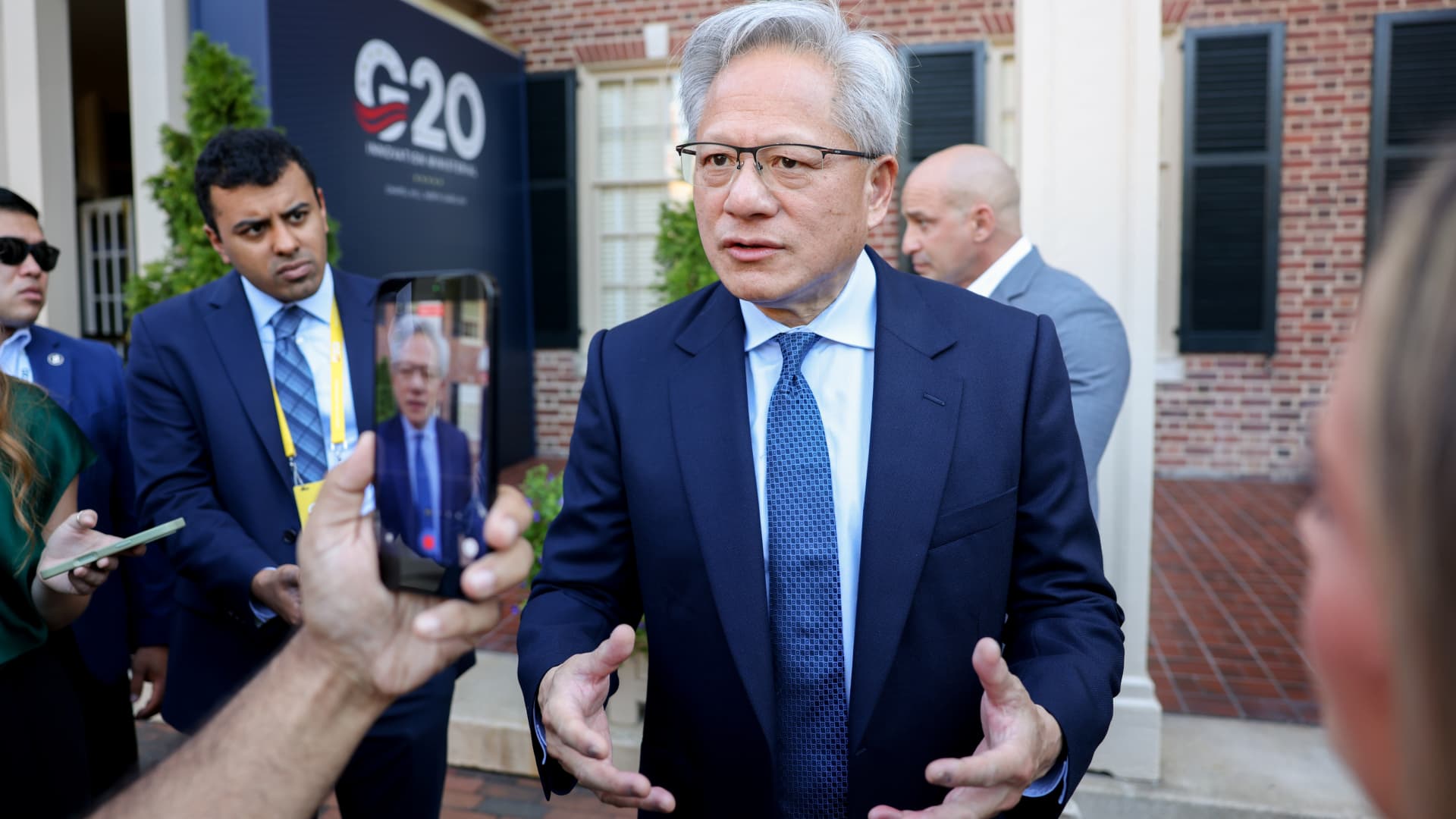
Jensen Huang, chief executive officer of Nvidia Corp., left, and Howard Lutnick, US commerce secretary, during the G20 Innovation Ministerial in Chapel Hill, North Carolina, US, on Wednesday, Sept. 2, 2026.
Cornell Watson | Bloomberg | Getty Images
Nvidia’s Jensen Huang told CNBC that he has “had no conversations” at the G20 related to the Trump administration’s forthcoming semiconductor tariffs.
Commerce Secretary Howard Lutnick told CNBC’s “Squawk Box” earlier Wednesday morning that tech giants are all aware that the Trump administration is working on a tariff framework for chips. He described the new import duties as a means to get companies to build their products in America.
Huang, in his remarks to CNBC on the G20 sidelines, praised Lutnick for being “really quite supportive of building in the United States” and suggested other countries should follow that example.
—Kevin Breuninger and Megan Cassella
Here’s what U.S. leaders have been saying on pushback towards AI data centers

The public backlash towards the AI buildout has leaders everywhere on notice.
“There is a lot more pushback in the communities across the U.S.,” Berkshire Hathaway CEO Greg Abel said in an interview with CNBC’s Becky Quick.
He added that the conglomerate would be interested in working with hyperscalers “if there was no impact to the rates of our other customers.”
Commerce Secretary Howard Lutnick dismissed opposition to data centers in the U.S. as “propaganda by our adversaries,” while Treasury Secretary Scott Bessent blasted the companies themselves on Tuesday for doing a “horrendous job” of reassuring communities about the benefits of the AI buildout.
Pennsylvania Gov. Josh Shapiro said Tuesday that “too many” data center developers don’t care about the communities where the projects are being built.
“Unfortunately, we’ve seen too many developers who don’t care about our communities, who are trying to run roughshod over our communities, and those are the kinds of data center projects we don’t want here,” Shapiro said in an appearance on “Squawk on the Street.” “We want to work with people that want to work with local communities.”
David Sacks, co-chair of the President’s Council of Advisors on Science and Technology, said that there’s “a good deal to be made here between local communities and data centers and the AI companies,” adding that he didn’t see a need for overregulation in an interview on “Squawk on the Street” that same day.
—CJ Haddad
Huang: AI is necessary infrastructure for every country
NVIDIA CEO Jensen Huang speaks during the G20 Innovation Ministerial on September 2, 2026 in Chapel Hill, North Carolina.
Sean Rayford | Getty Images
Nvidia CEO Jensen Huang said that AI is as foundational to every country’s development as core infrastructure.
“What every single country will have to do is you need to recognize that this is infrastructure, just as its water, roads, electricity, the internet,” Huang told Commerce Secretary Howard Lutnick in a fireside chat.
“Every single country needs to build infrastructure so that you could support your own local economy,” he said.
Huang referenced his favored “five-layer cake” analogy for AI, with energy at the bottom, followed by chips, data centers, AI models themselves, and data and applications.
The U.S. is “more deeply invested in inventing, building, developing the entire five-layer cake. However, every single region, every single country should decide which one of the layers they want to invest in,” Huang said.
“You don’t have to win in every single one of them. You don’t have to develop all of them. The most important part is that every single country should advocate for AI diffusion or the adoption of AI into your industries.”
—Kevin Breuninger
Lutnick echoes Trump’s tariff praise, says duties will boost GDP, lower bond yields
Commerce Secretary Howard Lutnick speaking with CNBC from the G20 Innovation Ministerial Meeting in Chapel Hill, N.C. on Sept. 2nd, 2026.
CNBC
Lutnick claimed to CNBC that Trump’s reanimated tariff policies will usher in a wave of economic benefits, including raising domestic growth, shrinking budget deficits and tamping down spiking bond yields.
He spoke as the 10-year U.S. Treasury yield hit its highest level since November, 2023 amid a global bond sell-off.
U.S. tariff rates under Trump are already highly above historical averages, even after the Supreme Court’s February ruling that struck down Trump’s expansive “reciprocal” duties.
Lutnick blamed muted U.S. GDP in the second quarter on the high court’s ruling, telling “Squawk Box,” “Those tariffs came down, imports came flooding in.”
After the tariff collapse, “imports come flying in, starting February all the way through the next quarter,” resulting in a 1.6% reduction U.S. GDP, he said.
“Over the next couple of weeks, they’ll be all back in place, and you’ll see imports start to fall, and you’ll see GDP rise.”
He went on to claim that as Trump finds ways to reimpose the scrapped tariffs, the import taxes will bring in revenues as high as $400 billion a year, reducing America’s rapidly increasing budget deficits.
“You’re going to see the economy start to kick up again as we go back to above 3 percent and the growth rate and the reduction in the deficit will not only stabilize the bond market, will bring rates down,” Lutnick said.
— Kevin Breuninger
Huang says AI is ‘the great equalizer’
Jensen Huang, chief executive officer of Nvidia Corp., left, and Howard Lutnick, US commerce secretary, during the G20 Innovation Ministerial in Chapel Hill, North Carolina, US, on Wednesday, Sept. 2, 2026.
Cornell Watson | Bloomberg | Getty Images
Nvidia CEO Jensen Huang called AI “the great equalizer’ and said the technology will democratize intelligence.
“Artificial intelligence will democratize intelligence and capabilities for the G20 countries,” Huang said in a fireside chat with Commerce Secretary Howard Lutnick. “For the countries that invest in it, it’ll help elevate your society, elevate your industry much, much more quickly than you possibly could have imagined before.”
—Chris Eudaily
Rates should ‘stabilize and start to decline’ over the coming months, Lutnick says
Howard Lutnick, US commerce secretary, arrives for the G20 Innovation Ministerial in Chapel Hill, North Carolina, US, on Tuesday, Sept. 1, 2026.
Cornell Watson | Bloomberg | Getty Images
Commerce Secretary Howard Lutnick doesn’t believe the recent rise in Treasury yields is anything to be concerned about.
In an interview with CNBC’s “Squawk Box” on Wednesday, Lutnick said he thinks that a pickup in the growth rate of the U.S. economy, as well as a reduction in the deficit — which reached its highest monthly level in more than five years in July — will ultimately “bring rates down.”
“I’m comfortable with where things are,” he said. “I think what you’ll see is rates stabilize and start to decline over the coming, let’s say, six months.”
On Wednesday, the 10-year U.S. Treasury note yield hit its highest level since November 2023.
—Sean Conlon
Semiconductor tariffs are coming, Lutnick says

Commerce Secretary Howard Lutnick told CNBC that the Trump administration is working on a tariff framework for chips and all the companies know they are coming.
Lutnick confirmed a Politico report from last week that the White House was weighing the move.
“I think what you’re going to see is targeted, thoughtful tariff policy that basically says if you build here, you don’t pay, but if you don’t build here, expect to pay to enter the greatest market in the world,” Lutnick said.
The tariffs on semiconductors have been in the works for some time, but the administration hasn’t discussed what is being considered publicly.
“We will be successful in semiconductors. They’re going to be built in America,” he said.
—Chris Eudaily
Commerce Sec. Lutnick claims Canada ‘blew up’ trade deal ‘for political reasons only’
Commerce Secretary Howard Lutnick speaking with CNBC from the G20 Innovation Ministerial Meeting in Chapel Hill, N.C. on Sept. 2nd, 2026.
CNBC
Commerce Secretary Howard Lutnick doubled down on blaming Canada amid an ongoing he said-she said over which country is responsible for tanking a trade deal at the 11th hour.
Lutnick told CNBC’s “Squawk Box” that Canadian negotiators started “adding crazy ideas to the mix” just hours before a deadline to reach a deal that would avert Trump’s 50% tariffs on Canadian goods from taking effect. He pointed to medium- and heavy-trucks for Canada’s ask on the Friday the talks devolved.
“And I said to one of the ministers, ‘Are you actually trying to blow this up?’ And his answer to me was, ‘I’m not allowed to say that,'” Lutnick said.
“They blew it up for political reasons only,” he said.
Lutnick also allowed that the U.S. may have made last-minute asks, as Trump has said sounds like something he may have done.
— Kevin Breuninger
Bessent blames companies for ‘horrendous job’ explaining AI, data center benefits
Treasury Secretary Scott Bessent answers questions during the 2026 G20 Financial meetings on Sept. 1, 2026 in Asheville, North Carolina.
Melissa Sue Gerrits | Getty Images
Treasury Secretary Scott Bessent said the conversation around AI and data centers needs “a big reset,” blaming AI companies for doing a terrible job of being trustworthy messengers for the tech boom.
“I think that the AI companies, whether it is the builders of the data centers, whether it is the labs themselves, have done a horrendous job, horrendous job of explaining themselves to the American people,” Bessent said in comments Tuesday following the G20 meetings with finance ministers and central bankers in Asheville, North Carolina.
Bessent said the companies need to convince the American people that “all the benefits will not accrue to a small group” and will instead be spread evenly.
—Chris Eudaily
Musk warns of overregulation, predicts 20%-30% boom from AI
Elon Musk, chief executive officer of Tesla Inc., speaks virtually during the G20 Innovation Ministerial in Chapel Hill, North Carolina, US, on Tuesday, Sept. 1, 2026.
Cornell Watson | Bloomberg | Getty Images
Elon Musk, the CEO of Tesla and SpaceX, said Tuesday that governments should seek to “make things default legal, not default illegal” to help foster growth, likening new companies to saplings in a forest.
“What most countries tend to do is they tend to provide too much support to the large existing trees in the forest, and not enough to the small saplings,” he said, adding that the regulatory environment “should be generally biased towards supporting” the small trees.
Musk, the world’s richest person, also made several bold predictions on the potential for AI growth and robotics.
“AI will probably increase the global economy by 20% to 30%” he said, adding that in 10 years he expects over a billion humanoid robots out in the world.
—Chris Eudaily
David Sacks says local communities can benefit from data centers

Former White House AI czar David Sacks addressed blowback against the AI data center buildout on Tuesday and said local communities can benefit from the construction projects.
“Data centers, if done right, they bring electricity costs down, not up, because the AI companies will generate net new power generation,” he said. “That’s really the key.”
Sacks, a venture capitalist who is co-chair of the President’s Council of Advisors on Science & Technology, said if the companies are allowed to generate their own power, then excess can be sent back to the grid, bringing costs down. He also said companies can help pay for grid upgrades.
President Donald Trump on Monday blasted opposition to data centers, posting on Truth Social that any locale stonewalling the buildout must “want to end up being backwards and poor.”
Sacks insisted that it’s still a local decision.
“The federal government should not preempt the decision of states with respect to data centers,” he said. “It is fundamentally a local decision, and we respect that and have done nothing to change that.”
—Chris Eudaily

