



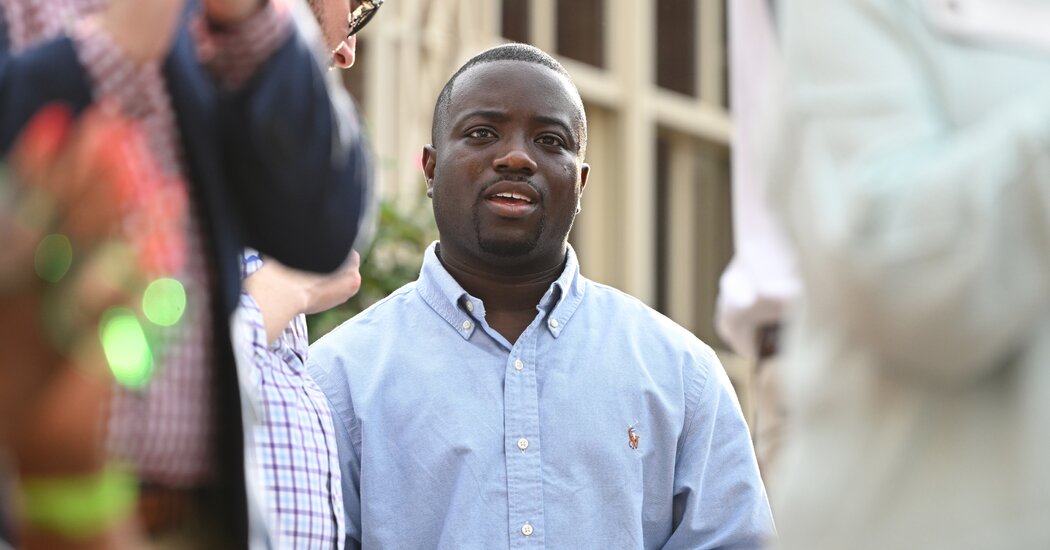
Adrian Boafo, a state delegate, won the Democratic nomination for a heavily blue House seat in Southern Maryland on Tuesday, according to The Associated Press, capping off an elbow-to-elbow primary in which spending from the pro-Israel and cryptocurrency lobbies played an outsize role.
Mr. Boafo, 32, bested nearly two dozen Democratic opponents in the contest to succeed Representative Steny Hoyer, 87, who was once the right-hand man to former Speaker Nancy Pelosi and is retiring after 44 years in office.
Mr. Hoyer’s retirement set off a scramble for a safe Democratic seat in the Fifth Congressional District, which includes Prince George’s County and its many Black voters. Mr. Boafo — a former aide to Mr. Hoyer, who endorsed Mr. Boafo — is very likely to win a seat in Congress in November given how overwhelmingly the seat leans to the left. Voters there chose Vice President Kamala Harris over President Trump by 33 percentage points in 2024.
Among Mr. Boafo’s opponents were Harry Dunn, a former U.S. Capitol Police officer who testified before Congress about defending the Capitol during the attack on Jan. 6, 2021, and Rushern Baker, a former state delegate who served as the top elected official in Prince George’s County from 2010 to 2018. Mr. Boafo also finished ahead of Quincy Bareebe, a businesswoman who funded her bid for Congress with a loan of more than $5.7 million to her campaign.
The main super PAC for the influential American Israel Public Affairs Committee and a super PAC tied to the cryptocurrency industry each spent more than $5.5 million backing Mr. Boafo’s candidacy, according to campaign finance filings from Friday.
Their ads mentioned his positions on immigration and the economy as well as his endorsements from Gov. Wes Moore and Sen. Angela Alsobrooks, both Democrats, but did not discuss Israel or crypto.
Senator Chris Van Hollen, a Maryland Democrat, accused the groups of seeking to “buy this congressional seat” in a virtual news conference held in early June.
And in the campaign’s final week, three of Mr. Boafo’s opponents called on him to reject the spending.
“Voters deserve to know what is happening in this race,” Mr. Baker, Ms. Bareebe and Mr. Dunn wrote in a joint statement on June 15. “When nearly $8 million in outside money floods into a congressional primary, the public has every right to ask why — and what those special interests expect in return.”
Candidates cannot bar super PACs from spending on their behalf. But while Mr. Boafo told Politico that he believed “big money has no place in Congress,” his website included a “red box” with instructions for messaging that outside groups could use to sway voters his way.
Mr. Boafo declined to state whether he supported the groups’ objectives or their efforts to influence his race.
“I’m proud to be helping lead the charge on this generational change we are seeing in our party and in our politics,” he said in a statement to The New York Times on Tuesday morning. “The work ahead is clear: Make things more affordable, stand up to this lawless president, and bring fresh ideas to Washington.”

