

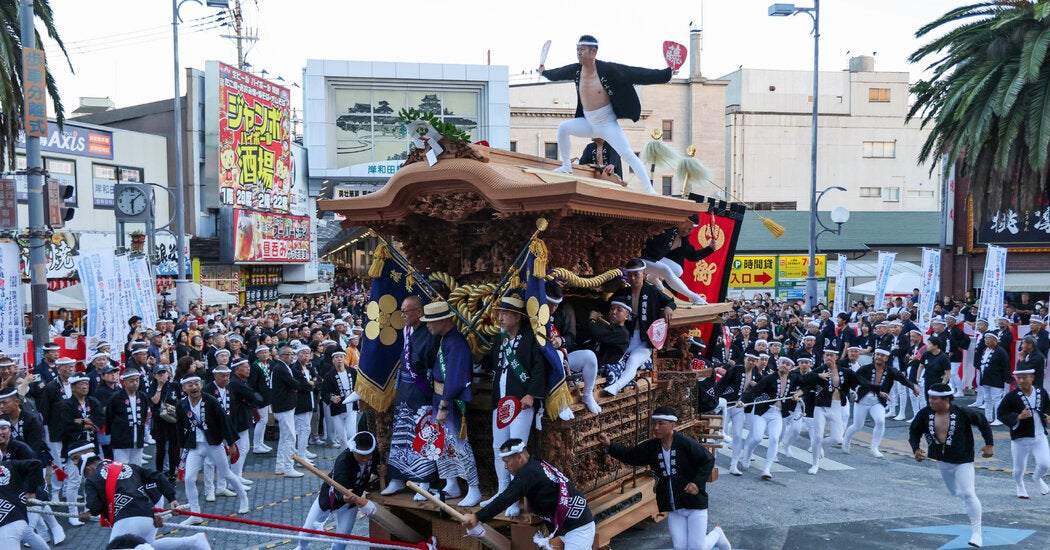
Every autumn, hundreds of Japanese people come together and dash down streets while pulling ornate wooden floats in the shape of shrines, a tradition known as danjiri.
But recent deaths and accidents are feeding anxiety about the ritual and bringing a somber note to the end of the mid-autumn festival season.
Osaka’s police department reported two deaths and several injuries in danjiri festivals in the cities of Izumiotsu and Izumisano on Oct. 10. In both instances, the floats, which weigh several tons, toppled over while turning corners, crushing participants who were standing on the side.
Because danjiri performances are rooted in religious tradition, a board of community leaders, rather than the police, decides the rules and safety protocols. The local police are investigating the circumstances of the deaths, but most organizers have stopped short of abolishing the sharp turns or calling for them to be taken more slowly.
“Heatstroke, falls and bone fractures are common occurrences here every year — though, ideally, no one should get hurt,” said Katsunori Fujita, 71, a chairman of the liaison council in Izumiotsu, who helps decide on the rules for the parades in his district.
Mr. Fujita witnessed the accident in Izumiotsu as he patrolled as a volunteer. He said he would continue enforcing safety precautions and instruct participants on where to escape during trial runs. But his district was unlikely to change the rules and the police were unlikely to intervene in the Shinto religious rite, he said.
The danjiri tradition dates back three centuries and began as a religious ritual during harvest season. Residents of Kishiwada, the southern city in Osaka prefecture where the tradition began, would carry a wooden float lit by hundreds of paper lanterns around the town before communal prayers at a Shinto shrine.
Over time, danjiri spread to other cities across Japan. It also became more violent. Scuffles often broke out as floats jostled each other on narrow streets. The frequent tussles led to danjiri becoming known as the “fighting festival.”
In the 1950s, community leaders in Kishiwada began to establish new rules to address the violence, including introducing a one-way system to avoid collisions between floats. It has since evolved into a parade with great displays of showmanship. Performers in traditional uniforms balance and dance on the roofs of the floats, which themselves are symbols of the vitality of each local community. Children are recruited to take part while in elementary school, practicing the sharp turns with hand-pulled wagons.
During the parade, young and old residents run ahead of each float, pulling it with ropes. They execute sharp 90-degree turns, known as yarimawashi, at full speed, as performers riding on the float lean in one direction to prevent it from tipping over.
But safety questions have been raised year after year. The fatalities earlier this month were not the first.
In 2022 and 2023, four people died and 32 were injured in four incidences. One danjiri participant died in Maniwa, a city in Okayama, leading to a one-year hiatus of the festival before it resumed in 2025. In 2023, police in Tondabayashi, a city in Osaka, accused three danjiri festival representatives of negligence after one death and three injuries, but prosecutors did not indict them.
Other festivals involving heavy floats have suffered fatalities. On Saturday, the deputy mayor of Saijo on Shikoku Island was killed while raising on his shoulders a three-ton float called a taikodai, which serves as a moving stage for drummers.
Hisao Arimoto, an associate professor who studies the danjiri festival at Konan Women’s University in Kobe, said that there had been calls for bans or changes every year, but few changes had followed. “It would be difficult to make drastic changes because it is an event that involves so many people,” he said by telephone.
Hideaki Karaki, a professor emeritus of the University of Tokyo, said that it would be impossible to eliminate risks altogether. “The very elements that create danger — its speed, its weight and the intense energy of the crowd — are also the core of what makes the festival so compelling,” he wrote in Wedge Online, a news and business magazine.
But he added that the accidents would continue if organizers claim that they had taken enough precautions without conducting proper risk assessments. “To ensure that a 300-year-old tradition can endure for another 300 years, what is required is the courage to look the dangers squarely in the eye,” he wrote.

