

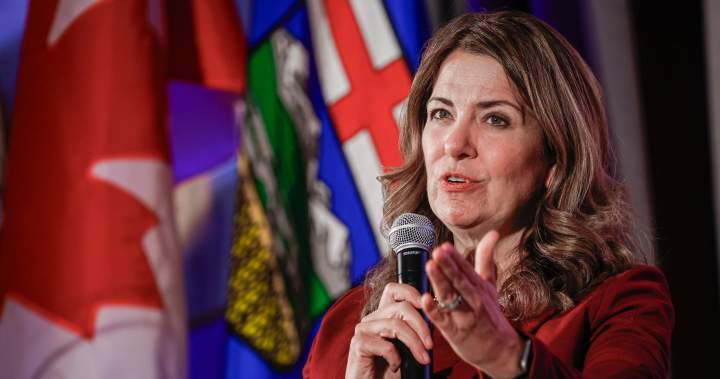
One day after Alberta voters rejected the idea of pursuing separation from Canada, Premier Danielle Smith said the turnout was a historic and a powerful testimony of the passion Albertans feel for the country and province.

“Yesterday, Albertans made their choice. Today, we begin the next chapter,” the premier said in a speech that was broadcast Tuesday night during airtime paid for by the Alberta government.
“Let us move forward not as a people divided by how we voted yesterday, but as neighbours, friends, Albertans and Canadians. Let us treat one another with respect and compassion. Let us stand proudly for this province.”
The outcome of the referendum‘s separatism question mirrors more than half a year of polling, which since the beginning of 2026 consistently showed about 70 per cent of Albertans wanted the province to remain in Canada.
Albertans roundly rejected leaving Canada by roughly 75 per cent, with 1.9 million ballots counted for the separation question as of late Tuesday afternoon, representing about 61.9 per cent of voters so far.
“At the end of it all, the people of Alberta cast their votes in an open and democratic referendum. And the resulting vote from Albertans has given our government a clear mandate.
“Alberta will remain a province of Canada. Albertans will continue to be Canadians.”

Alberta will continue to assert its autonomy and stand up for the issues important to residents, Smith said, but disputes will be settled within the political and legal institutions rather than pursuing the option of separation.
Smith indicated the question of independence has been put to bed.
“I want to make it clear tonight that for as long as I am premier, I will honour this mandate from Albertans and will not be holding another referendum on this issue,” she said. “It is time to move forward together.”
It was a debate Smith said was many years in the making, as Albertans have struggled to address many long-standing and legitimate grievances with Ottawa.
“I acknowledge the legitimate frustrations you’ve felt.”
Nearly half a million ballots were cast in favour of continuing down the road towards leaving Canada. In some ridings such as Central Peace-Notley and Rimbey-Rocky Mountain House-Sundre, the leave votes narrowly outnumbered the ones cast to stay.
Smith addressed those voters directly on Tuesday night.
“I recognize you as loyal Albertans. You love this province, and you want your family and neighbours to have every opportunity to succeed. Many of you view Ottawa as having threatened your freedoms and blocked your path to prosperity,” she said.
“You need to know that your voices have been heard. Not just by our government, but also by your fellow Albertans and your fellow Canadians.”

Smith’s message was one of unity and moving forward.
“Tonight, I want to invite every Albertan who may still feel hopeless or frustrated with the past direction of our country, to believe and hope in Canada again.”

Get breaking National news
Get breaking Canada news delivered to your inbox as it happens so you won’t miss a trending story.
But, it doesn’t appear Smith will get her wish that all Albertans will simply accept the results of the referendum and move on.
Instead, going forward, Smith and the governing United Conservative Party will have to contend with a motivated and more organized separatist movement turning their efforts to oust the premier and take further control of the party.
Jeffrey Rath, one of the central figures in the separatist movement who had a hand in former premier Jason Kenney’s ouster, told Global News he will be pushing for a special general meeting of the party to remove Smith as well.

Smith, in her speech, made the case that Canada has changed significantly over the past 18 months and credited all Albertans for helping make happen.
“I am well aware that not every grievance Alberta has with Ottawa has been resolved. There are still many political and constitutional battles ahead of us,” she said.
“But I am also convinced that the federal government is no longer targeting and trying to phase out and eliminate Alberta’s largest economic sectors as they attempted to do under the previous prime minister.”
“In fact, both the federal Conservatives and federal Liberals are united in supporting Alberta and our key industries in a manner we haven’t seen in a generation.”
Under Prime Minister Mark Carney, Smith said there is a renewed understanding that Canada cannot achieve prosperity by preventing its strongest industries from succeeding.
She said pipelines that were once declared impossible are now being built as national priorities, in reference to the Pacific Link project that received national interest designation on Oct. 1, with the goal of construction of the line to the B.C. Lower Mainland beginning next September.
“Canada is once again producing more energy, exporting more resources, building more major projects and attracting more investment,” she said. “I believe it’s working better every day, and it can work even better in the future if we keep fighting together for it.”

Smith’s speech was pre-recorded, so she did not answer questions from journalists. Smith is slated to do that on Wednesday at an 11:30 a.m. media availability in Calgary.
What about the other referendum questions?
While the question of leaving Canada appears to have been put to bed, the results for the other nine referendum questions have revealed Albertans are divided.
Ballots were still being counted by hand as of Tuesday afternoon, but an Elections Alberta website sharing minute-by-minute updates showed the yes option was leading on eight of the nine questions, including all five on immigration.
The leads were tight, ranging from 51 to 63 per cent provincewide.
The questions asked whether Alberta should have more say over who comes to the province to work and whether it’s time to put more limitations — and perhaps introduce fees — on temporary workers who seek access to health care and education.
The remaining four questions asked for Albertans’ blessing for Smith to lobby her provincial counterparts for support on amending the Constitution to take more power from Ottawa and abolish the Senate.
The yes side was leading on all of the immigration questions with roughly 54 to 58 per cent of the votes as of Tuesday afternoon.
One exception was Smith’s question five proposal to require proof of citizenship to vote provincially, which was leading with about two-thirds of the vote.
Broken down geographically, voters in Edmonton said no to all nine questions while in Calgary, voters said no to eight of the questions except question five.
The only question in which the no vote was leading provincewide on Tuesday afternoon — albeit by a tight 51 per cent for “no” to 49 per cent for “yes” — was question eight.
It asked if Alberans would support its government working with other provinces to opt out of federal programs like health care, education, social services without losing any of the associated federal funding for use in its social programs.

Colin Aitchison, a former United Conservative Party press secretary turned government relations consultant, told The Canadian Press the results present a clear mandate for the premier.
“Governments get elected on less than 50 per cent in this country, and then they move forward with implementing a mandate,” said Aitchison, a managing director with Enterprise Canada.
“Regardless of the size of the mandate, it is a clear mandate, and with voter turnout, I think it’s something that (Smith) can definitely point to when she’s trying to negotiate (with Ottawa),” he said.
Smith has said immigration is beneficial to Alberta, but that it must be balanced with the high cost of social services. Her government has yet to give specifics about how the proposals would work or how they would be implemented.
Avnish Nanda, a lawyer who had campaigned against the immigration proposals, said Tuesday he was shocked by the results so far, as he was expecting the questions to pass with much larger margins.
“We thought we would be blown out,” Nanda said in an interview.
Nanda said he didn’t think the results represent the will of Albertans. He pointed to polls that suggest some voters were confused by the wording of the questions and would vote differently depending on how the question was framed.
“These are hard questions (and) a (government) propaganda campaign that has misled Albertans to vote for things that are contrary to, I think, what they actually want and what’s in their best interest.”

On Tuesday, Carney said he favours pursuing pragmatic “common solutions” with the provinces on issues under federal jurisdiction.
When speaking to reporters as he welcomed the rejection of separation, Carney said pursuing constitutional changes can be a difficult, drawn-out process.
Conservative Opposition Leader Pierre Poilievre said Tuesday the Liberals allowed immigration to run “totally out of control” and he supports provinces being able to set their own levels.
The prime minister said disputes in areas like immigration can be resolved without constitutional amendments, adding his government has moved to bring immigration back under control.
With files from Jack Farrell, The Canadian Press

