



These background steps, including prompting, verification, reflection, code execution and the use of other external software tools, all consume more tokens, he said.
Based on Anthropic’s estimates, the average AI token cost of a software developer in an enterprise using Claude Code was US$13 per day, with monthly costs of roughly US$150 to US$250 per developer, said a Business Insider report in April.
For large tech businesses employing 500 developers, the AI token costs would be roughly US$75,000 to US$125,000 a month, or US$900,000 to US$1.5 million a year, before any discounts or enterprise deals.
Most AI providers do offer discounts for enterprise customers.
However, these are typically negotiated privately and based on usage volume commitment, contract length, models being used, customer support required and if whether cloud services are included.
According to media reports, OpenAI has offered some enterprise customers 10 per cent to 20 per cent discounts on multi-year or bundled deals.
Verma added that Asia “may become the first region where AI becomes a truly mass market at industrial scales”, as countries such as India, Indonesia, Malaysia and the Philippines have “huge services economies, large developer pools and are extremely price sensitive”.
If Chinese AI token cost makes AI execution cheaper, Asian companies could build AI into “call centres, field services, education, logistics and finance operations faster than if they had to pay premium Western prices”, he said.
But Wong said businesses in India and Southeast Asia should not judge AI costs by only the sticker price per million tokens.
An AI model trained to handle Chinese or English efficiently may use more tokens – and therefore cost more – when processing languages such as Tamil, Bahasa Indonesia or Vietnamese.
A model that appears 50 per cent cheaper can become more expensive in production if it performs poorly in a company’s local operating language, requires repeated attempts or needs more human review, Wong said.
The more useful metric, he added, is the “cost per successful outcome” – the total cost of getting a correct and usable result.
WHO IS WINNING THE AI RACE FOR BUSINESS ADOPTION?
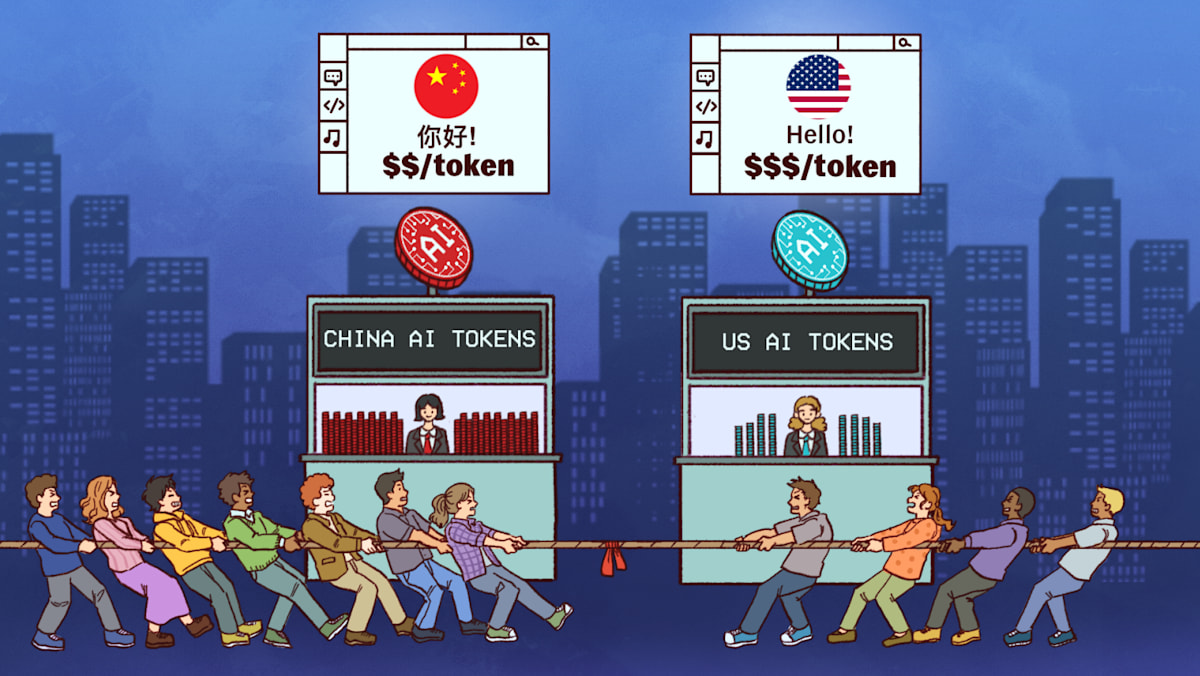
China is emerging as a stronger challenger to the US in the AI race because of its lower token costs, experts told CNA.
Chinese AI firms’ cost advantage comes from cheaper energy and more efficient models, including mixture-of-experts architectures, according to a Financial Times report.
Mixture of experts, or MoE, is an AI architecture popularised by DeepSeek’s R1 model last year. It uses multiple specialised sub-models within one AI model, but activates only the most relevant sub-model for each prompt. This reduces computing costs.
Think of an MoE model as a team of specialists – a doctor, lawyer and engineer – where only the most relevant expert responds while the others remain idle.

