

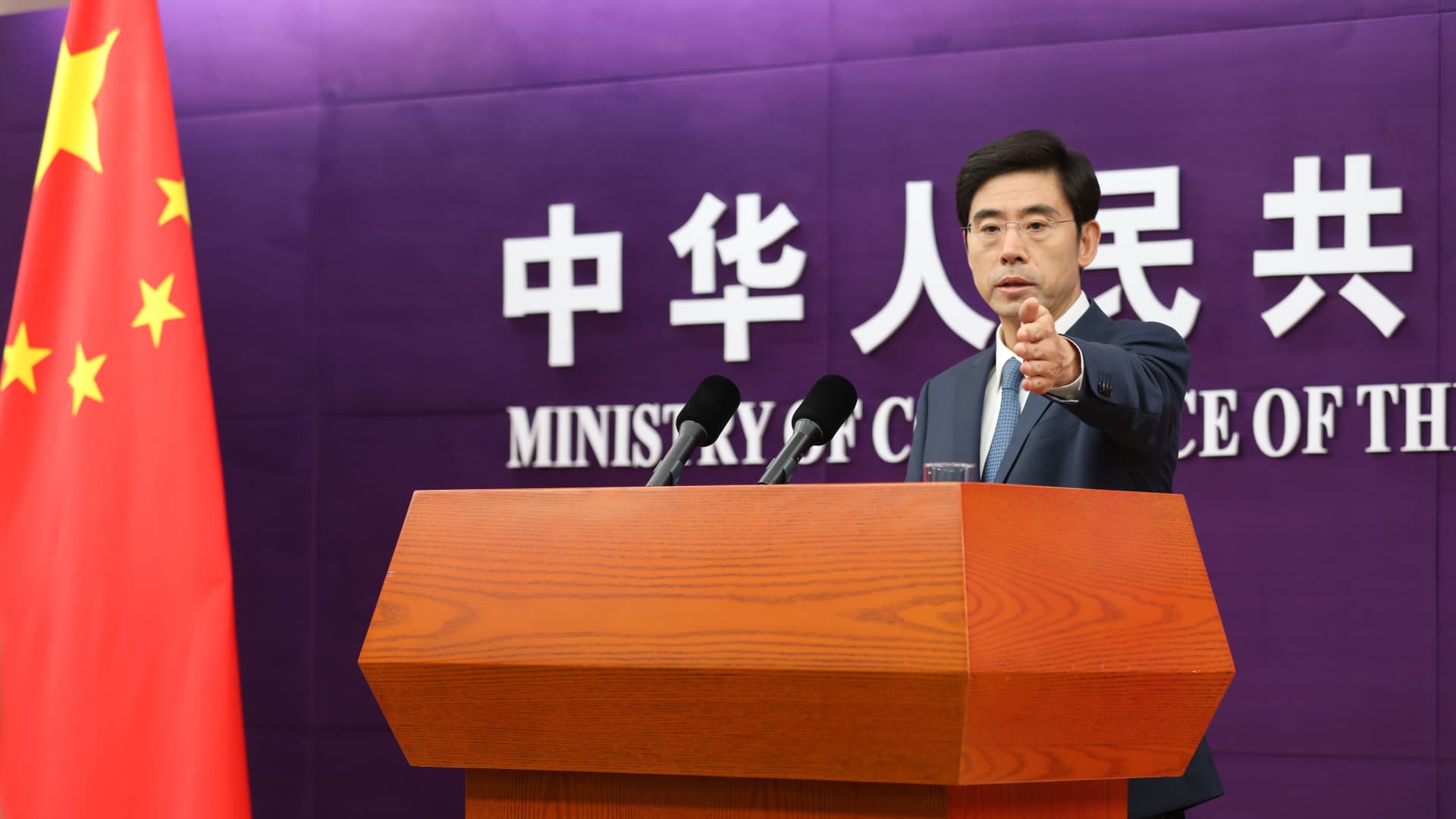
He Yadong, spokesperson for China’s Ministry of Commerce, gestures at a regular press conference on July 2, 2025 in Beijing, China.
China News Service | China News Service | Getty Images
BEIJING—China’s Commerce Ministry confirmed Thursday that its senior trade negotiators had held their first talks with the U.S. on artificial intelligence.
Spokesperson He Yadong told reporters the two sides also discussed plans for reducing tariffs, and extending trade arrangements agreed in Kuala Lumpur last October.
He was referring to China’s Vice Premier He Lifeng meeting with his counterpart, Treasury Secretary Scott Bessent, in New York in the runup to the summit this week between U.S. President Donald Trump and Chinese President Xi Jinping.
As Xi landed in the U.S., Bessent told Fox News on Wednesday the two countries agreed to extend a trade truce to January. The truce, reached in October 2025, kept tariffs lower and limited China’s export controls on rare earths, which are critical components of semiconductors and many household goods, as well as defense products.
Earlier in the week, Bessent said the two sides discussed establishing an AI dialogue and a mechanism to alert each other about AI risks.
The Chinese confirmation of the AI talks came just hours before Xi and Trump were scheduled to begin talks in Washington, D.C., as part of a state visit.
Trump said in a Truth Social post early Thursday that the leaders would discuss AI.
“A big day with President Xi of China. Super Intelligence (SI) will be a big topic of discussion, but I want to leave it exactly where it is. That is China’s position also. Our guardrail is the DOJ!” he wrote.
The president has been vocal about his opposition to further regulation of AI and reiterated his position to the UN General Assembly on Tuesday that: “We’re going to encourage it, not rein it in.”
The ministry added the two sides held constructive, candid talks, and reached multiple points of consensus.
Both countries are weighing how to address the risks posed by rapidly advancing technology after recent incidents involving AI systems raised fears that increasingly autonomous models could make attacks faster and harder to contain.


