

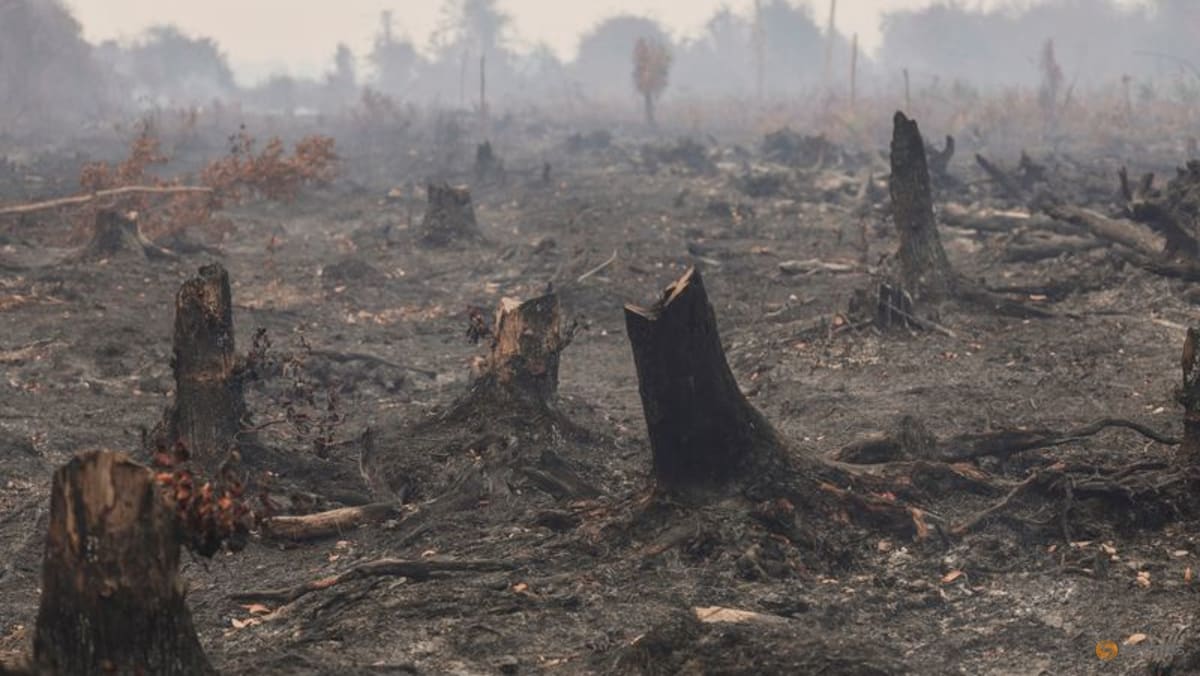
Meanwhile, experts are calling for fire-damaged land to be restored back to its original state rather than converted into plantations.
“Forest protection cannot be separated from how the surrounding landscape is managed,” said Mahawan Karuniasa, an environmental science expert at the University of Indonesia.
Scientists say restoring damaged peatlands is particularly urgent because these ecosystems are interconnected, allowing fires to spread rapidly through dried-out peat. When they burn, they can also release vast amounts of carbon dioxide that have been stored underground for centuries.
Fire-damaged land can be restored through a combination of measures including rewetting the peatlands, replanting native vegetation, restoring soil fertility and through measures that prevent recurring fires.
Indonesia’s forest and land fires burned an estimated 2.8 million hectares this year, according to independent monitoring platform Nusantara Atlas – an area roughly 38 times the size of Singapore.
In an article published by The Conversation, four scientists from the University of Sydney, the Center for International Forestry Research, Universiti Malaysia Terengganu and Indonesia’s Gadjah Mada University, estimated that the recent fires which blanketed the region with thick haze released 370 million tonnes of carbon dioxide into the atmosphere, equivalent to the annual emissions of about 97 coal-fired power plants.
Although peatlands accounted for just 20 per cent of the total area burned, they were responsible for 80 per cent of the estimated carbon emissions.
“The carbon released in 2026, particularly from peatlands, may not be replaced for hundreds of years. Serious restoration efforts are therefore essential to prevent these carbon losses from becoming an environmental debt passed on to future generations,” the scientists wrote.
Peatlands act as natural carbon stores, accumulating partially decomposed vegetation over thousands of years. When they burn, this stored carbon is released into the atmosphere as carbon dioxide, contributing to global warming, while replenishing the lost carbon can take centuries.

