



Legislation to suspend parts of the Declaration on the Rights of Indigenous Peoples Act is set to be tabled in British Columbia this week, according to First Nations leadership.

In an open letter to B.C. MLAs, the First Nations Leadership Council, the First Nations Summit, the Union of BC Indian Chiefs and the BC Assembly of First Nations said the provincial government would work to “muster support” for the bill.
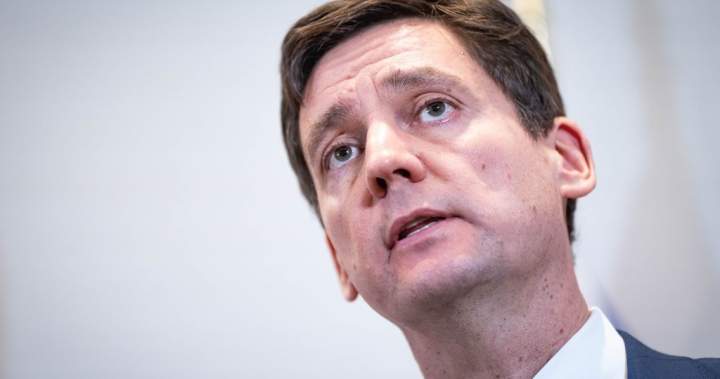
“Premier Eby has confirmed he intends to introduce legislation to suspend critical provisions of DRIPA despite overwhelming opposition from First Nations, and is seeking to build caucus and cross-party support to do so,” the letter reads.
A government source confirms to Global News that legislation is expected to be tabled this week.
Early last week, the B.C. government indicated the prospect of an early election was unlikely after saying legislation to suspend parts of DRIPA would not be considered a confidence vote.
On April 13, NDP house leader Mike Farnworth said MLA Joan Phillip, who is Indigenous, had indicated she is unable to vote for the bill.

Get daily National news
Get daily Canada news delivered to your inbox so you’ll never miss the day’s top stories.
With only a one-seat majority in the legislature, Farnworth said the government is still looking for a “path forward” on the legislation, but added it was “nonsense” to suggest Eby has lost confidence in the house.
Eby has said previously that DRIPA poses significant legal peril to the province, after it was interpreted in a recent court decision to mean it should be incorporated into B.C. laws “with immediate legal effect.”
The B.C. Court of Appeal ruled late last year the mineral rules in the province are “inconsistent” with the DRIPA legislation, which is based on the United Nations Declaration on the Rights of Indigenous Peoples.
The First Nations Leadership Council alleged Eby’s reasoning is “not only misleading but is also inherently wrong.”
“Attempts to suspend sections of DRIPA and the Interpretation Act to achieve a desired outcome in a court decision is an act of fettering the separation of judicial powers, and an egregious attempt to limit First Nations’ access to the court,” the leaders wrote.
The First Nations Summit recently issued a statement saying its members “unequivocally” oppose amendments to DRIPA, and called on governments of all levels to “fully adopt and implement” UNDRIP as a framework for reconciliation.
In its letter to B.C. MLAs, the leadership council urged MLAs not to support the legislation, adding it would increase legal risk.
“If you choose to support efforts to weaken these Acts and our co-developed framework for constitutionally required reconciliation, you are not avoiding legal risk – you are increasing it,” the letter says. “First Nations around the province have made their position clear – attempts to unilaterally suspend or repeal DRIPA and the Interpretation Act will invite legal challenge.”
DRIPA was unanimously passed in the provincial legislature in 2019 and requires that the B.C. government ensure the laws of the province are consistent with the UN declaration.
—with files from The Canadian Press
© 2026 Global News, a division of Corus Entertainment Inc.

