



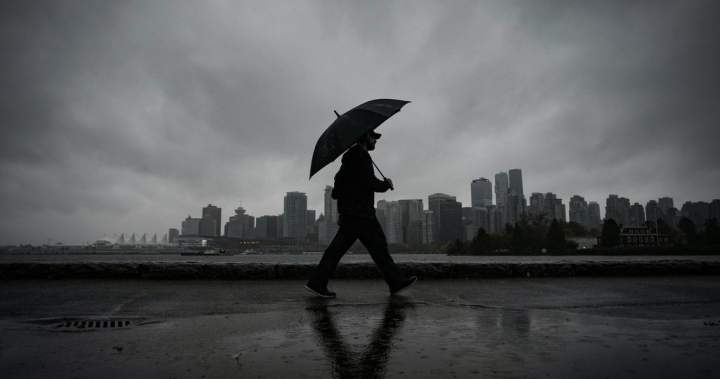
Many Canadians around the country have kept their umbrellas nearby this June, as rain and thunderstorms have dominated many people’s early summer plans.

As a result, experts say many could face a more intense mosquito season.
“From west to east, there have certainly been some areas that have experienced higher-than-normal rainfall amounts, one in particular out west,” Ross Hull, a meteorologist with Global News, said.
“Edmonton has seen bouts of heavy rain. There were bouts of heavy rain earlier in June and then just over the weekend, some areas saw basically near a month’s worth of rain in just a day or so.
“The Winnipeg area is also seeing more than what is normal or average for rainfall. Just looking at some of the numbers they’ve seen, or at least the airport in Winnipeg has seen over 100 millimetres of rain. That normal would be 90 millimetres.”
Hull also added that Toronto is above average as well, experiencing “80.3 [millilitres] at Pearson [airport] and the normal would be 71.5 [millilitres].”
Some parts of Montreal’s West Island and South Shore received heavy rain with amounts between 100 and 150 millimetres in just a few hours on Saturday, leaving thousands without power and some basements inundated with water.

In addition, the impending “super El Niño” that is set to spike global temperatures can be partly blamed for the escalated rainfall.
“No El Niño pattern is going to be the same, but typically that can lead to wetter-than-normal weather across eastern sections of the country; this year it’s southern Ontario, southwestern Quebec, particularly, or through Ontario and Quebec, and drier than normal and warmer than normal across the West,” Hull said.

Get breaking National news
Get breaking Canada news delivered to your inbox as it happens so you won’t miss a trending story.
“Now, that has panned out for parts of B.C. so far. It hasn’t east of the Rockies towards the Prairies, but as things progress here this summer, it does look like there certainly will be more bouts of dry weather developing in July, for instance, in Alberta, Saskatchewan, and Manitoba. And likely more bouts of wet weather around southern Ontario, southwestern Quebec.“
Environment and Climate Change Canada (ECCC) stated in its summer outlook that although “some regions have received higher-than-normal amounts of precipitation in recent months, delaying conditions favourable for wildfire, fire risk is expected to increase as the summer progresses.”
Currently, there are 135 active wildfires across Canada, 11 of which are classified as being out of control.
How does rainfall impact mosquito season?
John Soghigian, an assistant professor in the faculty of veterinary medicine at the University of Calgary, said mosquito season can start between May and June, peaking between July and August, and ending in October.
“Rain definitely leads to more abundance of mosquitoes,” he said.
“Depending on where you are in Canada, you’ll see different results of that rain. So, certain places in Canada have more species that rely on sort of a floodwater area than others. However, across the country, in the southern part of Canada, we tend to see a lot of mosquitoes in July and August. They respond really well to rainfall.“

“That allows those mosquito species to become really abundant when we have heavy rain. And then those species often love biting people and other animals, and so they’re going to be quite possibly plaguing us this summer.”
Rosalind Murray, an assistant professor in the biology department at the University of Toronto, said June is usually a “huge mosquito month” and the peak of mosquito season can last longer than usual this year.
“One thing that’s important to note about mosquitoes is that they require fresh water in order to complete their life cycle. So, they lay their eggs in fresh water, and they spend their larval stage and pupate in freshwater and then the adults are the ones that we know about that are terrestrial and they hang out and the females will bite us,” she said.
“The more freshwater environments that we have, the more likely you are to have bigger populations of mosquitoes. So, there’s just more habitat for those animals to complete their life cycle. And so, you can expect that there will be more of them.”
Murray also added that, depending on the species of mosquito, there can be anywhere between “hundreds to tens of hundreds” of mosquito eggs laid at once.
© 2026 Global News, a division of Corus Entertainment Inc.

