

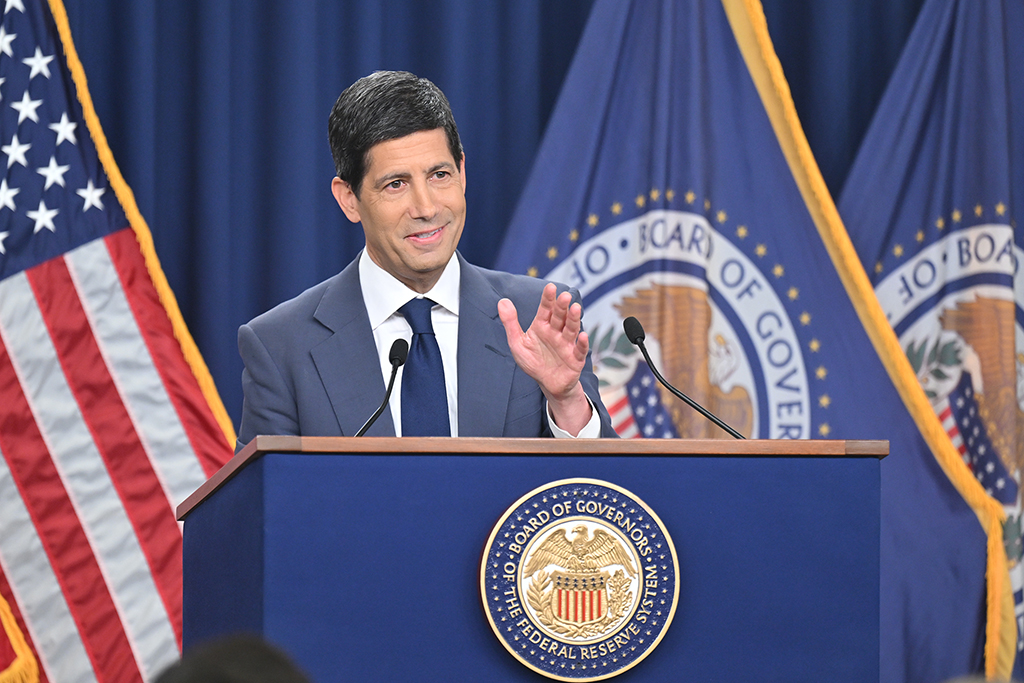
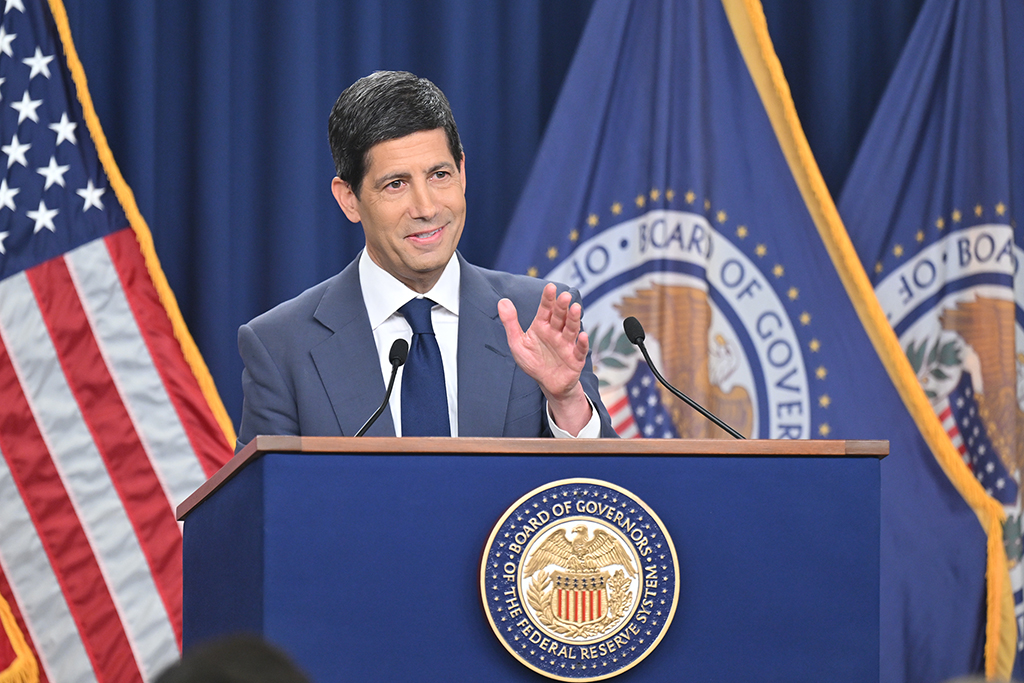
The Federal Reserve’s decision to hold interest rates steady was widely anticipated.
What proved harder to interpret was the message from Fed Chair Kevin Warsh, who reiterated that inflation remained too high but declined to indicate whether policymakers were preparing to raise rates again in December.
The Federal Open Market Committee voted 10-2 on Wednesday to leave the federal funds target range unchanged at 3.75%-4%.
Fed governor Lisa Cook and Cleveland Fed President Beth Hammack dissented, preferring an immediate quarter-point increase.
The statement upgraded its description of economic activity from “solid” to “strong”, citing resilient domestic spending, robust capital investment and productivity growth, while saying inflation “remains elevated”.
It added that “the accumulation of more information will help the Committee determine the policy stance appropriate to ensure a timely return of inflation to the Committee’s 2 percent goal”.
The wording left room for another increase, but did not commit the committee to one.
Warsh was similarly unwilling to signal the next move.
Asked whether there was still broad support for another increase this year, he said: “I don’t believe in forward guidance absent exigent circumstances, absent a crisis.”
Markets initially priced an 84.6% probability of a quarter-point hike after Thursday’s PCE release, but the odds had fallen to around 73% by Friday.
For Rebecca Homkes, an Economist and Lecturer at London Business School, the meeting met expectations on the decision but still left investors frustrated by the explanation.
“This week’s Fed meeting managed to somehow meet expectations and still induce frustrations,” Homkes said.
“While the no movement was firmly priced in, Warsh’s brief statements could be interpreted as inconsistent,” she told Invezz.
“So while the outcome was expected, guidance as to what data might inform a further hike would have been welcome. Despite talking tough on inflation and the Fed’s role in bringing it down, no urgency in getting to it was evident.”
She characterised the Fed as “talking tough on inflation but acting dovish that the economy can’t take much”.
She warned that the Fed risked falling behind the curve if it did not act while the data were pointing towards persistent price pressures.
JoAnne Bianco, Senior Investment Strategist at BondBloxx, offered a different reading.
She said the meeting should not be interpreted as a dovish shift because Warsh reiterated that inflation remained above target and that the committee was prepared to tighten further if necessary.
“The Fed held rates steady, but I do not think the meeting should be interpreted as a dovish shift,” Bianco told Invezz.
She added that Warsh’s acknowledgement that financial conditions had tightened did not mean policymakers considered them restrictive.
During the presser, the chair said conditions had tightened for some businesses and households since September, but added: “I’m unwilling and unable to call them tight.”
Warsh described the effects of the September increase as beginning to filter through credit availability and borrowing costs, but did not say they had removed the need for further action.
Asked why the Fed had not raised rates immediately when inflation remained above target, Warsh said price stability was not a matter of “some fixed individual date on a calendar” or “some isolated data point”.
The meeting came six days before the US midterm elections, prompting a question about whether politics had influenced the decision.
Warsh insisted politics played no role in the decision, saying he “didn’t hear an utterance about politics” or any reference to the upcoming elections during the committee’s two-day deliberations.
Robert R. Johnson, Professor of Finance at Creighton University’s Heider College of Business, said he believed the approaching elections were a contributing factor.
“While Warsh denied that politics played any role, I believe that the central bank wanted to show that it operates without political influence,” Johnson told Invezz.
“It will be much easier to raise rates in December and avoid criticism that any decision was politically motivated.”
Homkes said she did not believe politics had played a role, although she argued that inflation would have had to be considerably more severe to prompt a move immediately before the vote.
The latest inflation figures offered little evidence of a meaningful cooling in price pressures.
The personal consumption expenditures price index rose 0.5% in September from a month earlier, up from 0.3% in August, while the annual rate accelerated to 3.6% from 3.4%.
Core PCE, which excludes food and energy, increased 0.3% monthly and 3.1% annually, compared with 3.0% in August.
Both the monthly and annual readings were broadly in line with economists’ expectations.
David Russell, Global Head of Market Strategy at TradeStation Group, said earlier consumer and producer price releases had already pointed to uncomfortable inflation readings.
He said the latest PCE report did not move the needle because markets had already seen elevated readings on CPI, PPI and import and export prices.
Bianco said the figures reinforced the uneven nature of progress on inflation but did not materially change her December outlook.
Johnson said the report provided another data point supporting a rate increase.
Russell said a December hike remained his base case because inflation was above target while the economy and labour market remained strong.
He said a single weak jobs report was unlikely to alter market expectations, adding that “a credible decline in energy prices might be the only catalyst that could meaningfully impact interest rates”.
Russell told Invezz that the Fed could not indefinitely dismiss supply-side inflation pressures if they persisted and spread into other prices.
“But these pressures get passed through when they last,” he said.
“Core CPI doesn’t exist to ignore inflation. It exists to look past short-term noise, and $6 diesel is no longer short-term noise.”
Bianco said weaker labour-market data, slowing consumer demand or further tightening in financial conditions could reduce the probability of a December increase.
A broader pattern of moderating growth and easing inflation, she added, would make the Fed more comfortable holding rates steady.
Homkes said a December hike was likely after the latest growth and inflation data, and that it would take a combination of weaker jobs, cooler inflation and signs of a slowdown to change that assessment.
Johnson also expected another increase, saying data showing a slowdown in inflation could alter the Fed’s thinking, although he did not see that as likely.
MUFG’s US Macro Strategy team is less convinced that a hike is imminent.
In its October 28 FOMC recap, the bank put the probability of a December increase at 55%, compared with market pricing of roughly 80% at the time.
It said the decision was “not a done deal” and that the outlook could change with incoming data, financial conditions, inflation expectations and the election.
For markets, the challenge is identifying what evidence the Fed will consider decisive when Warsh has made clear he does not intend to prejudge the next meeting.
Until the next round of employment and inflation data arrives, a December hike may remain the central expectation—but not a settled outcome.

