



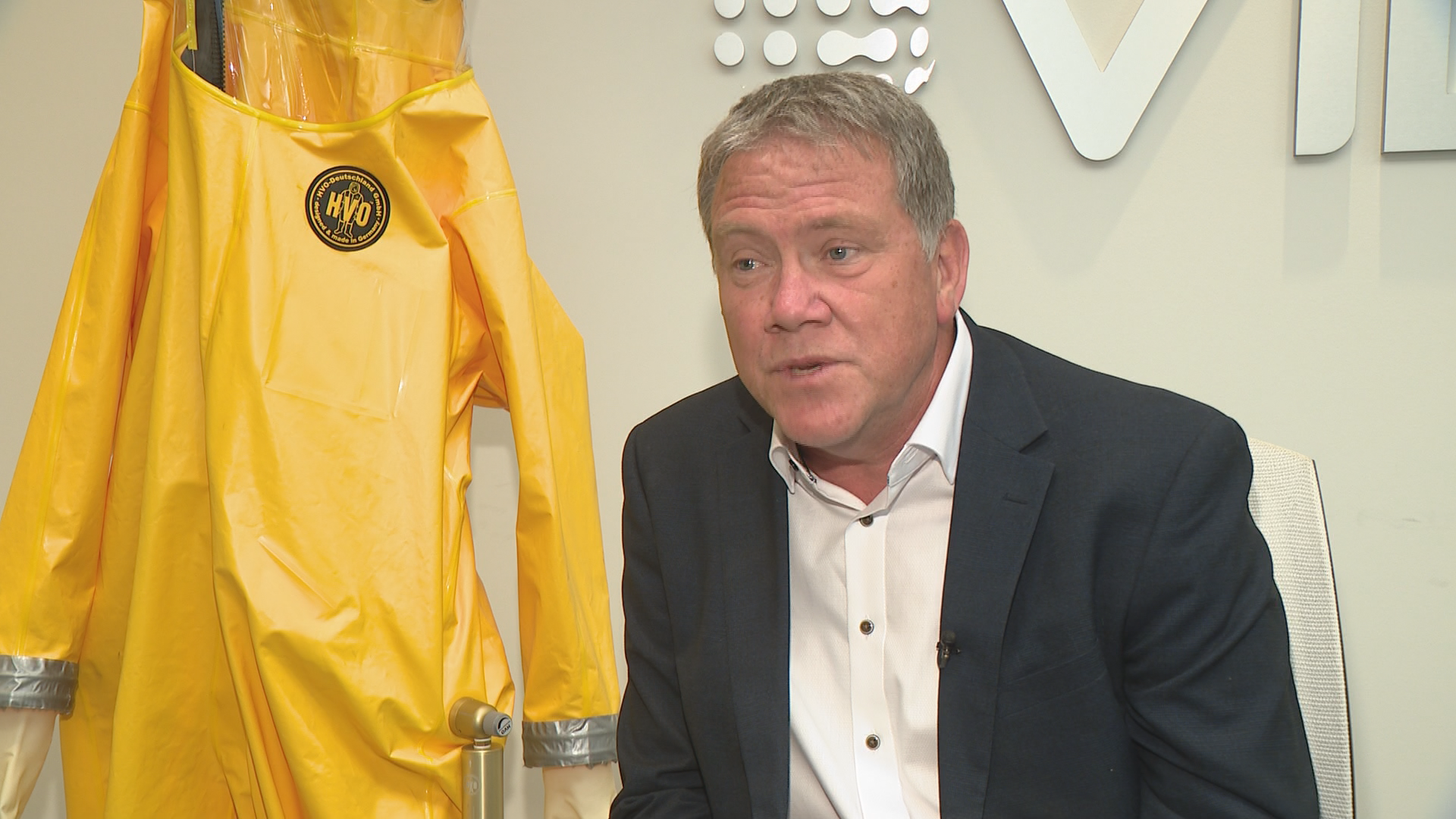
The director and CEO of the University of Saskatchewan’s Vaccine and Infectious Disease Organization says the institution expects its Containment Level 4 (CL4) labs to be operational next year following certification.

Volker Gerdts says the new containment labs, now fully constructed, will provide VIDO with a unique opportunity to research the world’s deadliest and most exotic pathogens.
“It allows VIDO in the future to respond to whatever the next pathogen is, whether it’s a human or an animal pathogen,” Gerdts told Global News in an interview, adding that he expects the labs to receive certification by federal regulators in 2027.
To date, only one facility in Canada has CL4 labs, and it is run by the federal government in Winnipeg at the Canadian Science Centre for Human and Animal Health — making the University of Saskatchewan the first educational institution in the country to host the labs.
VIDO has also completed construction of an animal facility to house a range of organisms, from small mosquitoes and ticks to large domestic and exotic species that carry deadly viruses, Gerdts said.

Get breaking National news
Get breaking Canada news delivered to your inbox as it happens so you won’t miss a trending story.
Currently, VIDO operates labs up to Containment Level 3. Research in these labs is on pause as they undergo a recertification process that happens every 10 years.
“We are testing everything — every door, every seal, every filter and so on — to ensure that the barriers of containment are as intact as they should be,” Gerdts said.
For PhD research student Liam Kerr, the prospect of hands-on experience in a CL4 lab drew him to the program in the first place.
“I want a future in containment work, and so getting this opportunity here is very pivotal to my future as working in containment,” Kerr said in an interview.
The new infrastructure is also expected to bring in talent and investment from around the world, Gerdts said.
“It’s part of our mission to train people, making sure that Canada in the future has a large enough skilled workforce to respond to whatever the next disease is. But at the same time, also train these individuals to maybe go to other countries and strengthen their workforce there,” he said.
This rings true for Rita Quintela, a PhD research student at VIDO who traded Spain for Saskatoon three years ago to better understand how bats can host viruses harmful to humans.
“This experience has opened, and it keeps opening, a lot of doors for me due to the uniqueness of the infrastructure that we have here,” she said, adding that she intends to go back to Europe once she completes her program for a research position.
Three years ago, VIDO opened its own in-house vaccine manufacturing facility.
Gerdts says all of these new additions help set the institution apart, making it Canada’s centre for pandemic research.
“We do a lot of work with industry, with pharmaceutical companies, with biotech, small and large startups, and so on,” he said.
“By having this infrastructure here, we offer these companies the unique opportunity to evaluate their technologies as they are developing them.”
© 2026 Global News, a division of Corus Entertainment Inc.

